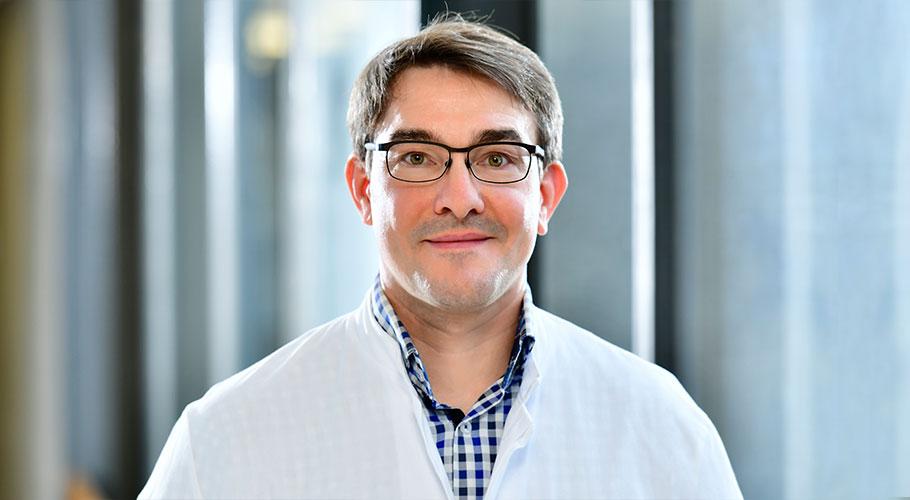
Prof. Dr. med. Tobias Cantz working group
Our Translational Hepatology and Stem Cell Biology research group is part of the REBIRTH Center for Translational Regenerative Medicine and aims to better understand the mechanisms of liver development and regeneration as well as pathophysiological changes in hepatic diseases and make them the target of innovative treatment strategies.
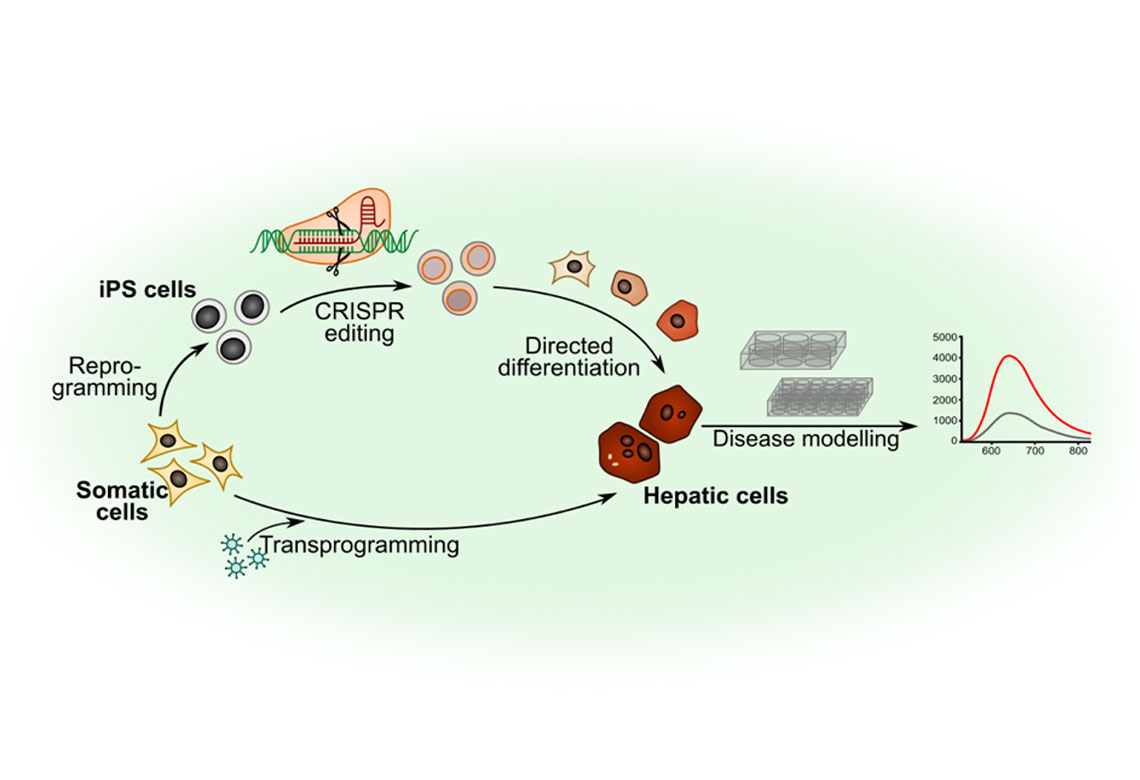
To this end, we use human induced pluripotent stem cells (iPS cells) in many projects in order to have patient-specific stem cells available with which the disease-relevant phenotype can be examined in the Petri dish after differentiation into hepatocyte- and cholangiocyte-like cells.
In addition, we have further developed the establishment of three-dimensional cell culture conditions or organoids that enable spatial aggregation of cells and thus a more authentic tissue-like organization of the differentiated cells. With a focus on hereditary liver diseases, we are also working on efficient application options for CRISPR/Cas9 technology for precise genome editing in order to be able to correct disease-specific genetic mutations in a targeted manner. With regard to the public debate on the use of pluripotent (embryonic) stem cells and aspects of modern genome editing procedures, we are involved in interdisciplinary discourse with partners in the humanities.
- Induced Pluripotent Stem Cell-Derived Hepatobiliary Organoids for Studies of Disease Mechanisms and Gene Engineering Approaches (Funding: REBIRTH - MWK Lower Saxony)
- iPS-based liver models and CRISPR/Cas-edited controls in the joint project HiChol - Translational Network for Hereditary Intrahepatic Cholestasis (Funding: BMBF)
- Functional liver cells from induced pluripotent stem cells as an alternative to animal experiments in the Institute of Toxicology (Funding: R2N network, MWK Lower Saxony)
- CONSENSE-T - consistent detection of pathophysiological changes based on patrolling T-cell-like cells (funding: BMBF)
Further information
- Eggenschwiler R, Patronov A, Hegermann J, Fraguas-Eggenschwiler M, Wu G, Cortnumme L, Ochs M, Antes I, Cantz T (2019). A combined in silico and in vitro study on mouse Serpina1a antitrypsin-deficiency mutants. Scientific reports. 9(1):7486.
- Dai Z, Song G, Balakrishnan A, Yang T, Yuan Q, Mobus S, Weiss AC, Bentler M, Zhu J, Jiang X, Shen X, Bantel H, Jaeckel E, Kispert A, Vogel A, Saborowski A, Buning H, Manns M, Cantz T, Ott M, Sharma AD (2019). Growth differentiation factor 11 attenuates liver fibrosis via expansion of liver progenitor cells. Gut. doi: 10.1136/gutjnl-2019-318812. [Epub ahead of print]
- Sahabian A, Sgodda M, Naujok O, Dettmer R, Dahlmann J, Manstein F, Cantz T, Zweigerdt R, Martin U, Olmer R (2019). Chemically-Defined, Xeno-Free, Scalable Production of hPSC-Derived Definitive Endoderm Aggregates with Multi-Lineage Differentiation Potential. Cells. 8(12). pii: E1571, doi: 10.3390/cells8121571.
- Jülicher K, Wahner A, Haase K, Barbour KW, Berger FG, Wiehlmann L, Davenport C, Schuster-Gossler K, Stitz J, Cantz T, Eggenschwiler R (2018). Functional characterization of the mouse Serpina1 paralog DOM-7. Biol Chem. 399(6):577-82.
- Advena-Regnery B, Dederer HG, Enghofer F, Cantz T, Heinemann T. Framing the ethical and legal issues of human artificial gametes in research, therapy, and assisted reproduction: A German perspective (2018). Bioethics. 32(5):314-326. doi: 10.1111/bioe.12433
- Galonska C, Charlton J, Mattei AL, Donaghey J, Clement D, Gu H, MohammadA, Stamenova E, Cacchiarelli, Klages S, Timmermann B, Cantz T, Schöler HR, Gnirke A, Ziller MJ, Meissner A (2018). Genome-wide tracking of dCas9-methyltransferase footprints. Nat Commun 9(1):597. doi: 10.1038/s41467-017-02708-5.
- Sgodda M, Dai Z, Zweigerdt R, Sharma AD, Ott M, Cantz T (2017). A scalable approach for the generation of human pluripotent stem cell-derived hepatic organoids with sensitive hepatotoxicity features. Stem Cells Dev. 26(20):1490-1504
- Hoepfner J, Kleinsorge M, Papp O, Alfken S, Heiringhoff R, Pich A, Sauer V, Zibert A, Göhring G, Schmidt H, Sgodda M, Cantz T (2017). In Vitro Modeling of Familial Amyloidotic Polyneuropathy Allows Quantitative Detection of Transthyretin Amyloid Fibril-like Structures in Hepatic Derivatives of Patient-Specific Induced Pluripotent Stem Cells. Biol Chem. 398(8):939-54.
- Fráguas MS, Eggenschwiler R, Hoepfner J, Schiavinato JL, Haddad R, Oliveira LH, Araújo AG, Zago MA, Panepucci RA, Cantz T (2016). MicroRNA-29 impairs the early phase of reprogramming process by targeting active DNA demethylation enzymes and Wnt signaling. Stem Cell Res. 19:21-30.
- Eggenschwiler R, Moslem M, Fráguas MS, Galla M, Papp O, Naujock M, Fonfara I, Gensch I, Wähner A, Beh-Pajooh A, Mussolino C, Tauscher M, Steinemann D, Wegner F, Petri S, Schambach A, Charpentier E, Cathomen T, Cantz T (2016). Improved bi-allelic modification of a transcriptionally silent locus in patient-derived iPSC by Cas9 nickase. Sci Rep.6:38198
- Yang D, Yuan Q, Balakrishnan A, Bantel H, Klusmann JH, Manns MP, Ott M, Cantz T, Sharma AD (2016). MicroRNA-125b-5p mimic inhibits acute liver failure. Nat Commun. 7:11916. doi: 10.1038/ncomms11916.
- Song G, Pacher M, Balakrishnan A, Yuan Q, Tsay H-C, Yang D, Reetz J, Brandes S, Dai Z, Pützer BM, Arauzo-Bravo MJ, Steinemann D, Luedde T, Schwabe RF, Manns MP, Schöler HR, Schambach A, Cantz T, Ott M, Sharma AD (2016). Direct reprogramming of hepatic myofibroblasts into hepatocytes in vivo attenuates liver fibrosis. Cell Stem Cell. 18(6):797-808
Our working group
Hannover Medical School
Hans-Borst-Zentrum (I11), Level 02
Carl-Neuberg-Str. 1
30625 Hannover
Phone +49 511 532-5251
Cantz.Tobias@mh-hannover.de
- Susanne Alfken (MTA)
- Dr. rer. nat. Reto Eggenschwiler
- Christian Felski (M. Sc.)
- Florian Langer (FWJ)
- Oliver Papp (PhD)
- Helmut Schwarzer (Lab Assistant)
- Dr. rer. nat. Malte Sgodda
- Iris Winter (Secr.)