Dr. Katja Dinkelborg, PhD is a physician researching the hepatitis E virus
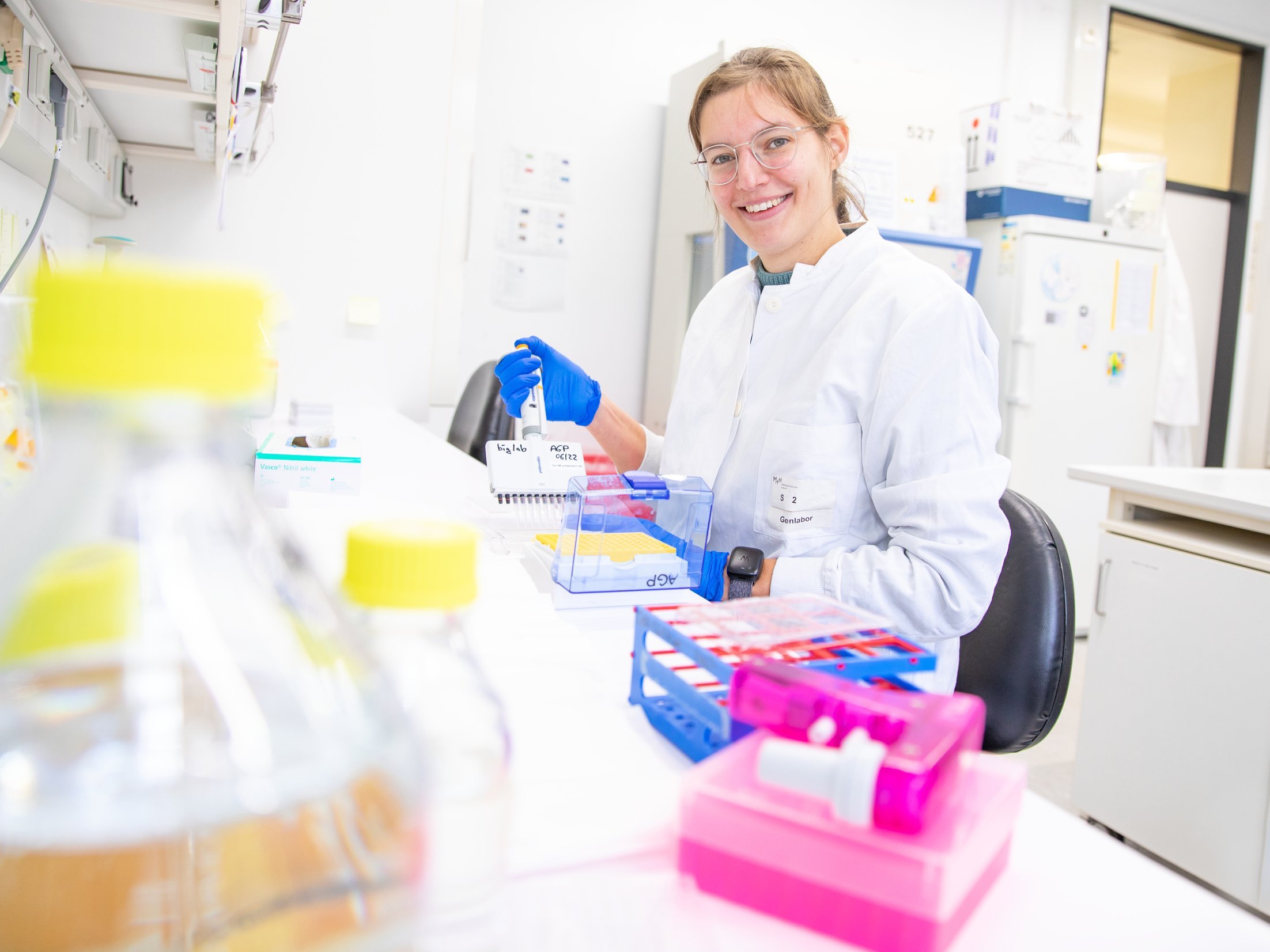
Dr. Katja Dinkelborg, PhD, enjoys spending time in the laboratory as a researching physician. Copyright: Karin Kaiser/MHH
Science or medicine, that's not a question for Katja Dinkelborg. She simply does both. As a doctor of medicine, she works at the MHH Clinical Department of Gastroenterology, Hepatology, Infectious Diseases and Endocrinology. As a scientist, she conducts research at TWINCORE, a joint institution of MHH and the Helmholtz Center for Infection Research. In June 2025, she also completed her PhD studies at the Hannover Biomedical Research School (HBRS) as part of the "Molecular Medicine" program and graduated with the top grade "summa cum laude". She also received the HBRS PhD Prize 2025 for the internationally recognized doctoral degree, which is earned through independent research and a dissertation. The award is presented annually to outstanding young scientists for a doctorate with excellent results. And Dr. Dinkelborg, PhD has delivered them. Part of her work was published at the beginning of this year in the prestigious journal "Nature Communications".
Research fellowship in the USA
Born in Berlin, she came to Hanover in a roundabout way. She first studied medicine in Göttingen because she wanted to move to "a typical nice university town". During her studies, a research scholarship from the Boehringer Ingelheim Foundation took her to Boston, USA. She then completed her practical year at the MHH, including in the Clinical Department of Gastroenterology, Hepatology, Infectious Diseases and Endocrinology] "Even as a student, I was fascinated by the liver," recalls the 31-year-old. Just like the organ, she is also fascinated by research. She can combine both at the Twincore Institute of Experimental Virology in the working group of associate professor (PD) Dr. Patrick Behrendt. He also suggested that she strengthen her scientific skills and do her PhD. A Clinical Leave Fellowship from the German Center for Infection Research (DZIF) enabled the young physician to take a year and a half off for research work. She focused on the liver virus hepatitis E, an infection that is relatively unknown in the population but is nevertheless very widespread.
Combining Clinical Department and Science
In healthy people, the infection is asymptomatic and therefore goes unnoticed. However, people with a weakened immune system or with liver damage can become seriously ill and even die. "We have discovered an antibody that recognizes a specific virus component and can neutralize the virus," explains Dr. Dinkelborg. The antibody could be suitable both as a vaccine against the virus and for hepatitis E therapy. The research team has already filed a patent application. The physician was particularly enthusiastic about the work because it combines Clinical Department and science. "You start with the patients, bring their problem to the lab and come back to the bedside with the results to help," enthuses the 31-year-old. How does she do it all? "With financial support from funding bodies and personal support from superiors such as Clinic Director Prof. Dr. Heiner Wedemeyer, PD Dr. Behrendt and Institute Director Prof. Dr. Thomas Pietschmann," she says. This also made it possible for her to become a mother during her PhD studies without having to stop her research work. "The DZIF financed a research assistant during her parental leave so that the project could continue and she then continued to work there as a PhD student herself," she says.
She would like to continue working as a researching physician, perhaps spending even more time in the laboratory at some point. "I really enjoy working in the Clinical Department, but research is my passion and allows me to work more flexibly," she says with a laugh. And this aspect is at least as important to her in order to meet the demands not only of her professional but also her private life. After all, she reserves a not inconsiderable amount of her time and energy for her family - her husband and her daughter, who is now almost two years old.
Text: Kirsten Pötzke