
▸ State examination
Practice right from the start!
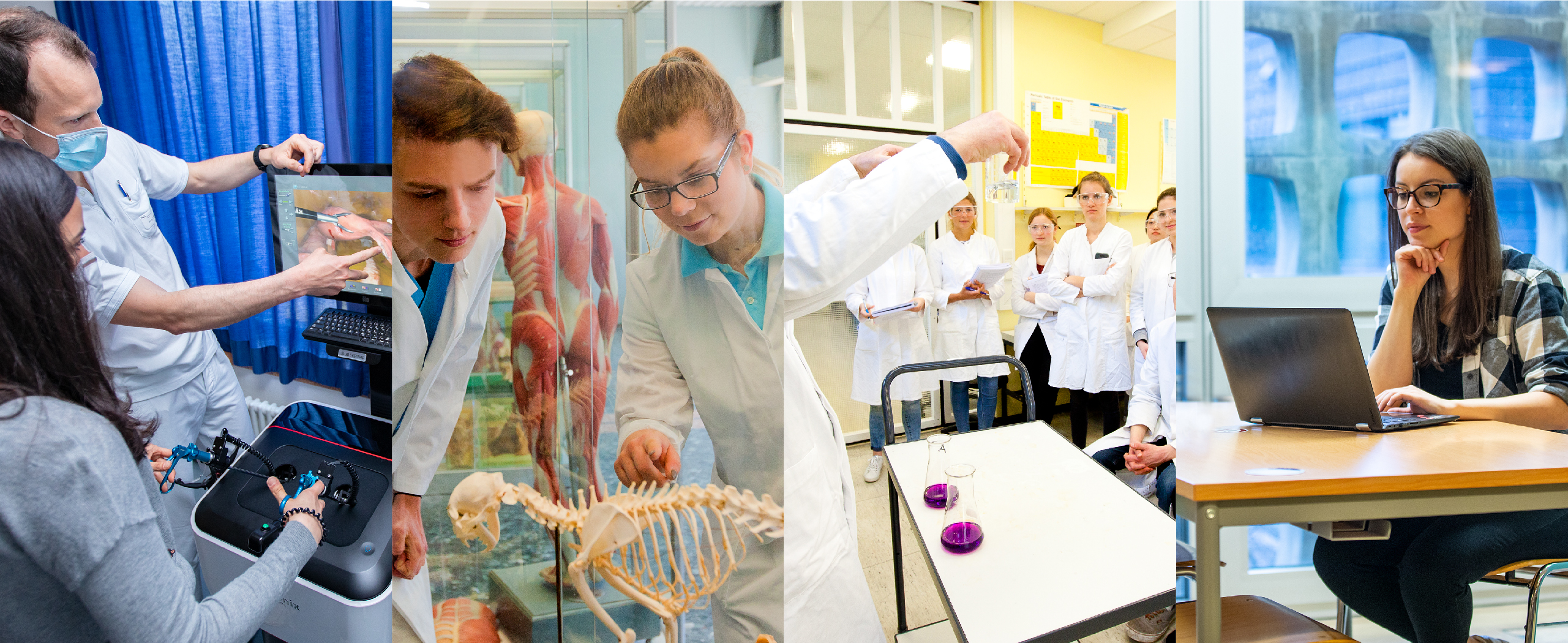
As a student on the HannibaL model degree program, you will have contact with patients right from the start; the classic separation of theory and practice, i.e. preclinical and clinical departments, no longer applies.
⇒ about the study programmes
Getting to the heart of the matter
Here you combine medicine with technical skills and lots of contact with patients.
⇒ about the study programmes
▸ Master's degree with state examination
The Master's degree program in Clinical Psychology and Psychotherapy is aimed at graduates of the relevant (polyvalent) psychological Bachelor's degree program and offers the opportunity to acquire the necessary professional qualifications for licensing as a psychotherapist.
▸ Bachelor
A joint study programmes of the Leibniz University Hannover Foundation and the Hannover Medical School at the interface of the classical subjects of chemistry, biology and medicine.
A joint study programmes of the Leibniz University Hannover Foundation, the University of Veterinary Medicine Hannover Foundation and the Hannover Medical School, in which the diverse manifestations of living systems are taught and studied at the molecular, cellular, organismic and population levels.
A cooperative study program of the Leibniz University Hannover Foundation and the Hannover Medical School at the interface between engineering, medicine and natural sciences.
Accompanying life from the very beginning
As a student here at the MHH, you will receive a scientific degree with practical professional training.
▸ Master
On the trail of the molecular foundations of life
Here you can research the cellular and molecular basis of life processes and their pathological changes.
Research-oriented - interdisciplinary - practical
Analyzing diseases and determining their causes is the task of biomedicine. You will work intensively with cell biology and molecular biology and combine both with medical questions.
Innovative - Interdisciplinary - Interactive
Here you will become an expert in large complex data sets in healthcare and (bio)medical research.
Human - Animal - Environment
Here you will learn the basics of various infectious diseases with special reference to zoonotic pathogens, i.e. pathogens that can jump from animals to humans.
⇒ about the study programmes
Shaping change in the healthcare sector
Here you will become an expert in planning and decision-making processes in the healthcare sector, a specialist in the development, implementation and evaluation of health-promoting and preventive programs, in health communication and in research and teaching in public health.
▸Promotion
The PhD program "Infection Biology" is open to persons who have successfully completed a university degree in medicine, dentistry, veterinary medicine or natural sciences and is intended to provide project-oriented postgraduate training in research with the aim of enabling in-depth independent scientific work and an extended professional qualification for tasks in research or related activities in the field of infection biology.
The MD/PhD study programmes in "Molecular Medicine" are aimed at medical doctors and natural scientists with a state examination or M. Sc. degree and are project-oriented and prepare students for research-based science. In addition to research work, the curriculum also includes key qualifications such as research and medical ethics, scientific writing and presentation.
The Cluster of Excellence REBIRTH (From Regenerative Biology to Reconstructive Therapy) has initiated the international PhD study program "Regenerative Sciences". This study programme is also located under the umbrella of HBRS and is intended to enable a research career in the field of regenerative medicine and benefits from the intensive cooperation within the REBIRTH Cluster of Excellence. The Cluster of Excellence REBIRTH focuses on research into diseases of the organ systems blood (including immunity), heart, lungs and liver. Synergies are developed by bringing together a broad spectrum of experts with profound background knowledge.
The PhD program "Systems Neuroscience" provides project-oriented postgraduate training in neuroscientific research with the aim of enabling students to carry out in-depth independent scientific work and to gain an extended professional qualification for tasks in research or related fields of activity.
The three-year doctoral program in the field of epidemiological research is a cooperative project between the Department of Epidemiology, the HZI Grad School and the HBRS (MHH). Upon successful completion, students usually acquire the title PhD or, in individual cases, Dr. rer. nat.
BIOMEDAS is aimed at students who are interested in combining disciplinary knowledge with the skills of a data scientist and working at the interface of bioinformatics, medical informatics, databases, data mining, machine learning, applied mathematics, biomedical modeling and analysis of complex networks.
The PhD program "Auditory Science" was developed as part of the Joint Research Academy of the Cluster of Excellence "Hearing for All".
▸Dual study
In the Bachelor of Business Administration, we train you as a future manager and specialist
We would like to work together with you to remain what we are as a university, hospital and employer: great. We will show you what modern HR work means, how our healthcare system works and why everyone is talking about agile project management. As part of the team, you will help to develop perspectives together - for you, for us, for the patients. We help together, others and each other.
In Bachelor Business Economics, we want to make you fit so that you can make us even fitter
AI, big data and many other challenges are rapidly changing the way we work. That's why we need bright minds who are keen to stay on top of things and be part of change. We want to show you what controlling means, how science funding works and what all this can have to do with you. Let's create perspectives for each other and find out what opportunities there are - for you, for us, for patients. We help together, others and each other.

Teaching mission statement | Digitization strategies for studying and teaching
Teaching mission statement
Hannover Medical School (MHH) is a leading university facility or institution and stands for high-quality teaching, research and patient care (in accordance with the MHH mission statement).
The MHH has an integrative and cooperative structure. Academic and scientific education is at the center of our university. The aim is to provide interdisciplinary and practical training for students. Close integration with research and patient care corresponds to our self-image.
All students acquire skills that allow them to actively participate in the creative processes of a digitalized knowledge society. Students are prepared for the responsible and independent performance of demanding tasks in society and share responsibility for their own studies. This is expressed through constructive participation in courses, active self-study and involvement in academic committee work. A strong and fair culture of discussion and feedback enables an intensive exchange of ideas.
The university management promotes teaching and learning through a supportive organization and infrastructure. Our aim is to design didactically sound digital teaching and learning environments. The MHH imparts in-depth knowledge in all disciplines and across subject boundaries. Lecturers at MHH work and conduct research at the highest level and incorporate the latest scientific findings into their teaching. Students learn all the principles of sound scientific work with a view to deepening their scientific competence.
MHH's open culture of values stands for overcoming gender, ethnic, cultural, social, religious and economic barriers. Diversity is characterized by mutual respect, participation, responsibility and tolerance. Science and innovation as a central component of our university community of values promote the skills and abilities of each individual.
The MHH is an internationally oriented university. Our aim is to enable people of all nationalities to work, teach, research and study at MHH.
Ensuring and sustainably developing the quality of our teaching is an ongoing process that the university management actively supports. Achievements in teaching receive the same respect, appreciation and recognition as achievements in research and patient care.
Senate resolution from 16.01.2019
The Hannover Medical School (MHH) is a leading institution of higher education and synonymous with excellence in teaching, research and health care (as stated in the MHH Mission Statement). Our approach is integrative and cooperative. Academic education and scientific learning are the primary focus of our university whose aim is interdisciplinary and practice-oriented higher education. Close interaction with research and health care reflects this overall concept.
All students acquire skills that enable active participation in the formation and development of a digitized scientific community. Students are prepared to assume challenging social positions independently and responsibly and to be accountable for their own studies. This is seen in their constructive participation and collaboration in university courses, active self-learning and work on academic committees. A distinct and fair discussion and feedback culture enables an intensive exchange of information and ideas.
The university's administration fosters and promotes teaching and learning with its supportive organization and infrastructure. A well-founded structuring of digital teaching and learning environments is our aim.
The MHH imparts specialized knowledge in all disciplines and across subject areas. Instructors at the MHH engage in work and research of the highest caliber and include current scientific discoveries in their teaching. Students learn all the principles of well-founded science as a basis for their own skills in academic scholarship.
The open values culture at the MHH stands for overcoming gender-specific, ethnic, cultural, social, religious and economic barriers. Diversity is shaped by mutual respect, participation, accountability and tolerance. As core components of our university community, science and innovation boost the skills and competencies of each individual.
The MHH is an internationally oriented university. Our aim is to enable people of all nationalities to work, teach, and engage in research and study at the MHH.
Ensuring the sustained excellence of our teaching is an ongoing process that is actively supported by the university administration. Achievements in teaching receive the same respect, esteem and recognition as achievements in research and health care.
Resolution of the Academic Board of Hannover Medical School from Jan 16, 2019
Preamble:
As a place of scientific education, it is the task of universities to enable students to meet the demands of scientific and technological progress in society and the world of work with professional expertise. One challenge in the near future is to adequately deal with the various aspects of digitalization. The digital transformation of the healthcare system has a direct impact on prevention, diagnosis and therapy and promotes new research approaches based on digital data. Digital research ranges from the generation of digital data, for example through the use of sensor-based, mobile devices, to the development and implementation of complex analysis processes.
In order to ensure excellence in student education in the future, a systematic integration of digital skills in all study programmes and across all disciplines is required. Digitalization aspects will be incorporated into the curricula in terms of both content and methodology to ensure a forward-looking and practical education. Corresponding teaching concepts are being developed and established.
Objective:
In accordance with the MHH's mission statement for teaching, students are given the opportunity to acquire qualifications and skills that allow them to actively and responsibly participate in the processes of shaping a modern knowledge society. With a multidimensional digitalization strategy for teaching, MHH creates the best possible conditions for a successful career start and further development in patient care as well as in biomedical and health science research.
The digitalization strategy for teaching at MHH addresses the following fields of action:
1. creating an up-to-date infrastructure for the use of digital offerings
The infrastructure is being expanded in line with the requirements of a digital transformation of teaching to ensure the future-oriented further development of teaching.
2. Sustainable further development of curricula for the acquisition of digital skills
In view of the dynamics of digital change, new content-related and didactic points of reference for the acquisition of digital skills will be implemented in the existing curricula. Forward-looking teaching and learning concepts, taking into account the opportunities and risks of digital processes, promote a confident and reflective approach to continuously evolving and increasingly complex technical innovations in the healthcare system.
3. Strengthening, establishing and further developing digital teaching formats
Building on the digital teaching offerings successfully established at MHH, these will be expanded in the direction of mobile use. A model will be developed for the crediting of digital teaching to the teaching load that adequately reflects the development of digital teaching formats and the supervision of online-based learning phases and recognizes the teaching commitment of lecturers in the process of digitizing teaching.
4. Further education and training for teachers on digital skills in teaching
The establishment of further education opportunities for teachers to acquire the necessary digital teaching skills is a cornerstone of the digitalization strategy for teaching. Support services are created for teachers to promote the digitalization of teaching.
5. Expansion of digital teaching and learning opportunities for MHH employees
As the only independent medical university, the MHH offers the structural prerequisites for high-quality
healthcare education at all levels of competence thanks to the close integration of Clinical Department, teaching and research. The development and establishment of digital teaching and learning opportunities as well as the opportunities to acquire digital skills therefore apply to all areas of education, training and further education at MHH.
6. Promotion of interdisciplinary and cross-disciplinary networking
The digitalization of the healthcare system not only strengthens interdisciplinary and cross-location patient care, but also leads to greater integration of different scientific disciplines in research. In addition to cross-university exchange in Clinical Department and research, inter-university networking in the field of teaching is being expanded through the expansion of cooperation and the exchange of teaching and learning materials.
Senate resolution from 15.01.2020
Preamble:
As a university, we primarily fulfill tasks in research and teaching as well as in preparing students for their professional careers.
In a time of change and ever faster technological progress, digitalization is becoming increasingly important and offers the MHH the opportunity to redefine and professionalize administrative processes
. This offers students a contemporary course of study and good preparation for the future digital world of work and takes account of the practical training in accordance with
the MHH's mission statement. The establishment of future-proof tools as a building block of the MHH digital strategy plays a decisive role in this.
Objective:
Digital Management is intended to make it easier for students, teaching staff and study administrators to organize their studies by simplifying processes and making information more easily available in order to meet the increasingly complex requirements of studying. This also enables students to share responsibility for their own studies in accordance with the
mission statement for teaching. This also includes the possibility of flexible and location-independent study organization.
The following fields of action result from this objective.
1. services for students
The most important field of action here is the provision of services for students via a central portal function (ideally via single sign-on and off) and for various
end devices. These services include registering for and deregistering from certain courses and examinations, receiving certificates and proof, submitting applications to
and providing information on study progress, performance status, timetables, teaching materials and fees, as well as using and changing
personal data. These standard processes can be simplified and accelerated through the automation and provision of a central software interface and at the same time advance the data integration of the digital strategy.
2. internationalization
The internationalization of the university landscape undoubtedly contributes to the enrichment of teaching and research and is therefore also anchored in the mission statement for teaching. EU and DAAD exchange programmes promote internationalization at universities. The resulting legal framework conditions, such as the "ERASMUS without paper" initiative, require the digitalization of exchange-related processes based on contractual agreements so that exchange students can focus on the core objectives of their stay abroad.
3. optimization of administrative processes
It is important to make existing electronic interfaces between the various existing software solutions more usable, but also to create new interfaces and to simplify data access by centralizing student data, e.g. by using an electronic student file, thus saving students unnecessary trips
and the double submission of evidence. In addition, the optimization of administrative processes is essential in order to be able to guarantee reliable administration and support for students as well as organizational support for lecturers with regard to
digitization strategy for student administration the continuously increasing number of students at the MHH. Here, too, there is a concrete implementation of the networking of partners and stakeholders envisaged as part of the digital strategy.
4. evaluation
The digitalization of student administration facilitates the systematic evaluation of studies and teaching. These surveys, which go beyond the legally required evaluations
, contribute to quality assurance in studies and teaching and increase students' chances of successfully completing their studies.
5. legal framework
The legal framework for student administration has become increasingly complex in recent years. Regulations within the framework of the EU GDPR, the
Online Access Act (mandatory implementation by 31.12.2022) and the Higher Education Statistics Act, which are intended to protect students' legal rights and at the same time make it easier for them to study, have created additional workload. These legislative objectives can be increasingly taken into account through automation
.
6. infrastructure
Only a sustainable, state-of-the-art infrastructure can enable effective interaction between students, staff and lecturers for the purpose of better study organization. In addition to setting up the infrastructure, Nursing is also of central importance.
7. outlook
The quality of research, teaching and patient care is also reflected in the administration. In addition to the students, the various areas entrusted with student administration benefit from professional digital administration: the Student Office, the Office of Academic Affairs, the program coordinators, the lecturers, the International Office, the alumni networks and the university management. The sustainable further development of study organization and student and examination administration is an ongoing process that the university management actively supports in the sense of "good administration practice". The objectives of the mission statement for teaching and the digitalization strategy for teaching
are thus also being continued in student administration
Senate resolution from 12.10.2022