During your stay
Your treatment procedure
During your nursing admission interview, we discussed with you or your relatives what therapeutic and nursing support you require.
The day usually starts at around 07:00.
Your responsible nurse will support you with your morning activities if required. You will also receive the medication prescribed by your physician.
If you have not yet had contact with an administrative staff member at this time, we ask you to report to the administrative patient admission department between 07:00 -15:30 (Fr. until 14:00) to have all billing-relevant data recorded. Please sign out with your nurse for this purpose.
Necessary examinations and therapies start at 08:00 and can take place throughout the day. If you need to fast for examinations or a planned operation, the nursing staff will inform you.
From around 13:30, the nursing staff from the late shift will come to the ward. After an exchange of information with the early shift, which usually takes place in the duty room, the nurse responsible for the afternoon will introduce themselves to you. You can find out from them whether any examinations are planned for you in the afternoon. As in the morning, you will also be supported by your responsible nurse in your evening activities during the late shift. After the information exchange with the nursing staff on the late shift, the nurse will go through all the rooms and check that everything is ready for a restful night. At 06:00 a.m., our night shift is replaced by the nursing staff from the early shift.
The ward round takes place regularly in the morning. A team of nurses and physicians will visit you to discuss your further treatment at the MHH.
The ward round is an ideal time to ask all the medical and nursing staff responsible for you any questions you may have.
As a leading university hospital, the MHH trains young physicians, nurses and many other professional groups. Practical lessons with patients are very important for students and trainees.
Of course, you will be asked beforehand whether you agree that what you have learned may be put into practice under the instruction of well-trained experts. We would like to thank you in advance for your understanding and support.
As already mentioned, the examinations and therapies prescribed for you will take place from around 08:00.
The nursing staff on the ward will inform you about planned examinations and therapies.
You will be taken to and collected from the departments where the examinations take place in good time by the staff of the in-house transport service. The transport service will also accompany you back to your patient room.
Unfortunately, despite good planning with the help of special hospital software, there may be waiting times for examinations due to emergencies. We ask for your understanding and assure you that we are constantly working to further improve processes in order to keep waiting times as short as possible.
If you have an examination appointment on call and still want to leave the ward briefly (e.g. for administrative patient admission), please sign out with your responsible nurse.
All inpatients at Hannover Medical School (MHH) can support medical research with their treatment data. The MHH is part of the Medical Informatics Initiative (MII) of the Federal Ministry of Education and Research (BMBF). A standardized nationwide declaration of consent enables medical research to obtain broad consent for the use of pseudonymized clinical data for the first time on the basis of the EU General Data Protection Regulation. Such data is invaluable for the medicine of the future. The patient data will be made available to researchers at other German university hospitals and will also be used for joint, multi-center research projects. The strict regulations of the EU General Data Protection Regulation are observed: This means that data cannot be traced back to the original person. At the MHH, the signed consent is valid for 30 years, which means that patient data can be stored and used for research purposes for up to 30 years if the person concerned does not revoke it. After five years, patients are asked for their consent again. The stored data may also be used for unforeseen questions. This is an important prerequisite for a wide range of research projects - from personalized medicine to the development of AI-based decision-making aids. The university hospitals involved in the Medical Informatics Initiative have drawn up a model for broad consent. You can find the sample text for patient consent here.
Further information on the Medical Informatics Initiative for Patients can be found here.
During your stay in hospital, the ward staff will assess whether you require further Nursing and treatment after discharge.
With your consent, social services staff in particular will inform you about aftercare options and arrange these.
For example, we will initiate rehabilitation measures or apply for home nursing care and aids so that your treatment outcome is secured and you can continue to recover.
Doctors will conduct a discharge consultation with you and are available to answer any questions you may have about previous and further medical care. You will receive a medical report, which will form the basis for any further treatment outside the hospital that may be necessary.
Further information on discharge can be found here.
Your room, meals, Internet
The television must be switched on (red light on the device must be lit - standby).
In order to use the television, you must purchase a chip card, which you also need to use the safe and telephone. Operating instructions.
Television is free of charge. You must be registered for the television service (see operating instructions). The television must be switched on (red light on the device must be lit - standby).
Use on the bedside telephone:
- Chip card must be inserted (as explained under "Registering, re-registering, deregistering")
- Press the TV button
- Select the program with two digits (e.g. 04 for RTL) or use the "P+" and "P-" buttons to switch one program forwards or backwards
- To switch off, simply press the TV button again.
- You can switch on the sound for the TV via the nurse call device on your bed, channel 5 or 6. You can also adjust the volume using this device.
Use with a telephone with a blue keypad background and white buttons:
- Chip card must be inserted (as explained under "Registering, re-registering, deregistering")
- Press the "S" key
- Press the green button on the phone
- Select the program with two digits (e.g. 04 for RTL) or use the "P+" and "P-" buttons to switch one program forwards or backwards
- To switch off, press the program "00"
- You can switch on the sound for the television via the nurse call device at your bed, channel 5 or 6. You can also adjust the volume using this device.
Hotspots
Free Internet access (hotspot) is available for all patients and visitors in the shopping arcade (especially at the main entrance and at the back).
Patient Internet
The patient internet is available on some of our wards.
Wards 11, 12, 13, 15, 16, 17, 21, 22, 23, 25, 26, 27, 28, 31, 32, 33, 35, 36, 37, 38, 41, 42, 43, 45, 46, 47, 48, 77, 78, 79 are now equipped with it - the costs are €2.50/day or €10.00/week and must be paid via PayPal.
PayPal also offers the payment option of direct debit, credit card etc. as a "PayPal guest". This requires a cell phone, as the access number is sent by SMS.
The patient internet is available free of charge on ward 18.
If you have any queries, please contact the following telephone number: 0511-532 2000.
Registration:
Search the WLAN network for Patienten_Internet and select it.
Confirm the terms of use, select a daily or weekly ticket and follow the instructions.
Meal plan
Unless your physician has prescribed a special diet, you can choose from at least three different menu suggestions every day.
There are current menus on each ward from which you can make your selection. Please pass this information on to the nursing staff in good time so that your wishes reach the central kitchen. Drinks are available free of charge at the nursing support points.
The Canteen of the MHH is also open for guests from Monday to Friday from 11:30 to 14:15.
The kitchen hotline is available daily until 2 p.m.: 0511/532 3386 or via patient telephone: 92-3386 or by e-mail: Kuechenbuero@mh-hannover.de
For questions about special diets (e.g. diets, allergies): 0511/ 532 3398 or via patient telephone: 92-3398 or by e-mail: Diaetbuero@mh-hannover.de
►You are also welcome to visit us on our homepage.
► Click here for the current menu!
Telephone, television and safe, own telephone, fax or internet connection.
We want to help you make your stay as pleasant and safe as possible. That is why we have installed chip card telephones at your bedside, safes and televisions in the rooms.
► Safe
In conjunction with the chip card, a safe (if available) is available for your valuables. You can also operate the television via the telephone keypad. You also have the option of ordering an Internet connection for your notebook or a fax connection. The current prices for the Internet connection can be found on our notice boards.
When you leave the Clinical Department, please leave the safe open for your successor.
►Emergency safe call in case of discharge: 8888
(Fri. 13.00-20.00 and Sat.+Sun. 9.00-20.00)
Please note that no liability is accepted for your valuables!
⇒ If you have any questions about the telephone, safe or television, you can call the service center (telephone number 2000) free of charge.
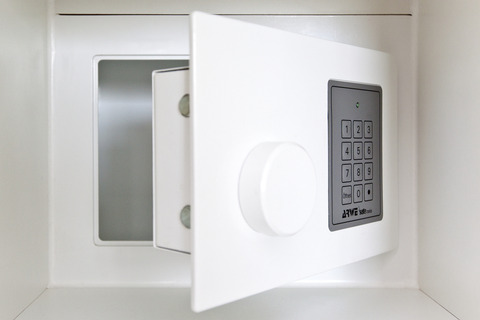
Telephone, television and safe, own telephone, fax or internet connection
We would like to help you make your stay as pleasant and safe as possible.
We have therefore installed chip card telephones at your bedside, safes and televisions in the rooms. In conjunction with the chip card, a safe (if available) is available for your valuables. You can also operate the television via the telephone keypad. It is also possible to order an Internet connection for your notebook or a fax connection. The current prices for the Internet connection can be found on our notice boards.
► Making phone calls
The MHH would like to make your stay as pleasant as possible. For this reason, the rooms are equipped with telephone and TV systems.
The telephone number at which you can be called can be found on your HiMed card, e.g.: 0511-531-_ _ _ _
You must be registered for the telephone service.
- Card must be inserted (chip on top)
- Lift the handset
- Press the yellow "AMT" button (if you do not have a yellow button, dial "0")
- Dial the number as usual and make the call
All MHH internal numbers (usually the last 4 digits) can be dialed free of charge with the area code 92-_ _ _ _ (i.e. without "AMT" (yellow key or "0").
You can obtain an adapter for connecting a computer or a fax machine from the service center (toll-free telephone number 2000). With analog connections, your telephone line is occupied by a computer/fax during use and is not available during this time. With DSL Internet connections, there is no restriction for your telephone connection.
If you do not wish to use the telephone the following day, please log out the day before using the options listed under "Logging in 3" or "S3", or log out completely using 0, so that the daily rent is not automatically debited.
⇒ If you have any questions about the telephone, safe or television, you can call the service center (telephone number 2000) free of charge.
► Mobile phone
Cell phone calls are generally permitted in the MHH, but not in intensive care units and in certain diagnostic and therapy areas.
Please remember not to disturb other patients with your phone calls. If in doubt, please ask the nursing staff or physicians.
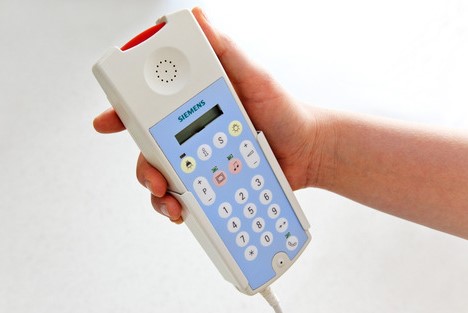
We would like to help you make your stay as pleasant and safe as possible.
That is why we have installed chip card telephones at your bedside, safes and televisions in the rooms. In conjunction with the chip card, a safe (if available) is available for your valuables.
You can also operate the television via the telephone keypad. It is also possible to order an Internet connection for your notebook or a fax connection. The current prices for the Internet connection can be found on our notice boards.
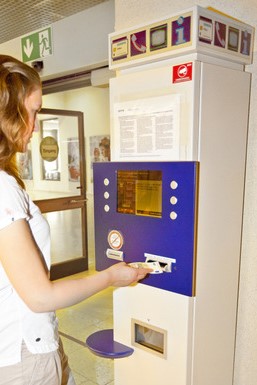
The telephone, safe and television are operated using the chip card, which you can either obtain from the designated machines (e.g. in the shopping arcade opposite Medipress) or order from the service point (toll-free telephone number 2000).
If your card is empty, we will be happy to recharge it for you (minimum charge € 10.00). The prices are displayed at the ticket machines.
Advice and services
Dear, dear patient!
The chaplains at the MHH see themselves as discussion partners for patients and their relatives as well as for those working in the hospital.
Hospital chaplains want to meet, support and accompany people in the hospital system. Together with patients, relatives or employees, they want to search for security and meaning, and in doing so, people can discover solutions to their own questions and problems.
Pastoral care at the MHH is a service provided by the churches and is offered by Protestant and Catholic chaplains for the people in the hospital. The chaplains are aware of their denominational independence, but see themselves as ecumenical and united in their mission.
Pastoral care is not only aimed at members of their own denomination and religion, but is open to everyone in recognition of their own religious and ideological convictions. There is a regulated ward affiliation for the chaplains.
It is helpful for all requests for visits and discussions to be made directly - in person/by telephone/written form - to the hospital chaplaincies. Conversations can take place in the rooms, on the ward or in the hospital chaplaincy rooms (on both sides of the chapel). Acceptance and comfort, relief and understanding, strengthening can be experienced in pastoral care and encounters, in church services and pastoral care. The fragility of life, the confrontation with illness, suffering and death can also be dealt with together.
► Services/offers :
- Pastoral discussions with patients
- Support and advice for relatives and other affected persons
- Support for children and their relatives
- Crisis intervention (on-call service)
- End-of-life care
- Organization and support in farewell situations
- Spiritual support in prayer, anointing of the sick, communion for the sick, emergency baptisms, blessings
- Church services, children's services, official acts
- Counseling and pastoral care for staff/employees in the building
- Seminars as part of in-house training and further education
Training and support for volunteers
Cultural events such as concerts, readings, exhibitions, etc. - Participation in the clarification of ethical issues
► Church services
You are cordially invited to the church services in the chapel (in the shopping arcade):
- Protestant service:
"What moves the soul", Tuesday 1.30 p.m.
- Catholic service:
Holy Mass, Saturday 6.45 p.m.
Holy Mass, Wednesday 6.45 p.m.
- Devotions: on special Tuesdays 6.45 p.m.
- Children's services: will be announced on the notice board
► Protestant hospital chaplaincy
Telephone: 0511 532-5474 (radio call: 0177 532-5474)
E-mail: Ev.Seelsorge@MH-Hannover.de
► Catholic hospital chaplaincy
Phone: 0511 532-5405 (radio call: 0172 510-8604)
E-mail: Kath.Seelsorge@MH-Hannover.de
Homepage of the Protestant and Catholic pastoral care services
The services offered by the hospital chaplaincy are not tied to affiliation with a religious denomination. Requests for visits and advice from patients and relatives can be arranged via the wards or directly by telephone.
► Muslim prayer room
The MHH prayer room is open 24 hours a day to students, staff, patients and visitors.
A Friday sermon is also held here on Fridays (1 pm).
Further information can be found here
Civil status
All births and deaths at the MHH are processed by the Civil Status Office.
- The civil status office is located in the central patient admission area.
- The office is open Monday to Thursday from 8.00 a.m. to 2.30 p.m. and Friday from 8.00 a.m. to 12.00 p.m.
►Contact persons:
- For deaths: Ms. Kowalczyk,
Phone: 92-4242 (internal toll-free number)
- For births: Ms. Polley and Ms. Bracke
Phone: 92-6171 (internal toll-free number)
Administration of estates and valuables
For all questions regarding the administration of estates and the storage of valuables, please contact the Central Service and Information Department - Reception-K06 in the shopping arcade (Bettenhaus).
In exceptional cases, such as admission via the emergency admission department, your valuables will be deposited with the estate administration. Your valuables can be issued to you personally or to a person authorized by you.
Please remember to bring an identity card or passport with you.
Unfortunately, theft cannot be ruled out even in hospitals. You are therefore asked not to bring valuables or large sums of money into the Clinical Department.
Please help to protect your property from damage or loss by taking special care of your personal belongings such as glasses or dentures.
Please use the safe in your patient room to store your personal valuables and small amounts of money.
► Information - Reception-K06
- Telephone information on 0511 532 3388, 2106 or 2107 around the clock
► Consultation hours:
- Daily from 09:00am to 6:00pm
We support YOU!
We are a group of volunteers at the MHH who offer patients help and support in the special situation of hospitalization.
Further information can be found in our flyer
Range of tasks
We take the time to talk to you
- for a conversation,
- for errands in the house (newspapers, refreshments, telephone cards, etc.)
- for walks in the house and garden,
- Assistance for patients and relatives in the admission area
- Free coffee and tea service in the waiting areas of the outpatient clinics
- Patient care immediately before an operation
► Contact:
Tel.: 0511- 532 2298 (we will call you back promptly)
Mail: Gruene.Damen.Herren@mh-hannover.de
►Working hours:
Mon. - Fri. 8 a.m. - 12 p.m.
► Join us!
Become part of the strong community of Green Ladies and Gentlemen and experience how fulfilling this voluntary work can be.
You need to bring:
- 3 -4 hours one day a week
- Empathy and emotional stability
- Reliability and sociability
- Confidentiality and positive charisma
We offer you:
- Expert instruction
- Certified further training
- insurance cover
- Reimbursement of travel expenses
- Regular exchange within the group, regionally and nationwide
- Advice and information from the eKH office
.
Many MHH patients are involved in self-help groups and support the work of the university.
Below you will find an excerpt from a list of organizations that cooperate closely with the MHH.
You can also find further contacts on our Donations and support page or at the Hanover contact, information and advice center for self-help KIBIS-KISS.
► List of some self-help organizations
Bladder cancer sufferers - Facebook self-help group Hanover
BRCA network - help with familial breast and ovarian cancer
Federal Association of Organ Transplant Patients e.V.
German Society for Muscle Diseases e.V. DGM
DSAI, German Self-Help Association for Congenital Immunodeficiencies
German Association for Ankylosing Spondylitis (Morbus Bechterew Landesverband Nds. e.V.)
Deutscher Diabetiker Bund Landesverband Niedersachsen e. V.
German Association for the Hard of Hearing - Regional Association of Lower Saxony e.V.
Dystonia self-help group - Hanover regional group
Group for relatives of people suffering from depression (therapy-led)
Haus Schutzengel for people with cystic fibrosis
State association for kidney patients, dialysis patients and transplant patients in Lower Saxony e.V.
MRKH Mayer-Rokitansky-Küster-Hauser self-help group
Open discussion group for women with alcohol, medication and drug problems
Prostate cancer self-help group Burgdorf
Rheuma League Lower Saxony e. V.
Self-help group for liver transplant patients Germany e.V.
Self-help group for children and young people with kidney disease
Lymphoma and leukemia self-help group Hanover
Stuttering self-help group Hanover
Transplant Support Association
ZNS - Hannelore Kohl Foundation - For injured people with damage to the central nervous system
The Clinical Ethics Committee (KEK) of the MHH offers advice to patients, relatives and all members of the treatment team if ethical questions and conflicts arise during the course of treatment that cannot be resolved by the parties involved.
Ethics counseling can be useful, for example, if the benefits of a planned treatment are assessed differently or if there is uncertainty as to whether further treatment is still in the patient's best interests.
The CEC does not make any decisions itself, but supports those responsible for decisions in finding a viable solution in the interests of all those affected.
You can reach the CEC by calling 0511-532 4267 or from the patient hotline on 92-4267.
See also www.mh-hannover.de/kek.html
Hannover Medical School is not only a globally recognized Transplant Centre, but also one of over 100 so-called removal hospitals in Lower Saxony, as hospitals where organs and tissues can be donated.
An organ/tissue donation is always highly customized to the individual needs and wishes of the potential donor and is subject without exception to the regulations of the German Transplantation Act (TPG).
In order to be able to meet the wishes of patients who wish to donate tissue or organs for other seriously ill people at the end of their lives at any time and to fulfill the requirements of the TPG, 3 so-called Transplantation Officers (TxB) work at Hannover Medical School. These transplant officers are responsible, for example, for ensuring that
- determining the wishes of patients who are potential donors
- providing the necessary time and attention for all questions and uncertainties of relatives,
- the MHH staff concerned are informed and know what to do,
- contact with external partners (e.g. DSO, DGFG) works,
- every organ donation meets the strict safety and quality requirements,
- the dignity of the patient/donor is always given top priority.
⇒ The team of transplantation officers currently consists of
PD Dr. Elvis Hermann
Martin Gernart
Dr. Frank Logemann
Palliative medicine is not about healing, but about quality of life.
This primarily means alleviating agonizing symptoms and responding to the physical and mental needs of the terminally ill.
For children, it is particularly important to spend as much time as possible at home.
In order to be able to meet the various problems and needs of terminally ill patients and their relatives, we care for our patients and their relatives in a multi-professional team of specialized physicians, nurses, psychologists, social workers, physiotherapists, art therapists, pastoral workers and volunteers.
Further information and advice centers can be found on the following website Palliative Medicine
When a person dies in hospital, relatives want to say goodbye to their relative in peace and with dignity.
At the MHH, this is not only possible at the bedside of the deceased, but also, by prior arrangement with the Institute of Pathology, in a specially equipped farewell room.
The room is deliberately kept simple and can be decorated with religious symbols as required.
A mediatively designed garden is also available for the relatives and friends of the deceased.
For further information, please call: +49 511 532 - 4584 (available until 15:00 on weekdays).
Farewell room of the MHH, Building J 6, first floor, Carl-Neuberg-Straße 1, 30625 Hannover