Worth knowing
Visits from family and friends are very important for patients in hospital - they encourage, distract or often contribute to recovery during a longer hospital stay. You can find the regulation for the MHH here.
- Playground
The playground is located in the inner courtyard of the children's hospital (building K 10) and is popular with young patients.
But patients' children are also welcome to play there.

To request documents relating to past treatments at the MHH (requests in accordance with the General Data Protection Regulation), please send a written request with your handwritten signature to the following postal address:
Hannover Medical School
Department of Ward Assistance
OU 3017
Carl-Neuberg-Str. 1
30625 Hanover
Please enclose a copy of your identity card / photo ID or your health insurance card and specify which type of documents (e.g. physician's letter) you would like to receive and at what time (outpatient visit or inpatient stay at the MHH).
In the case of requests from third parties, we also require a release from the duty of confidentiality or, if applicable, a copy of the power of attorney / care certificate. If you would like to receive documents from deceased persons, we require documents that prove your valid relationship to the deceased person (e.g. copy of birth certificate, copy of certificate of inheritance, copy of marriage certificate).
We will send the documents to the address given in your letter.
If you need individual documents, such as a medical report or physician's letter, directly for further treatment (no request under the General Data Protection Regulation), please contact the outpatient clinic or ward responsible directly.
Please note that you must send us your details by post only. This is essential for the verification process!
For optimal drug therapy, your home medication will either be prescribed during your hospital stay, possibly changed to the same or similar active ingredient, or even adjusted.
These medicines are procured by the Central Pharmacy.
When taking your medical history, please state all the medicines and food supplements you are taking so that potential interactions and side effects can be ruled out.
If you have a federal medication plan, please also provide this when taking your medical history.

- Admission
You have entered your personal details and signed the treatment contract in the patient admission department. A personal admission interview will take place on the ward. During this interview, please also name your next of kin/relatives and let us know whether you have drawn up a living will or power of attorney. Please discuss any other personal wishes directly with the ward team.
- Right to self-determination
You decide for yourself whether and to what extent the measures we propose (examinations, treatment and Nursing) are carried out. You have the legal right to consent to or refuse planned measures at any time during your treatment. When planning your treatment, you will also be informed about existing alternatives. Your physician will advise you on the most sensible solution from a medical point of view. As a rule, patients agree to the recommended measure. However, if you are unsure whether this solution is the best from your point of view, you have the legal right to express and discuss these doubts.
If you do not wish a medically recommended measure to be carried out, the next steps will be discussed with you. Your physician will explain the consequences of your decision to you. This is done with the intention of averting avoidable harm to you.
- Duty to inform
The physician has a duty to inform you of the risks of the treatment in good time, and you can request an explanation of unclear terms or methods at any time.
In the case of surgery or similar procedures, the physician must inform you in advance of the necessity, risks, type and scope of the necessary procedure. The law stipulates that you must agree to such treatment and also give your consent in writing. For this reason, a record is made of this information, which you and the physician sign. In life-threatening emergencies that require rapid action, written consent may be dispensed with.
- Clarification and information
To enable you to exercise your right to self-determination, you will be informed about all planned diagnostic and therapeutic measures (examinations, operations, medication, etc.), about all medical findings (blood tests, diagnostic imaging, etc.) and about your diagnosis and prognosis in personal consultations with your physician. You will receive all information in a way that you can understand. If you seek advice, the treatment team will advise you to the best of their knowledge and belief. If you wish to obtain a second medical opinion, you will be supported in this. You have the legal right to inspect all objective data in your medical records, provided that the rights and interests of third parties are not affected.
- Declaration of wishes, living will
If you are temporarily or permanently unable to give consent, a living will or other form of declaration of intent written by you will be helpful in planning further treatment. After checking its validity, it will guide the treatment team's further decisions. If there is no living will, the further procedure will be based on your presumed wishes. The determination of your presumed wishes includes information provided to us by your relatives/caregivers as well as our responsibility for your well-being. If you yourself have not expressed an opinion on the question of a possible organ removal or autopsy after death, your next of kin will be asked for their consent.
- Human dignity
The employees of the MHH respect your dignity and individuality in all phases of your life or illness. We show consideration for your intimacy, shame and vulnerability and support your wish for well-being. No patient is disadvantaged or discriminated against in the course of treatment. We ensure that dying patients receive intensive professional and personal support. They have the legal right to a dignified and pain-free life until death.
- Research and teaching
At the MHH, you have the opportunity to take part in research projects that serve the further development of medicine. You can also actively contribute to preparing MHH students and trainees for their professional practice. You decide for yourself whether and to what extent you would like to participate in research and teaching. If you do not wish to participate, you will not suffer any disadvantages.
- Dismissal
You have the legal right to responsible planning and preparation for your discharge from the MHH. This includes in particular that your further medical and nursing care has been organized and that necessary measures for further rehabilitation have been initiated. You will be discharged with a physician's letter, which forms the basis for further treatment. In a discharge interview, your physician will answer any unanswered questions about the past treatment process and further medical planning.
- Duty of confidentiality
All employees of Hannover Medical School are subject to a duty of confidentiality. We will maintain confidentiality towards third parties about your illness and everything you entrust to us. However, at your request, the physicians treating you can be released from their duty of confidentiality so that they can provide information to the persons you have named. In accordance with the statutory provisions, there is a limited right to information on the part of the cost bearer with whom you are insured and on the part of post-treatment Facilities or Institutions. Patient data will only be passed on due to legal obligations or with your express written consent.
- We would like to ask you ...
We have now informed you about your patient rights.
The recovery process depends very much on a mutually good relationship between the patient and the treatment team. For this to succeed, we are dependent on your cooperation.
We would like to ask you to do the following:
► Feel jointly responsible for the treatment process and contribute to it to the best of your ability.
► Keep to your treatment plan and appointments.
► Inform us of any changes in your state of health.
► Ask immediately if you have not understood something (e.g. during the ward round or during care procedures).
► Support us in fulfilling our teaching and training mission. Help students and trainees to gain practical experience in dealing with patients.
► Share your wishes and criticism with us openly and in good time.
► If possible, please contact the employees concerned directly so that a remedy can be found for the specific situation.
► Be considerate of your fellow patients and respect their legal rights - find out about the relevant regulations on your ward.
► Before you are discharged, take the opportunity to rate our Clinical Department and our efforts to improve your health (patient questionnaire) - this will give us a chance to review our actions and further improve our services.
◦Feel jointly responsible for the treatment process and contribute to it to the best of your ability.
All inpatients at Hannover Medical School (MHH) can support medical research with their treatment data. The MHH is part of the Medical Informatics Initiative (MII) of the Federal Ministry of Education and Research (BMBF). A standardized nationwide declaration of consent enables medical research to obtain broad consent for the use of pseudonymized clinical data for the first time on the basis of the EU General Data Protection Regulation. Such data is invaluable for the medicine of the future. The patient data will be made available to researchers at other German university hospitals and will also be used for joint, multi-center research projects. The strict regulations of the EU General Data Protection Regulation are observed: This means that data cannot be traced back to the original person. At the MHH, the signed consent is valid for 30 years, which means that patient data can be stored and used for research purposes for up to 30 years if the person concerned does not revoke it. After five years, patients are asked for their consent again. The stored data may also be used for unforeseen questions. This is an important prerequisite for a wide range of research projects - from personalized medicine to the development of AI-based decision-making aids. The university hospitals involved in the Medical Informatics Initiative have drawn up a model for broad consent. You can find the sample text for patient consent here.
Further information on the Medical Informatics Initiative for Patients can be found here.
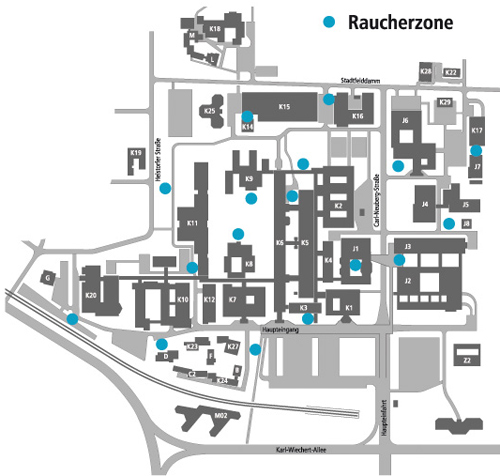
Smoking and alcohol are prohibited at Hannover Medical School (MHH).
Smoking is not permitted in the rooms, corridors or hallways. Smoking is also prohibited in front of the entrances, in the parking lots or in outdoor areas.
Special smoking areas have been installed for smokers. We ask you to strictly adhere to the zones provided for this purpose.
- Smoking is prohibited in the buildings and entrance areas of the MHH.
Everyone is happy to receive a nice gift. The gesture is good for the soul. But bear in mind the special situation in a hospital.
If you want to bring something to eat or drink, please ask the nursing staff. It can happen that the patient cannot tolerate certain foods at times.
Potted plants must not be brought in because the soil may contain germs. Cut flowers and floral water can also be problematic for reasons of hospital hygiene, so please take note of the information below.
Cut flowers may not be brought to certain wards:
- Intensive care and oncology wards: Please do not bring flowers.
- Transplant surgery ward: Please ask before your visit whether flowers may be brought in.
Changes in the spectrum of diseases, the role of the patient and not least the increase in market-oriented elements in healthcare place increased demands on the health and disease-related knowledge of healthcare users. With the aim of increasing the health literacy of citizens and patients and promoting health communication, an independent educational program was established with the Patient University at Hannover Medical School. Further information can be found here.
The National Network INSEA "Healthy and Active Living" aims to establish a self-management program for people with chronic diseases in Germany. The program is a standardized course with a defined course program and an evaluated accompanying book, which is based on the proven "Chronic Disease Self-Management Program" (CDSMP) of Stanford University (USA). INSEA is supported by Careum (CH), where the program is already being successfully implemented under the name EVIVO. Implementation in Germany is made possible by the Robert Bosch Stiftung and BARMER. The self-management program "Healthy and active living" is suitable for all illnesses, i.e. for both physically and mentally ill people. People who are able and interested in spending two and a half hours a week with other people over a period of six weeks can take part.
A prerequisite for the successful implementation of the program and for broad dissemination is also that interested people with and without chronic illnesses are recruited and trained as course leaders. They should be able to run a course in tandem with another course leader trained in the project. The course leaders, i.e. people who are open to other people and who are able to run a course in a socially competent manner, are trained by two certified trainers in 4-day courses.
Further information can be found here.
The G-BA (Federal Joint Committee) determines which medical services are available to people with statutory health insurance and provides hospitals with patient information. Background information on the G-BA can be found here.
The leaflets provide information on preventive medical check-ups and data collection, for example. You can find them here.
The data surveys provide reliable information on whether and when patients can be treated better.