Biomedical Soft Robotics
Dr.-Ing. M. Bartholdt | Prof. Dr. J. Foroughi | Prof. Dr. A. Ruhparwar
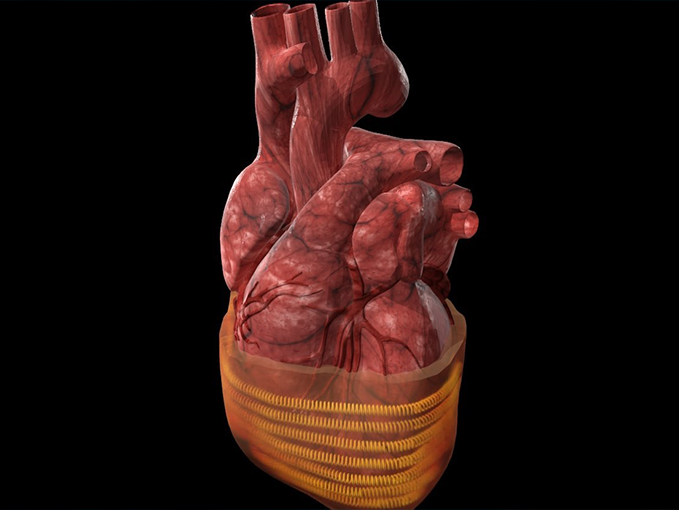
Smart materials are opening new possibilities in healthcare, and artificial muscles are among the most striking examples. Also known as electroactive polymers, they contract, expand, and generate force in response to an electrical stimulus, mimicking the movements of natural musculature.
At Hannover Medical School, we have developed artificial heart muscles capable of powering soft robotic devices that emulate complex biological behavior, including the compression and twisting actions of the heart. Engineered to undergo intricate deformations while keeping weight and spatial footprint minimal, our electro-thermally actuated muscles have demonstrated exceptional force generation — a significant step toward fully soft robotic ventricular assist devices (VADs). Building on this, we aim to create a next-generation VAD in the form of an implantable soft robotic sleeve. Key objectives include miniaturizing the sleeve, optimizing its long-term durability, and refining its operating parameters for seamless integration with natural cardiac function. The result would be a less invasive, more efficient alternative to conventional mechanical support for patients with end-stage heart failure.
A second strand of our work addresses the energy supply of wearable and implantable medical devices (WIMDs). While these devices enable continuous monitoring, early diagnosis, and personalized treatment, they still depend on batteries — which means surgical risk for implant replacement and the inconvenience of frequent recharging. Energy harvesting offers a way out: converting biomechanical movement directly into electrical energy. We are developing stretchable nanocomposite piezofibers that capture energy from muscle contractions, combining biocompatibility with robust mechanical properties. These flexible piezoelectric structures are well-suited to wearable sensors, implantable systems, and tissue-stimulation scaffolds.
Together, these efforts point toward self-powered, fully soft medical devices — safer, more reliable, and more patient-friendly than the technologies they would replace.
[1] J. Foroughi et al., “Soft robotic cardiac sleeves: materials, actuation mechanisms and translational pathways,” Mater. Horiz., vol. 13, no. 11, pp. 5237–5267, 2026, doi: 10.1039/D6MH00433D.
[2] S. Wildhirt et al., “First-in-Human Experience With a Biventricular, Pulsatile MCS Platform Technology Avoiding Blood Contact,” JACC: Basic to Translational Science, vol. 10, no. 3, pp. 267–269, Mar. 2025, doi: 10.1016/j.jacbts.2025.01.017.
[3] A. Ruhparwar et al., “Implanted Carbon Nanotubes Harvest Electrical Energy from Heartbeat for Medical Implants,” Advanced Materials, vol. 36, no. 32, p. 2313688, Aug. 2024, doi: 10.1002/adma.202313688.
[4] F. Mokhtari et al., “Highly stretchable nanocomposite piezofibers: a step forward into practical applications in biomedical devices,” J. Mater. Chem. B, vol. 12, no. 38, pp. 9727–9739, 2024, doi: 10.1039/D4TB01630K.
[5] A. Weymann et al., “Artificial Muscles and Soft Robotic Devices for Treatment of End‐Stage Heart Failure,” Advanced Materials, vol. 35, no. 19, p. 2207390, May 2023, doi: 10.1002/adma.202207390.
[6] F. Mokhtari, G. M. Spinks, S. Sayyar, Z. Cheng, A. Ruhparwar, and J. Foroughi, “Highly Stretchable Self‐Powered Wearable Electrical Energy Generator and Sensors,” Adv Materials Technologies, vol. 6, no. 2, p. 2000841, Feb. 2021, doi: 10.1002/admt.202000841.
[7] D. Kongahage, A. Ruhparwar, and J. Foroughi, “High Performance Artificial Muscles to Engineer a Ventricular Cardiac Assist Device and Future Perspectives of a Cardiac Sleeve,” Adv Materials Technologies, vol. 6, no. 5, p. 2000894, May 2021, doi: 10.1002/admt.202000894.
Dr.-Ing. Max Niklas Bartholdt
Lead Engineer of the Biomedical Soft Robotics Research Group
Department of Cardiac, Thoracic, Transplant, and Vascular Surgery
Hannover Medical School (MHH)
OE 8890
Stadtfelddamm 34, 30625 Hannover, Deutschland
Tel.: +49 511 532-1455
E-Mail