Capsid Engineering
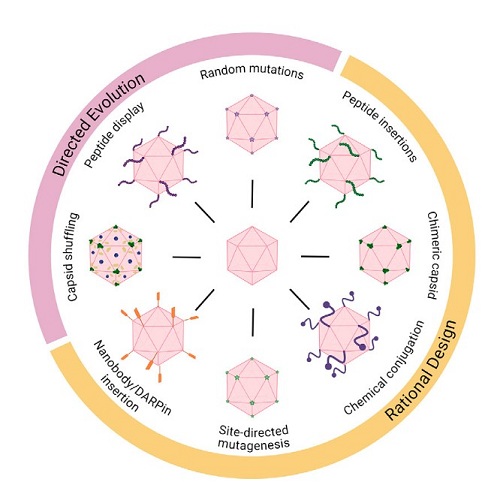
The AAV capsid protects the viral or vector genome and drives the AAV infection or AAV vector transduction process. Specifically, certain epitopes presented on the capsid mediate attachment to and entry into the cells, while others contribute to intracellular transport, nuclear entry and the release of the viral or vector genome.
Capsid engineering was initially developed to overcome barriers to cell entry and enable the transduction of cell types that are refractory to AAV vectors derived from naturally occurring serotypes. Since then, it has become a powerful strategy for redirecting vector tropism towards predefined target cells and for tailoring host-vector interactions.
Our group develops AAV vectors with engineered capsids to improve gene delivery to a wide range of target cells and tissues. To achieve this, we use rational capsid design approaches or high-throughput screening of AAV capsid libraries. Furthermore, we investigate key factors for redirecting the tropism of AAV vectors, advance capsid library technologies, and develop new libraries and engineering strategies to further expand the capabilities of AAV vectors for gene and cell-based therapies.
Figure reproduced from Araujo et al., Adeno-Associated Virus Vectors — a Target of Cellular and Humoral Immunity — are Expanding Their Reach Toward Hematopoietic Stem Cell Modification and Immunotherapies, Human Gene Therapy, 2024