Flap Lab 2.0
Dear colleagues,
This fall we would like to offer you a new edition of our
popular and successful flap preparation course at the
Hannover Medical School.
This is a practical preparation course for learning
how to perform flaps to cover defects and is aimed at
residents in further training to become
specialists in plastic surgery/hand surgery and specialists
in plastic and aesthetic surgery.
The aim of this "hands on" course is to enable
course participants to learn how to prepare
flaps themselves using cadavers under professional
guidance. Tutors will explain the specific
criteria of the selected flaps, in particular
indications, range of the flaps, vascular supply and the
special anatomy. In addition, typical access routes to
recipient vessels for free microsurgical flaps
will be illustrated and prepared.
Following a brief introduction and video demonstration
of the respective anatomical regions, each participant
will carry out the dissections independently.
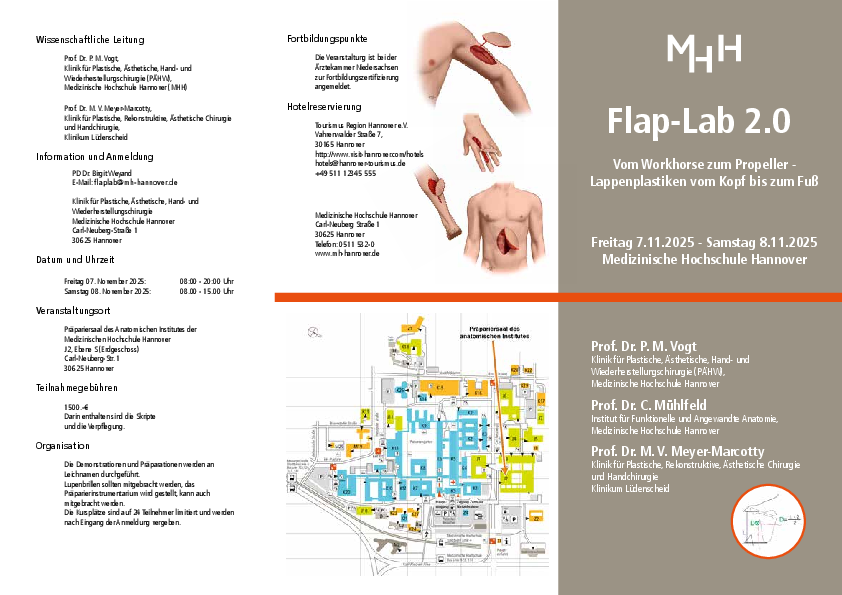
The flyer for the event with all important information can be found here.
We look forward to welcoming you in Hanover.
Prof. Dr. P.M. Vogt
Prof. Dr. M. Meyer-Marcotty
Prof. Dr. B. Weyand
Registration for Flap Lab 2.0
Review of the 2021 online seminar series
Update on plastic, aesthetic, hand and reconstructive surgery
On May 4, 2021, the Clinical Department of Plastic, Aesthetic, Hand and Reconstructive Surgery, under the direction of Prof. Dr. P.M. Vogt, held an online seminar on "Nerve lesions of the upper extremities", continuing the successful series started last year during the COVD-19 pandemic.
Prof. Dr. Dr. Leila Harhaus, Senior Physician at the BG Trauma Clinic Ludwigshafen/University of Heidelberg, began by presenting modern concepts for neuroma therapy. Under the motto "give the nerve something to do", she used techniques such as "TMR" (targeted muscle reinnervation) or "RPNI" (regenerative peripheral nerve interface) to demonstrate surgical options for successfully treating neuroma complaints.
Dr. Andreas Gohritz, senior physician at the University Hospital Basel, then described innovative concepts for improving arm and hand function in patients with CNS damage. Using patient examples, he impressively demonstrated how a combination of different procedures (e.g. the Alphabet Procedure) can restore basic grasping functions and thus help patients to lead a more independent life.
Finally, PD Dr. Birgit Weyand, senior physician at the MHH's PÄHW, reported on functional reconstruction options for traumatic paralysis of the upper extremity. In addition to classic motor replacement operations with tendon rearrangements, neurotization procedures were also presented, which can be used to successfully reinnervate paralyzed muscles.
The event was moderated by Prof. Dr. Dr. P.M. Vogt and the team received technical support from Ms. S. Goldscheck. Around 50 participants from several European countries were able to follow the exciting presentations online and ask and discuss questions via the chat.
On June 30, 2021, the Clinical Department of Plastic, Aesthetic, Hand and Reconstructive Surgery, under the direction of Prof. Dr. P.M. Vogt, held an online event on the topic of "Implant-based multiplanar breast augmentation - a concept for dynamic implant-tissue interaction and sustainable shape stability".
Dr. Marian S. Mackowski, Head of the Medical One Clinical Department in Hamburg, presented the current concepts of aesthetic and sustainable shape stability in his lecture, with which long-term stable results can be achieved even with large implant sizes.
Due to the high demand for a surgical video, we would like to draw your attention once again to the publication including video that appeared in April in the European Journal of Plastic Surgery, which can be accessed via the following link:
We would like to thank all participants for the exciting chat questions that brought our event to life!
In this unique interdisciplinary webinar, we were able to attract top-class experts to share the latest findings and best practices in burn care and intensive care medicine.
PD Dr. Stüber from the Department of Anaesthesiology and Intensive Care Medicine at the MHH provided information on the current study situation as well as his own experiences over the past year with the treatment of patients with severe courses of COVID-19 infection. PD Dr. Wallner from the BG-Klinikum Bergmannsheil in Bochum presented xenogeneic fish skin from Icelandic cod as an interesting and innovative wound dressing for burn patients. Using clinical examples, he was able to demonstrate its use both as an epidermal and as a partial dermal skin substitute. Dr. Wilhelmi from the traumatology intensive care unit of the MHH was able to impressively demonstrate the importance of factor XIII in the treatment of patients with extensive wound areas and injuries, both clinically and in the context of current literature, and raise awareness of the need for prompt and continuous substitution. Dr. Dieck, head of intensive care at the Lower Saxony Centre for Severe Burns, presented initial experiences with the novel and rediscovered ventilation concept of laminar flow and the Evone ventilator. This allows improved lung-protective ventilation to be achieved for selective indications, e.g. in the treatment of ARDS. PD Dr. Krezdorn, senior consultant at the Lower Saxony Burn Center, gave an overview of the data on the use of plasmapheresis in burn patients. In particular, he also reported on his own results of early pre-emptive plasmapheresis in selected patients with extensive findings of toxic epidermal necrolysis.
On November 2, 2020, our webinar series led by Prof. Vogt and PD Dr. Jokuszies included an advanced training course certified by the Medical Association of Lower Saxony on the topic of early childhood hand malformations.
Once again, we were able to attract experienced speakers for our webinar in the form of Ms. Maren Schelly, paediatric nurse from the Wilhelmstift Children's Hospital - the leading center for early childhood hand malformations in Germany - and Dr. Brodowski from the local Prenatal Diagnostics Department of the Clinical Department of Gynaecology and Obstetrics.
Dr. Brodowski kicked off this training course with his impressive ultrasound images and 3D reconstructions of prenatal hand and foot malformations and once again emphasized the importance of the interdisciplinary cooperation practiced at the MHH with his presentation.
Afterwards, Ms. Maren Schelly, paediatric nurse at the Wilhelmstift in Hamburg, demonstrated the conservative treatment options for camptodactyly and thumb-in-palm malformation. Using selected treatment cases and innovative splinting techniques such as the Streifi-Flex splint and the Glove-Splint, she was able to demonstrate impressive treatment results and the value of conservative therapy for these particular malformation entities.
Last but not least, PD Dr. Jokuszies gave an overview lecture on the treatment of the entire spectrum of hand malformations at the MHH. He paid particular attention to the now established OMT classification, which uses molecular biological and genetic findings to describe formation and differentiation disorders, as well as the Erhardt Developmental Prehension Assessment for the systematic observation and recording of children's grasping patterns and development. Since 2006, around 50 patients with early childhood hand and foot malformations have been treated at the MHH every year. In total, this amounts to more than 1400 treatment cases since 2006.
In conclusion, this training course met with a great and positive response from colleagues from all over Germany and from a wide range of specialist areas.
Looking back: Online seminar series 2020
Update on plastic, aesthetic, hand and reconstructive surgery
Therapy of the scahoid fracture
Dr. med. Sören Könneker, Hannover Medical School
Treatment of arthrosis of the thumb saddle joint
Dr. med. Alexander Zach, Heliosklinikum Stralsund
Treatment of rheumatic diseases
Dr. med. Christian Weinand, Osnabrück Hospital
Principles of successful aesthetic breast augmentation
Dr. med. Marian Mackowski, Medical One Hamburg
Implant/expander-based reconstruction with and without matrix - what's new?
Dr. med. Karl Breuing, Rhode Island Hospital / America
Rescue operations in implant surgery - the path to autologous tissue
Dr. T. Mett, OA, MHH
In another online seminar, we were able to attract experts on the exciting topic of dermal skin substitutes, who gave us insights into the clinical application of new materials.
As part of an interactive online expert panel moderated by Professor Vogt, the possible applications of these materials in the area of complex wounds and burns were examined and discussed.
Dr. med. Nicco Krezdorn, MHH, presented the topic of "dermal skin replacement in complex wounds".
Prof. Dr. med. Thomas Kremer, Leipzig, then demonstrated the application in the treatment of severe burns.
The seminar was rounded off with an interesting interactive discussion afterwards.
We would like to thank the speakers for their excellent technical contributions, Polymedics for organizing the webinar and the participants for their active participation in our internet seminar.
You are welcome to send us a message if you would like to watch the seminar again.
On 21.10.2020, in the proven continuation of our online seminar series and under the direction of Prof. Vogt and PD Dr. Jokuszies, an advanced training course on the topic of early childhood hand malformations certified by the Medical Association of Lower Saxony took place.
Senior physician Dr. Max Mann from the Department of Surgery for Childhood Hand Malformations at the Wilhelmstift Children's Hospital - the leading center for early childhood hand malformations in Germany - and Dr. Brodowski from the Clinical Department of Gynecology and Obstetrics at the MHH presented the latest findings in their fields.
PD Dr. Jokuszies kicked off the training with an overview of malformation surgery in the Clinical Department for Plastic, Hand and Reconstructive Surgery at the MHH, which has treated over 600 patients since 2006. A major innovation is the replacement of the classification system introduced by Swanson for the classification of early childhood hand malformations by the OMT classification, which is based on findings from molecular biology, histochemistry, chromosome analysis and genetic engineering and allows an exact prediction of early childhood or embryonic developmental disorders on the basis of the individual stage of development.
Dr. Brodowski then presented the innovations in his field with impressive ultrasound images and 3D animations of prenatal hand and foot malformations. Thanks to high-resolution ultrasound technology, it is now even possible to visualize the mobility of small joints in real-time 3D mode in utero.
Last but not least, Mr. Mann spoke about the diagnosis and treatment of radial club hand, a hand malformation that can cause severe deformities of the forearm and hand and requires a complex and graduated treatment concept. Here, the innovative Vilkki procedure offers the possibility of building up a wrist by creating a radial column. Innovations in pollicization are the sole detachment of the interosseus muscles according to Mennon and the incision according to Ezaki and Carter.
In conclusion, this training course met with a great and positive response from colleagues from a wide range of specialist areas such as pediatric radiology, human genetics and pediatric oncology.