Nursing
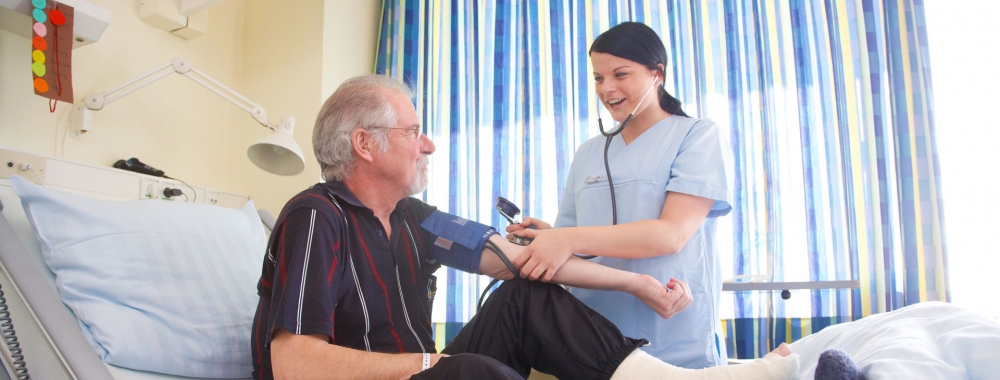
You are looked after around the clock. It is guaranteed that a nurse will be near you at any time of the day or night.
The day
Every working day on our wards begins with the handover of the nursing staff at 6.00 am. Here, the night shift reports to their colleagues on the early shift about their night. In addition, the details of the daily routine are planned and everything else that is important for your care is discussed.
Our day with the patients then begins at around 06.30 am. We administer medication, measure pulse, blood pressure and temperature and help with personal hygiene as required.
At 07.00 a.m., the daily ward round takes place with the ward physicians and the responsible senior ward physician. Please ask your questions about the course of treatment here.
Breakfast is served between 08:00 and 09:00. Afterwards, the dressings are changed together with the ward physicians and decisions are made about further individual treatment and care measures.
Lunch is served at around 12.00 noon. Various types of food are offered, which are adapted to the respective clinical pictures. It goes without saying that diabetics receive a suitably prepared diabetic diet. Please inform us of any special diets when you are admitted as an inpatient. Dietary advice is also available. If you do not have to restrict your diet due to illness, you can choose what you like best from our daily menu.
After lunch, you will have time to rest until we serve afternoon coffee or tea between 2.30 and 3.00 pm. In the meantime, the ward is handed over from the early shift to the late shift. In the afternoon, any bandages are renewed and any outstanding examinations are carried out. In the early evening, when things have calmed down a bit and the visitors have left the ward again, you will be served your evening meal at around 5.30 pm.
The night
The ward is taken over by the night shift at 8.30 pm. The night shift ensures your care together with the physician on duty. In addition, a senior physician is available on call at all times.
The day of the operation
You will have your last meal at 10.00 p.m. on the evening before the day of the operation. Drinking is usually possible until midnight. Anesthesia is only possible on the following day if you have not eaten or drunk anything before the start of the operation. Smoking is also strictly forbidden, as smoking a cigarette and chewing gum increase the risks of anesthesia.
When you wake up from the operation, you will be in the anesthesia recovery room. Here you will be observed until you have recovered sufficiently from the operation to be transferred back to our ward without risk. If your operation was a major and prolonged procedure, you may spend the night in the Intensive Care Unit 44 of the Clinical Department of Anesthesia, where a team of physicians and intensive care nurses will look after you around the clock. In most cases, however, we will inform you before the operation of the need for intensive care monitoring after the operation.
Discharge
Your discharge from our treatment must be decided by the head or senior physician. This decision is usually made the day before. Please do not be disappointed if we have prepared you for discharge but your findings, your wound or your constitution do not allow this on the day of discharge and we recommend that you remain under our care until you can go home without risk.
For organizational reasons, the time of discharge is between 11.00 am and 1.00 pm. You will then receive a detailed physician's letter from us for the colleague providing further treatment.
Parents and children
Of course, our youngest patients do not have to do without their parents during their inpatient stay. It is usually possible for one parent to stay in a room with the child.