History of
Milestones in nuclear medicine at the MHH
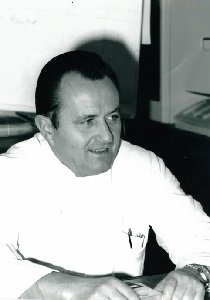
The history of nuclear medicine at the MHH begins in the winter semester of 1965/66, with the move of Prof. Dr. med. Dr. h.c. Heinz Hundeshagen moved from Marburg to Hannover Medical School, where he was entrusted with the establishment of a Department of Nuclear Medicine and Special Biophysics.
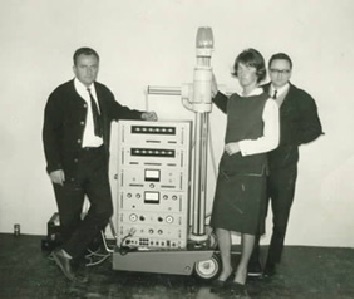
In 1968, Prof. Hundeshagen was appointed full professor and the independent "Clinical Department of Nuclear Medicine and Special Biophysics" was created.
In January 1973, the Triga Mark-I research reactor was put into operation in nuclear medicine. The reactor is used until 1996 for the production of radioisotopes, but also in cooperation with the University of Hanover for activation analyses in materials testing.
1974 a whole-body counter is installed, which is used for nuclear medical examinations, but also for incorporation measurements as part of radiation protection. The MHH has been the official measuring point for Lower Saxony since 2001. The whole-body counter, together with another partial-body counter, is now operated by the Radiation Protection / Medical Physics staff unit (headed by Prof. Dr. Dr. Lilli Geworski), which has been independent since 2011.
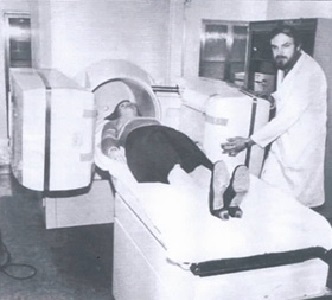
One of the first centers for positron emission tomography (PET) in Germany is established in the Clinical Department:
A cyclotron (Scanditronix MC35) for the production of short-lived PET radioisotopes is installed as early as 1976. This was followed in 1978 by a first-generation PET scanner (the so-called "Brownell camera") and in 1990 by the installation of a Siemens ring PET scanner. Since then, pioneering achievements have been made in the development of various PET radiopharmaceuticals and their application in medical clinics and research.
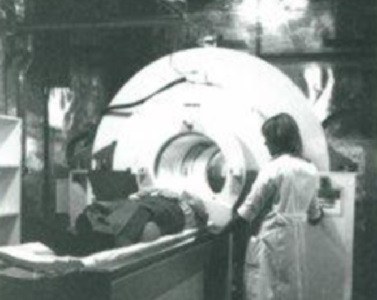
In 1983, the first clinical magnetic resonance tomograph (Siemens, 0.2 T) in Germany is installed in the nuclear medicine department at MHH. The MRI department was in operation until 1996 following its reinstallation in 1985. Since then, MRI at the MHH has been carried out entirely in the Institute of Diagnostic and Interventional Radiology and the Institute of Diagnostic and Interventional Neuroradiology.
Prof. Hundeshagen retires in March 1997. During his tenure, he was rector of the MHH several times. He was also the first President of the German Society of Nuclear Medicine (DGN), as well as founder and first Editor-in-Chief of the "European Journal of Nuclear Medicine".
(Link to DGN-Page "Personalities of German Nuclear Medicine - Prof. Dr. H. Hundeshagen")
Prof. Dr. med. Wolfram H. Knapp takes over as Director of the "Clinical Department of Nuclear Medicine" in May 1997.

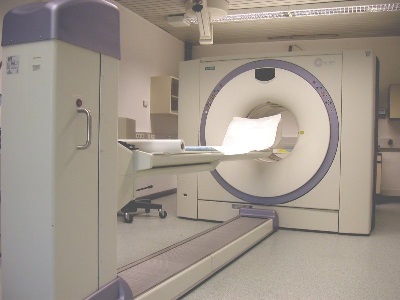
Under Prof. Knapp, so-called "hybrid imaging" is introduced into nuclear medicine diagnostics.
In 2004, a PET/CT system (Siemens Biograph Duo) is installed. A SPECT/CT system (Siemens Symbia T2) followed in 2006. Both cameras are operated in close cooperation with the Institute of Radiology.
Prof. Kanpp's work also focuses on the development of new nuclear medicine therapy procedures. For example, radioimmunotherapy for lymphomas and peptide receptor radionuclide therapy (PRRT) for neuroendocrine tumors are being introduced at the MHH. Pioneering work is also being carried out in the field of tumor therapy with alpha emitters.
In 2006, the MHH received approval to decommission the research reactor, which had already been shut down in 1996 and was subsequently decommissioned and completely dismantled by 2008.
Prof. Knapp is retiring at the end of December 2010. During his tenure, he was, among other things, the fifth President of the German Society of Nuclear Medicine (DGN) and President of the European Association of Nuclear Medicine (EANM).
(Link to DGN-Page "Personalities of German Nuclear Medicine - Prof. Dr. W.H. Knapp")
Prof. Dr. Frank M. Bengel takes up office as the third Director of the Clinical Department of Nuclear Medicine on 1.1.2011.