Acute pain service
The Clinical Department of Anaesthesiology and Intensive Care Medicine offers comprehensive pain therapy care for all patients at the Medical School through the facilities or institutions of the Acute Pain Service. The team of physicians and nursing staff develops specific pain therapy treatment concepts tailored to the individual needs of patients. State-of-the-art drug and non-drug treatment methods are used for this.
A particular focus here is the seamless care of patients undergoing surgery at the Medical School. From the first day in the Clinical Department, starting with the explanatory and informational discussions with the treating surgeons and anesthetists, through the operation and recovery phase to the days and weeks after an operation, the MHH acute pain service is available to patients and all treating disciplines with competent advice and goal-oriented selection of suitable therapy procedures.
When the anesthetic procedure is selected, the appropriate accompanying pain therapy procedure is also chosen and discussed in detail. In the case of standardized operations, comprehensive pain treatment is thus ensured at an early stage for the entire duration of the inpatient stay.
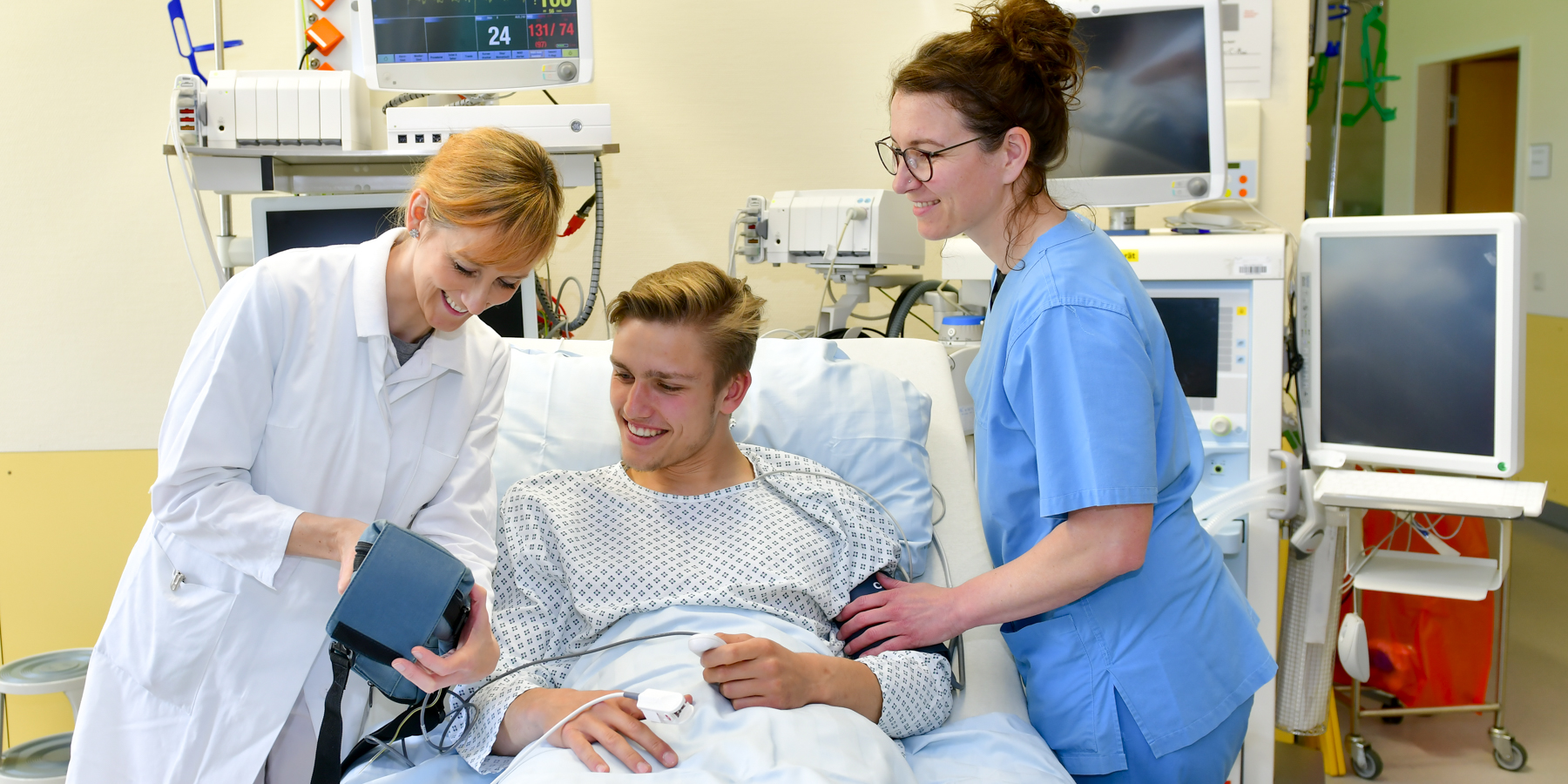
Pain can occur at any stage of treatment, be it surgery or any other treatment of a non-surgical nature.
For this reason, the MHH's acute pain service can be called in at any stage of treatment, even if pain occurs unexpectedly, so that new pain can be brought under control as quickly as possible during the course of treatment.
One of the most modern pain therapy procedures accompanying an operation is the use of "pain catheters". This refers to the insertion of local anaesthetic medication in the immediate vicinity of the nerves responsible for transmitting pain stimuli in a body region via special catheters. These catheters are already available for many operations. The pain medication is administered via special pumps, which are also programmed and supervised by the acute pain service in the form of daily visits to the patient's bedside. The focus here is on the daily adjustment of therapy to the patient's current situation.
Another benefit of daily visits to pain patients is the systematic collection of data. This includes, for example, the daily recording of the type, intensity and localization of pain. All data collected during the course of pain therapy is stored and can be used to answer scientific questions, both for established therapies and for the development of new pain therapy strategies, while maintaining patient anonymity. Since 2015, the MHH - coordinated by the Acute Pain Service - has been participating in a multicenter, interdisciplinary benchmark project to improve acute pain therapy in surgical centres/hospitals
(QUIPS - Quality Improvement in Postoperative Pain Therapy). The aim is to gradually improve pain therapy in medical care facilities by continuously collecting anonymized data that reliably reflects the quality of pain therapy care through a national and international comparison platform. The acute pain therapy nursing team makes a sustainable and future-oriented contribution to this.
In this way, the acute pain service at the MHH also contributes to the continuous improvement of existing therapy options and research into new treatment methods.
Contact:
E-mail: Anaesthesiologie.ASD@mh-hannover.de