
More news on the homepage
Bringing movement into cancer prevention
The MHH is participating in the EU PIECES project and aims to reduce the risk of cancer and improve liver health with personalized exercise programs.
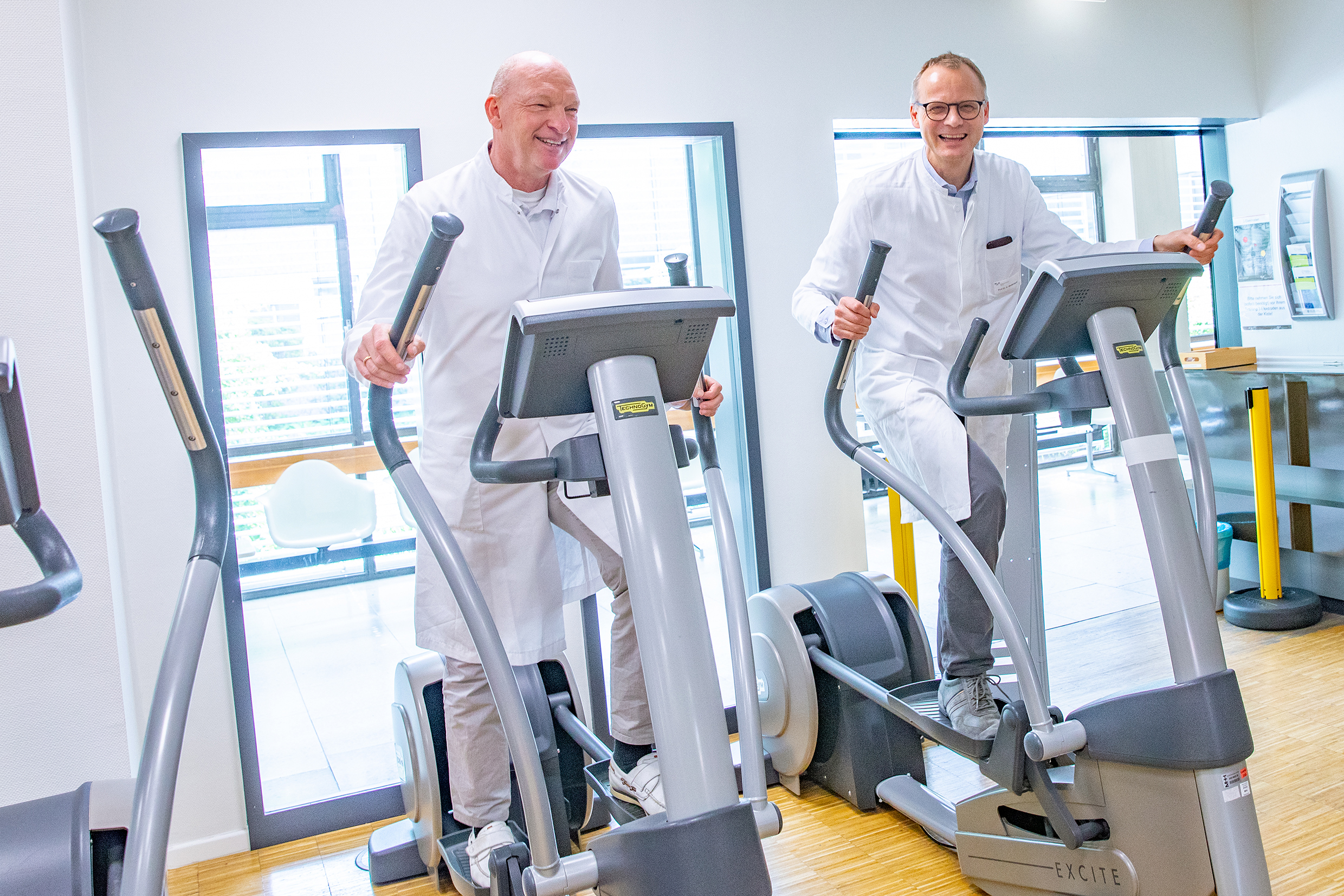
Around three million people in the European Union are affected by cancer. For 1.34 million of them, the disease is fatal. However, around 40 percent of cancer cases could be prevented through effective prevention strategies such as a healthier lifestyle and early detection. In order to achieve this, the EU has launched the "Mission Cancer" funding line, which supports cancer prevention projects. One of these is the PIECES project, a consortium of 16 members from ten EU countries, in which Hannover Medical School (MHH) is also involved with the Clinical Department of Gastroenterology, Hepatology, Infectious Diseases and Endocrinology and the Department of Rehabilitation and Sports Medicine. The aim is to investigate why existing effective cancer prevention programs often fail when implemented in everyday life and how they can be better adapted to people's needs and national conditions. The EU is now funding the project over four years with a total of 6.9 million euros. The MHH will receive around 680,000 euros of this.
Toolbox for personalized fitness programs
"We have many good primary cancer prevention programs in the EU, but unfortunately they don't always work everywhere," says Prof. Dr. Heiner Wedemeyer, Director of the Clinical Department of Gastroenterology, Hepatology, Infectious Diseases and Endocrinology. The PIECES project offers the opportunity to test the wide range of preventive measures, the effectiveness of which has already been proven in controlled environments, under real-life conditions. Sub-projects are concerned with improving the following risk factors: tobacco and alcohol consumption, lack of exercise, infections with human papilloma viruses (HPV), UV exposure and nutritional factors. The MHH sub-project focuses on exercise in connection with liver health.
"Sufficient physical activity not only reduces the risk of cardiovascular disease, but also of chronic inflammation, which increases the risk of a variety of cancers," explains Prof. Dr. Uwe Tegtbur. The sports physician has already proven this in several studies. "In a collaboration with Volkswagen AG and employees of the MHH, we were able to show in the context of workplace health promotion that personalized fitness programs could reduce fitness and body weight and thus also health risk factors such as body fat, high blood pressure and blood sugar levels and improve mental stress and liver health," says the Director of the Clinical Department of Rehabilitation and Sports Medicine. This approach is now to be transferred to a digital platform and, as a toolbox, contain all the tools that can be used to put together programs tailored precisely to individual needs. These include digital questionnaires to record the health and lifestyle situation and wearables that measure and display performance and progress in movement and activity. "In this way, we achieve individual support that is independent of time and location, which meets participants exactly where they are and motivates them to actively improve their health situation," says the sports physician.
Non-alcoholic fatty liver disease increases cancer risk
The physicians want to focus specifically on liver cancer prevention. "In Germany alone, around 20 million people have a non-alcoholic fatty liver, mostly due to severe obesity," says Professor Wedemeyer. If left untreated, non-alcoholic fatty liver disease (NAFLD) can develop into inflammation. This in turn can lead to an excessive proliferation of connective tissue cells in the liver (fibrosis) and ultimately scarring of the liver tissue. Such liver cirrhosis increases the risk of tumor formation. "In the case of non-alcoholic fatty liver inflammation, however, liver cell cancer can also occur before cirrhosis is present, which is why we need to intervene as early as possible," emphasizes the gastroenterologist. "And if people get enough exercise, their liver values will also improve." The combination of precisely tailored exercise training, preventive examinations and medical advice should help to reduce the increasing number of NAFDL cases and thus also reduce the risk of cancer.
To ensure that the approach not only works in Germany, but is also transferable internationally, PIECES is investigating a package of measures on various cohorts throughout Europe. "In the end, our toolbox should be combinable according to the modular principle so that the right prevention program can be put together for every person, regardless of gender, nation, physical condition and living situation," says Professor Tegtbur.
Text: Kirsten Pötzke