
More news on the homepage
Making immunotherapy against bile duct cancer more effective
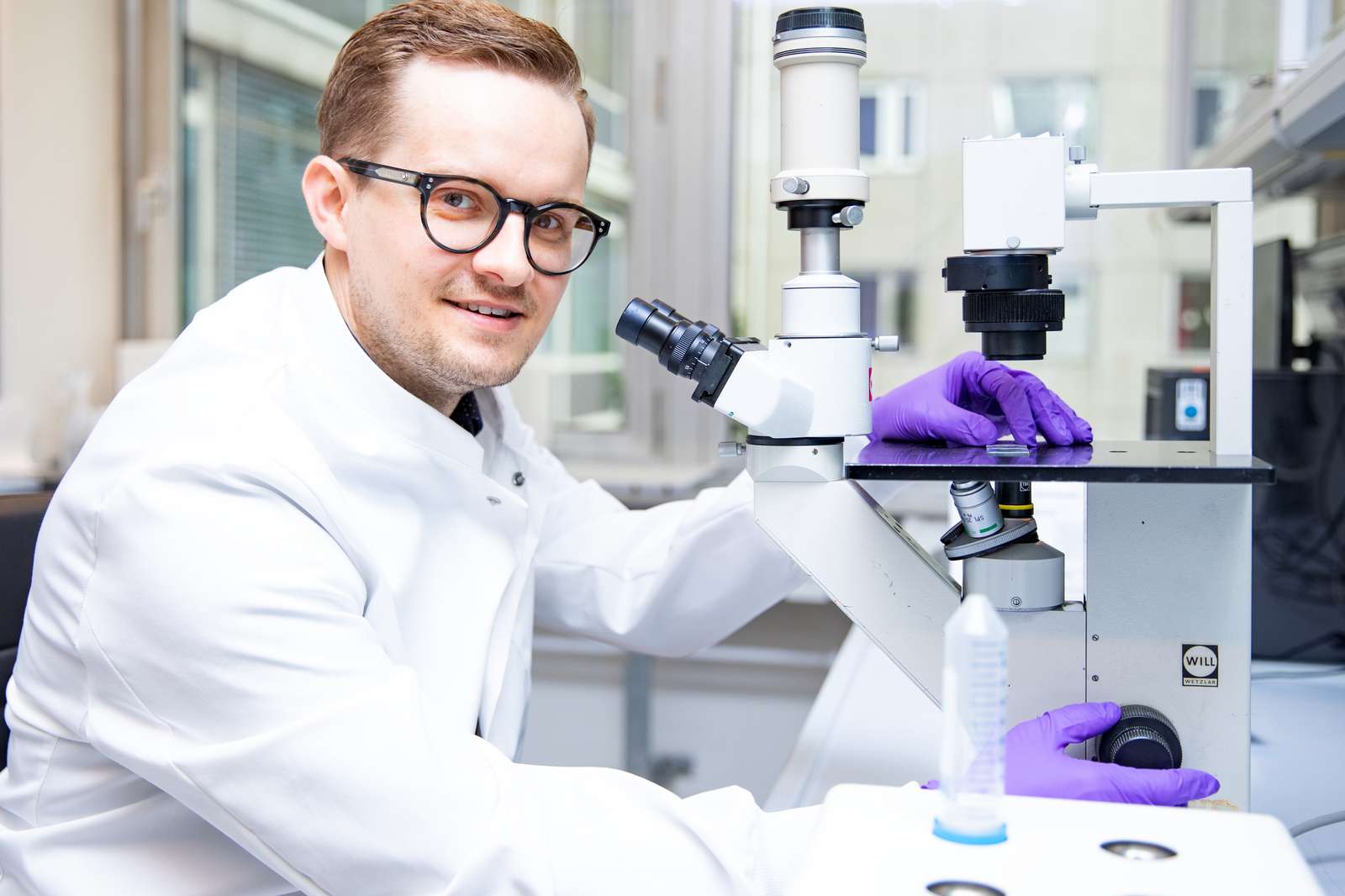
MHH gastroenterologist Dr. Bernd Heinrich investigates how bacteria and immune cells exchange information in the tumor environment. The Else Kröner-Fresenius Foundation has awarded him a memorial fellowship worth 250,000 euros.
Bile duct cancer is a rare but serious disease that is usually fatal. Known technically as cholangiocarcinoma (CCA), it can affect the bile ducts inside and outside the liver. The frequency of cases is increasing worldwide and the chances of recovery are considered poor. If the tumor is completely removed by surgery, there is a chance of recovery, but the cancer is usually only discovered late. In advanced tumor stages, cancer medicine relies on chemotherapy and, more recently, also on immunotherapies. However, the response rates are still low. The immediate area around the cancer site, the so-called tumor microenvironment, apparently plays an important role. This is where cells of the innate immune system and bacteria interact with each other. How this influences the course of the disease is still largely unknown.
This is where Dr. Bernd Heinrich, assistant physician at the Clinical Department of Gastroenterology, Hepatology, Infectiology and Endocrinology at Hannover Medical School (MHH), wants to start. Using modern sequencing methods, he and his team want to investigate the network of innate lymphoid cells (ILCs) and bacteria in bile duct cancer and its microenvironment. The new findings should help to improve the effect of immunotherapies. The Else Kröner-Fresenius Foundation has awarded the scientist the Memorial Scholarship for particularly talented young physicians and is funding the project with 250,000 euros over two years.
Three different CCA subgroups
Depending on its location in relation to the liver, bile duct cancer is divided into three subgroups, which also differ genetically from one another. "In various studies, we have already identified certain bacterial compositions in the bile or stool of patients with CCA," says Dr. Heinrich. "We were able to see that the bacterial composition differs between the three subgroups, which obviously influences the course and prognosis of the disease." This is because the bacteria not only play a role in the repair of the bile ducts, but can also trigger infections, which in turn promote uncontrolled growth of the bile ducts. At the same time, the tumor microenvironment also contains cells of the innate immune system, the first line of defense of our body's immune system. These ILCs influence the immune response against tumors and interact with the bacteria.
Determining bacterial flora
In preliminary studies on patients with liver cancer, Dr. Heinrich has already established that a change in the intestinal microbiome after the use of broad-spectrum antibiotics influences the growth of liver cancer and liver metastases. "We assume that ILCs play a crucial role in tumor immunity and are important regulators in the tumor microenvironment in CCA," says the physician. "We want to understand how the ILCs interact with the bacteria inside and outside the tumor and what influence this has on the development of the disease." ILCs react very quickly when their environment changes. This may also happen if, in addition to the local bile duct bacteria, other bacteria from the adjacent intestine migrate into the liver.
Dr. Heinrich wants to isolate the ILCs from surgically removed CCA tissue from the three tumor subgroups. "We use these to produce sections, which we also examine for bacteria and compare with healthy controls." In addition, oral and rectal swabs taken before the operation will provide information about the bacterial flora of the patients and the relationship between the microbiota in the intestine, liver and bile ducts. The analysis of the bacterial composition from the tissue samples and swabs is carried out in cooperation with the Comprehensive Cancer Center Lower Saxony (CCC-N).
Investigating the influence of antibiotics
"Our aim is to identify certain subgroups of ILCs, bacteria or their metabolic products, which can then be used to improve the immune response against the tumor," explains Dr. Heinrich. "So far, we have been treating the three subtypes in the same way, which is probably not correct These new therapeutic approaches will then be tested in tissue models and compared with the immunotherapy currently used. The aim is to develop new treatment combinations for optimized immunotherapy of bile duct cancer.
The researchers also want to investigate the effects of antibiotics prescribed for chronic inflammation of the bile ducts, which increase the risk of developing cholangiocarcinoma. "We want to find out whether strong broad-spectrum antibiotics are more likely to prevent tumor development because they fight inflammation or whether they actually promote cancer by adversely altering the mirobiome," says the gastroenterologist. "Ultimately, our investigations will take us a step closer to personalized medicine and precision oncology."
Text: Kirsten Pötzke