
More news on the homepage
New weapon against hepatitis D
The way is clear for drug therapy for this particularly aggressive liver disease.
Status: June 22, 2023
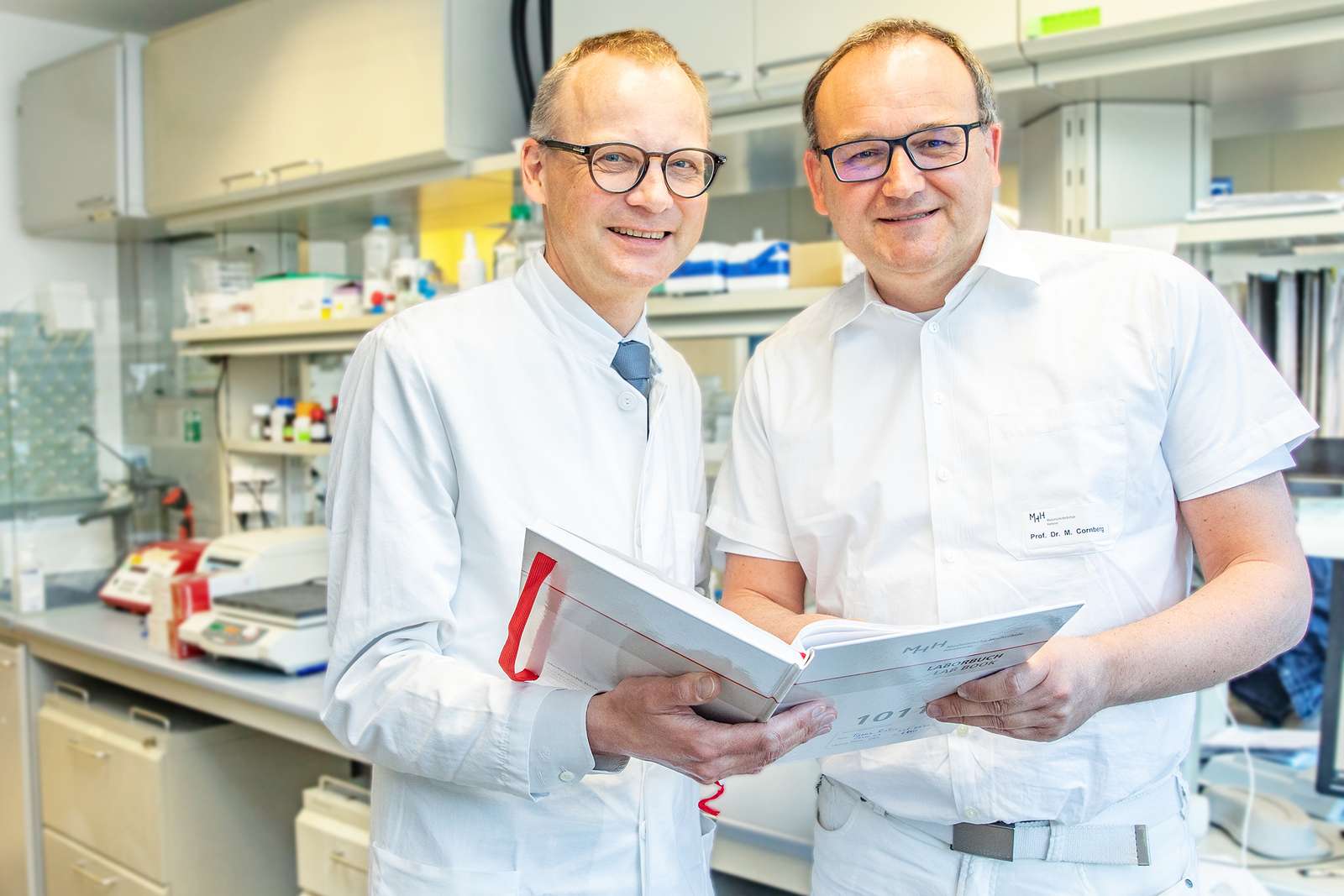
Infection with hepatitis D viruses (HDV) causes the most severe form of chronic viral hepatitis disease. Around ten to 20 million people worldwide are affected. The disease is currently incurable, and the only treatment option is often a liver transplant. However, the way is now clear for treatment with an effective drug. In a multicentre study with 150 participants, an international research team led by Prof. Dr. Heiner Wedemeyer and Dr. Markus Cornberg from the Clinical Department of Gastroenterology, Hepatology, Infectious Diseases and Endocrinology at Hannover Medical School (MHH) was able to prove that the active substance Bulevirtide significantly reduces the viral load in blood serum and liver and normalizes liver inflammation levels in many cases. "This means that the requirements for full approval of the drug have been met and we can finally provide all treating physicians with a sharp sword against hepatitis D," says Clinic Director Wedemeyer, who led the clinical development of the drug. The study was published in the internationally renowned medical journalNew England Journal of Medicinepublished.
Particularly aggressive virus
HDV is an incomplete virus and needs the hepatitis B virus (HBV) as a helper in order to package its RNA genetic material in its envelope, dock onto the liver cell and penetrate it. A hepatitis D infection therefore only occurs as a co-infection with a hepatitis B infection. To date, neither hepatitis B nor hepatitis D can be cured. There is a preventive vaccination. However, this no longer helps people who are already infected. HDV also accelerates the course of the disease, while the infectious disease hepatitis D is considered to be particularly aggressive and can quickly lead to liver cirrhosis or liver cancer. "We therefore also call hepatitis D the devil variant because it is so diabolical and malignant," says Clinic Director Wedemeyer.
Based on the positive results of an earlier study, the European Medicines Agency (EMA) had already provisionally admitted the drug. "This is extremely unusual because the requirements for full approval are only met with the clinical phase 3 trial. This shows how urgently an effective drug is needed for this serious liver disease," emphasizes the liver expert. In the current study, the drug was tested on a larger number of patients to see whether its efficacy and safety could be confirmed in a large number of different patients. Possible interactions with other medications were also investigated.
Entry into liver cells blocked
Bulevirtide was developed at Heidelberg University Hospital and the German Center for Infection Research (DZIF). The drug blocks the docking point for the HBV envelopes on the liver cell. As this is now occupied, the HD viruses can no longer enter the cell. Patients who are already infected also benefit from this: the drug protects the newly formed liver cells from HDV infection, while at the same time cells that are already infected are destroyed by the immune system. The virus is thus deprived of its basis for existence, as it always has to infect new liver cells in order to persist in the body.
"We tested the antiviral activity on 150 patients who were infected with both HBV and HDV," says Professor Cornberg. "Almost half of them had already developed liver cirrhosis, i.e. scarred liver tissue." Those affected were injected daily with the drug under the skin. The treatment was administered for a total of 144 weeks in the study. The "primary endpoint" is now being reported after 48 weeks of treatment, i.e. the time at which the treatment goal has been achieved. The results of the phase 3 study show that the concentration of HDV RNA in the blood serum and liver decreased significantly. "We also found that the liver values improved significantly in most cases," says the hepatologist and infectiologist. The course of the disease will show how long the patients will ultimately need to be treated. The researchers working with Professor Wedemeyer and Professor Cornberg are also investigating this in the EU-funded research project D-Solve. What is already important: "Prolonged therapy is not a problem because the drug has hardly any side effects and is very well tolerated overall," emphasizes Professor Wedemeyer. "Bulevirtide is a real game changer. We now expect to receive full approval from the European Medicines Agency in the near future."
Text: Kirsten Pötzke