
More news on the homepage
Fighting liver cancer with ultrasound
The MHH enters into a clinical partnership with Uzbekistan and supports a training program for sonography diagnostics of hepatocellular carcinoma (HCC).
Status: May 17, 2023
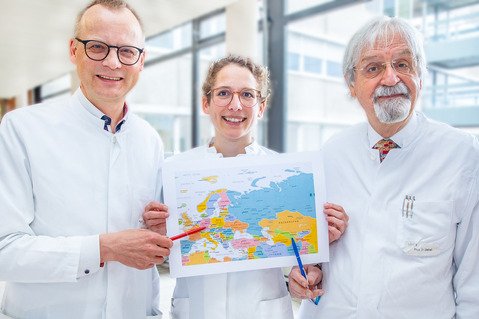
Conducting joint research into viral hepatitis while improving healthcare in the partner country is the aim of a new partnership between Hannover Medical School (MHH) and the leading infectious diseases clinic in Uzbekistan. The Clinical Department of Gastroenterology, Hepatology, Infectious Diseases and Endocrinology is cooperating with the Medical Clinic of the Institute of Virology and the Scientific Research Institute of Virology (SRIoV) in Tashkent. The Deutsche Gesellschaft für Internationale Zusammenarbeit (GIZ) is supporting the PLUTHO project (Prevention of virus-induced Liver Cancer in Uzbekistan: The Tashkent-Hannover-Liver-Network) for two years with 300,000 euros. One focus is the establishment of a structured ultrasound training program for the early detection of liver cancer for Uzbek physicians by the MHH Clinical Department. In addition, both clinic partners want to improve the diagnosis of infections with hepatitis viruses and find new biomarkers for the individual risk of liver cancer.
Hepatitis D infections increase the risk of hepatocellular cancer
"Chronic viral infections of the liver are a major health problem in Uzbekistan," says Prof. Dr. Michael Gebel. The senior physician for ultrasound at the MHH Clinic has been in contact with colleagues in the Central Asian republic for years and initiated the Clinical Department partnership. "While infections with hepatitis viruses are rather rare in Germany, around one in ten people there are affected by chronic viral hepatitis," explains the gastroenterologist. Infections with the hepatitis B virus and co-infections with the hepatitis D virus are among the most common liver infections. And these significantly increase the risk of hepatocellular carcinoma (HCC). Cirrhosis of the liver or liver cancer are therefore among the most common causes of death.
Ultrasound training at the MHH and in Tashkent
This is now set to change. The solution is ultrasound. "HCCs are very easy to treat if we can detect them early enough using sonography," says assistant physician Dr. Lisa Sandmann, one of the project's lead scientists. However, this requires not only modern equipment, but also qualified personnel. The MHH will therefore be sending ultrasound experts to Tashkent for four further training courses to train colleagues there. Physicians will also be invited to the MHH for training in ultrasound diagnostics. "We want to train multipliers in our Clinical Department who will then pass on their knowledge at home, creating a culture of further education and training," explains Dr. Sandmann.
The joint research activities focus on the development of test procedures to determine the viral load in hepatitis D infections and the identification of biomarkers for the early detection of HCC. "The SRIoV is a renowned research institution in the field of viral hepatitis and the implementation of clinical studies," emphasizes Professor Gebel. The MHH has a leading position worldwide in the field of chronic liver diseases. Nevertheless, the university with its focus on infection research benefits from the samples from the Uzbek patient cohort. "We believe that the new cooperation will also provide excellent support for existing projects at our site," says Clinic Director Prof. Dr. Heiner Wedemeyer.
Cooperation is politically justifiable and ethically necessary
Liver expert Wedemeyer does not see any problems with the political situation in the Central Asian country, which is formally a presidential republic. "Although the country is not a democracy comparable to EU states, the GIZ, with its clear guidelines regarding the political justifiability of its funding lines, has clearly endorsed this cooperation," emphasizes the gastroenterologist. "We also consider it necessary to maintain contact with Uzbekistan and help the people there for medical and ethical reasons alone."
The funding for the development of the PLUTHO Clinical Cooperation will initially run for a period of two years and is intended to establish long-term cooperation between the clinics.
Text: Kirsten Pötzke