MHH project "COVID-19 cohort" helps to clarify the risk of disease
What factors are responsible for the fact that some people become seriously ill after being infected with the SARS-CoV-2 coronavirus, while others only develop mild symptoms or none at all? Scientists in an international consortium called the "COVID-19 Host Genomics Initiative" are investigating this question. In addition to smoking and obesity as risk factors for a severe course of COVID-19, the research team has also found genetic factors in the human genome that appear to play an important role. Hannover Medical School (MHH) is also involved in the global collaboration. It has contributed biosamples and data from its "COVID-19 cohort", a research project funded by the Lower Saxony Ministry of Science and Culture (MWK) with more than two million euros. The first results from the global research network's investigations have now been published in the journal Nature.
Data from Hanover for global study
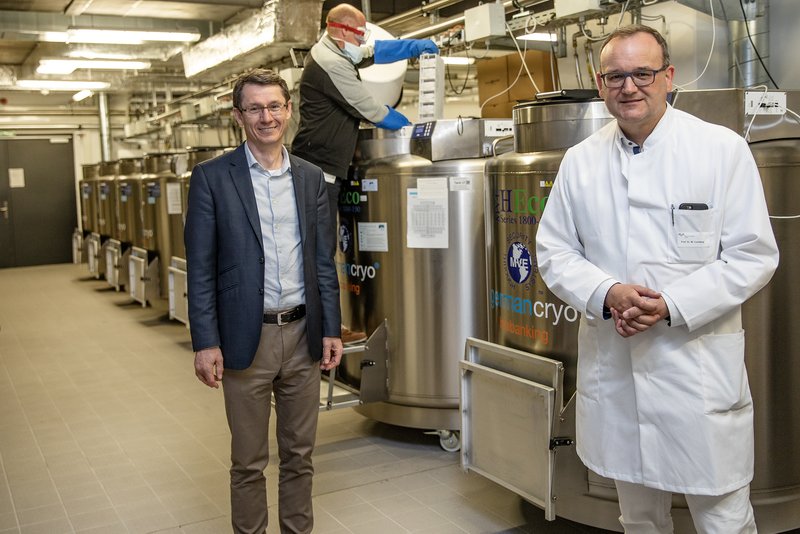
Biosamples and data from the "COVID-19 cohort", which have been collected and compared since March 2020 from patients with varying degrees of coronavirus SARS-CoV-2 as well as control samples from people with other respiratory diseases from various MHH clinics and the Hannover Region Clinical Department, come from the MHH. The COVID-19 Biobank is housed in the Hannover Unified Biobank (HUB). "The HUB meets the high safety requirements for processing and storing the biosamples," emphasizes Prof. Dr. Thomas Illig, Head of the HUB. For its analysis, the "COVID-19 Host Genomics Initiative" has compiled clinical and genetic data from almost 50,000 patients worldwide who have tested positive for the virus, as well as from two million control subjects from numerous biobanks and clinical studies.
Genetic starting points for new therapeutic strategies
"Analysis of the genetic data revealed 13 sites in the human genome that are strongly associated with infection or severe courses of COVID-19," explains Prof. Dr. Markus Cornberg, Deputy Director of the MHH Clinical Department of Gastroenterology, Hepatology and Endocrinology and Director of the Centre for Individualised Infection Medicine (CiiM), who is responsible for the clinical processing of the samples stored at the HUB. Some of these gene loci are apparently also associated with autoimmune diseases, lung cancer or pulmonary fibrosis, a pathological proliferation of connective tissue, which then hardens and scars (fibrosis) and leads to shortness of breath. "These results could help to find targets for future therapies," says the infectiologist. And this is urgently needed. Although vaccines offer protection against infection with SARS-CoV-2, there is still considerable room for improvement in COVID-19 treatment.
The "COVID-19 Host Genomics Initiative" is one of the most extensive collaborations in human genetics and currently comprises more than 3,500 authors of 61 studies from 25 countries. In addition to the Hannover Unified Biobank (HUB) and the MHH Clinics of Gastroenterology, Hepatology and Endocrinology, Pneumology, Clinical Department of Rheumatology and Immunology, as well as the COVID outpatient clinic, the Hannover Region Clinic, the Centre for Individualised Infection Medicine (CiiM) and the Helmholtz Centre for Infection Research are also involved in the Hannover COVID-19 Cohort project.
SERVICE
For further information, please contact Prof. Dr. Thomas Illig illig.thomas@mh-hannover.de, phone (0511) 5350-8450 and Prof. Dr. Markus Cornberg at cornberg.markus@mh-hannover.de, phone (0176) 1532-6821.
The original paper "The COVID-19 Host Genetics Initiative. Mapping the human genetic architecture of COVID-19" can be found here.