Announcements
Institute for Ethics, History and Philosophy of Medicine
We're looking for new team members!
The Institute for Ethics, History, and Philosophy of Medicine has two openings for research associates in the field of ethics, artificial intelligence, and healthcare. The first position is part of the EU-funded PREPAIR-VAC project, which focuses on AI-supported methods for vaccine development. The second position focuses on the responsible use of generative AI in the context of healthcare. We look forward to receiving your applications through the MHH Career Portal!
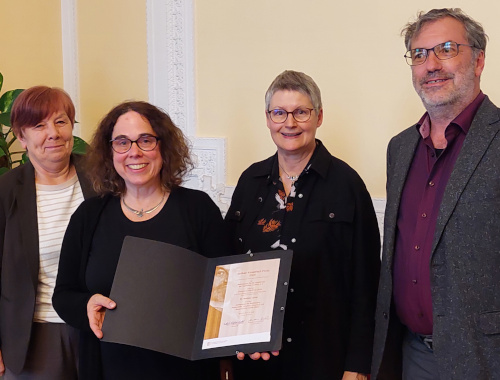
Wiebke Lisner Awarded the Arthur Kronthal Prize
PD Dr. Wiebke Lisner received the Arthur Kronthal Prize on September 18, 2026. The Kommission für die Geschichte der Deutschen in Polen e.V honored her book "Hebammen im Wartheland. Geburtshilfe zwischen Privatheit und Rassenpolitik, 1939-1945" (Midwives in the Wartheland: Obstetrics Between Privacy and Racial Policy, 1939–1945) as the “best publication in her field of work in 2024 and 2025.” The award ceremony took place at the German Historical Institute in Warsaw. The certificate was presented on behalf of the board of the Kommission für die Geschichte der Deutschen in Polen e.V. by Prof. Dr. Krystyna Radziszewska (University of Łódź), Prof. Dr. Isabel Röskau-Rydel (University of Kraków, 1st Chair), and Matthias Barelkowski, M.A. (2nd Chair).
Interview with Sabine Salloch: "AI cannot take responsibility"
In a recent interview with the German daily "Süddeutsche Zeitung", Sabine Salloch discusses the use of artificial intelligence in medicine. Among other things, she points out that responsibility still lies with human actors and that the AI learns from training data that reflects human decisions. She also comments on the transformation of the physician’s role in the face of increasingly powerful information technology systems.
Remembrance project "The empty consulting room"
Report on a project that focuses on the experiences of Jewish physicians who returned to Germany after the Second World War
Interview with Wiebke Lisner and Jonathan Voges
How Germany and the world prepared for the pandemic
„Die Verantwortlichen gingen davon aus, dass es ganz schrecklich werden würde“ by Berit Uhlmann, published on 9 October 2025 in Süddeutsche Zeitung
Planetary health and research ethics: a new field of work for medical ethics
Since 2013, the ethical requirement that ecological sustainability should be taken into account in medical research has been included in the Declaration of Helsinki. To date, however, there have only been a few medical ethics analyses on the question of concrete implementation. A new Target article in the high-ranking American Journal of Bioethics analyzes the multiple ethical dimensions at the intersection of research and environmental protection, with particular attention to questions of social value. Concrete proposals are made for the inclusion of sustainability aspects in research ethics assessments.
Pranab Rudra wins AEM Young Scientist Award
October 2024
Pranab Rudra, research associate at the Institute of History, Ethics and Philosophy of Medicine, was awarded the Young Researcher Award for the best presentation at the 2024 Annual Meeting of the Academy of Ethics in Medicine. He received the prize for his presentation "Supporting informed consent through AI chatbots".
Artificial intelligence in healthcare
April 2024
In spring 2024, the Institute is organizing a series entitled"My physician, AI and me". In several meetings, citizens and physicians will discuss artificial intelligence in healthcare. The project is funded by the Lower Saxony Ministry of Science and Culture as part of the "Discourses on the Future" program.
New publication: Climate change and professional ethics
October 2023
In their new article, Henk Jasper van Gils-Schmidt and Sabine Salloch further develop the approach to professional ethics presented last year and now relate it to the topic of medical responsibility in the face of climate change. With the help of Christine Korsgaard's theory of practical identities, they show that the goal of ecological sustainability should be the subject of medical action and professional ethics. The article was accepted as a "Feature Article" and will be accompanied by a commentary process.
DFG network "Digital Bioethics"
June 2023
The German Research Foundation (DFG) is funding the "Digital Bioethics" scientific network (spokesperson: Prof. Dr. Dr. Sabine Salloch) for three years from October 2023. In recent years, information technology and data science approaches have become increasingly important for dealing with medical and bioethical issues and practical fields of applied ethics. The network comprises 14 international experts from bioethics and related scientific fields. The aim of the collaboration is to coordinate the emergence of new research directions and to develop solutions for the responsible use of information and data science methods in ethics.
Frank Ursin receives EACME Collaboration Award for "Digital Bioethics"
February 2023
The European Association of Centres of Medical Ethics (EACME) has awarded start-up funding to three scientists from Germany and Poland. Bioethicists Dr. Frank Ursin from Hannover Medical School, Dr. Cristian Timmermann from the University of Augsburg and Prof. Dr. Tomasz Żuradkzi from the Jagiellonian University in Krakow will use the €1,000 Collaboration Award to plan a joint research project.
The content of the research project will be dedicated to the new field of digital bioethics. Entitled "Data literacy and digital tools for bioethical research", the project aims to make an innovative contribution to the methodological development of bioethics researchers. As more and more empirical and conceptual bioethical research is confronted with large amounts of data, data literacy and digital methodological knowledge are becoming increasingly important. However, digital and data-supported research methods are hardly widespread in bioethics.
This gap is to be closed by first identifying framework concepts for data literacy and digital tools that are already established in other disciplines such as the digital humanities. Subsequently, an empirical survey will be conducted to determine how these digital tools are currently used by bioethicists internationally. The aim of the project is to lay the foundations for the preparation of structured training for bioethicists in order to increase their data and methodological competence.
Obituary for Prof. Dr. med. Wolfgang U. Eckart
August 2021