Doctoral program GESA (2013 - 2016)
As part of the doctoral program funded by the Lower Saxony Ministry of Science and Culture
Health related care for a self-determined life in old age: Concepts, users' needs and responsiveness of the health care system from a public health perspective - GESA -
Health related care for a self-determined life in old age - Theoretical concepts, users' needs and responsiveness of the health care system
15 Georg-Christoph-Lichtenberg doctoral scholarships were awarded from 01.10.2013 to 30.09.2016.
The doctoral program was carried out by the Hannover Medical School in cooperation with the University of Osnabrück, the Jade University of Applied Sciences Wilhelmshaven Oldenburg Elsfleth, Oldenburg and the Helmholtz Centre for Infection Research in Braunschweig.
Prof. Dr. Ulla Walter and Prof. Dr. Marie-Luise Dierks were in charge of the project. Dr. Martina Plaumann was responsible for the scientific coordination.
Background and objective
Current developments in the healthcare of the population must be reflected against the background of the demographic transition and the associated health restrictions of an ageing population (chronic illnesses, multimorbidity) as well as medical-technical developments and, at the same time, increasingly discussed financial restrictions. Health-related care includes not only medical care in the narrower sense, but also all services provided by professionals in the healthcare sector as well as services outside the healthcare sector and the involvement of non-professionals. In recent decades, traditional role patterns of professionals and users have changed in the direction of more participation and informed decision-making by those affected. The deficit-oriented view of ageing has also changed to a more differentiated and, in particular, resource-oriented view, which is accompanied by a change in images of ageing.
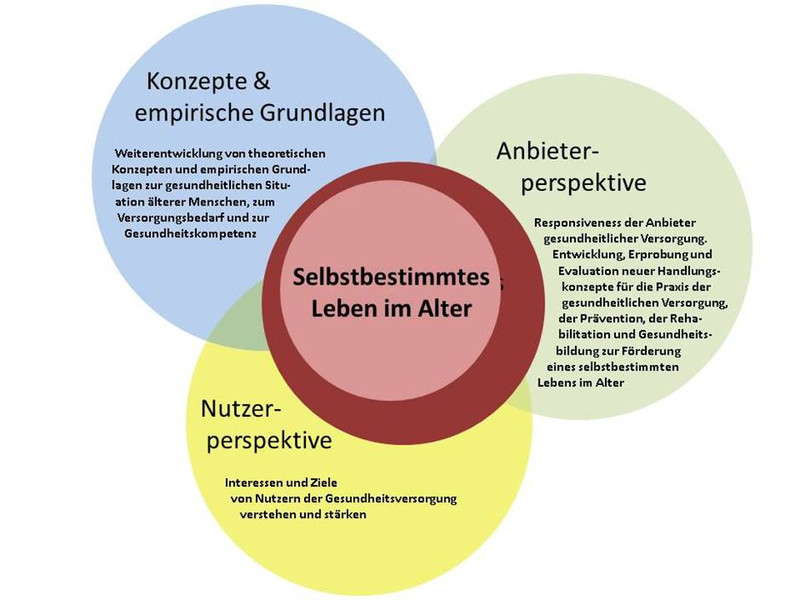
The aim of the program was to process and further develop existing theoretical concepts and empirical foundations, to analyze the responsiveness of providers of health-related care, to survey the needs and goals of users and to develop action concepts for a self-determined life in old age. When considering old age, the program assumed that ageing is a fluid process; apart from the socio-political definition of retirement age, it is not possible to clearly define when old age begins. Strategies for a self-determined life in old age begin in the so-called middle years.
The special feature of the doctoral program was a research framework that dovetailed different perspectives in all projects (see illustration). All research topics were implemented in such a way that the theories and concepts, the provider and the user perspective were each taken into account, whereby the emphasis could differ.
The doctoral program extended over a period of three years (2013-2016). During this time, the students worked on their own research projects. The program was accompanied by subject and method-related seminars, lectures and colloquia. The languages of instruction were German and English. All accompanying courses were compulsory; in exceptional cases, doctoral candidates with relevant knowledge from previous study programs or professional experience could be exempted from participation after consultation with the supervisor and the responsible committee. This did not apply to the courses on counseling and support, key qualifications and supervised teaching activities.
At the beginning of the structured training, the theoretical and methodological foundations for the successful completion of one's own research were laid in the first semester. In the following semesters, these foundations were deepened, and the doctorate-related offers were designed in such a way that intensive and tailor-made support for the doctoral candidates was possible. In addition, students on the program were systematically encouraged to present their (partial) results at scientific conferences, to write their own articles and research proposals and to play an active role in teaching courses.