Hyperpolarization MRI
Conventional magnetic resonance imaging is limited in its spatial and temporal resolution due to the low signal strength of magnetic resonance compared to unavoidable noise signals. This applies in particular to the imaging of substances with low concentrations in living tissue, such as metabolic intermediates.
One of the reasons for this is the low polarization, i.e. alignment of the nuclear spins in a preferred direction parallel to the main magnetic field of the MRI, to which the measurable MR signal is proportional. For example, in the case of hydrogen protons in a clinically used magnetic field of 3T at 37°C, only about every 100,000th hydrogen proton contributes to the MR signal.
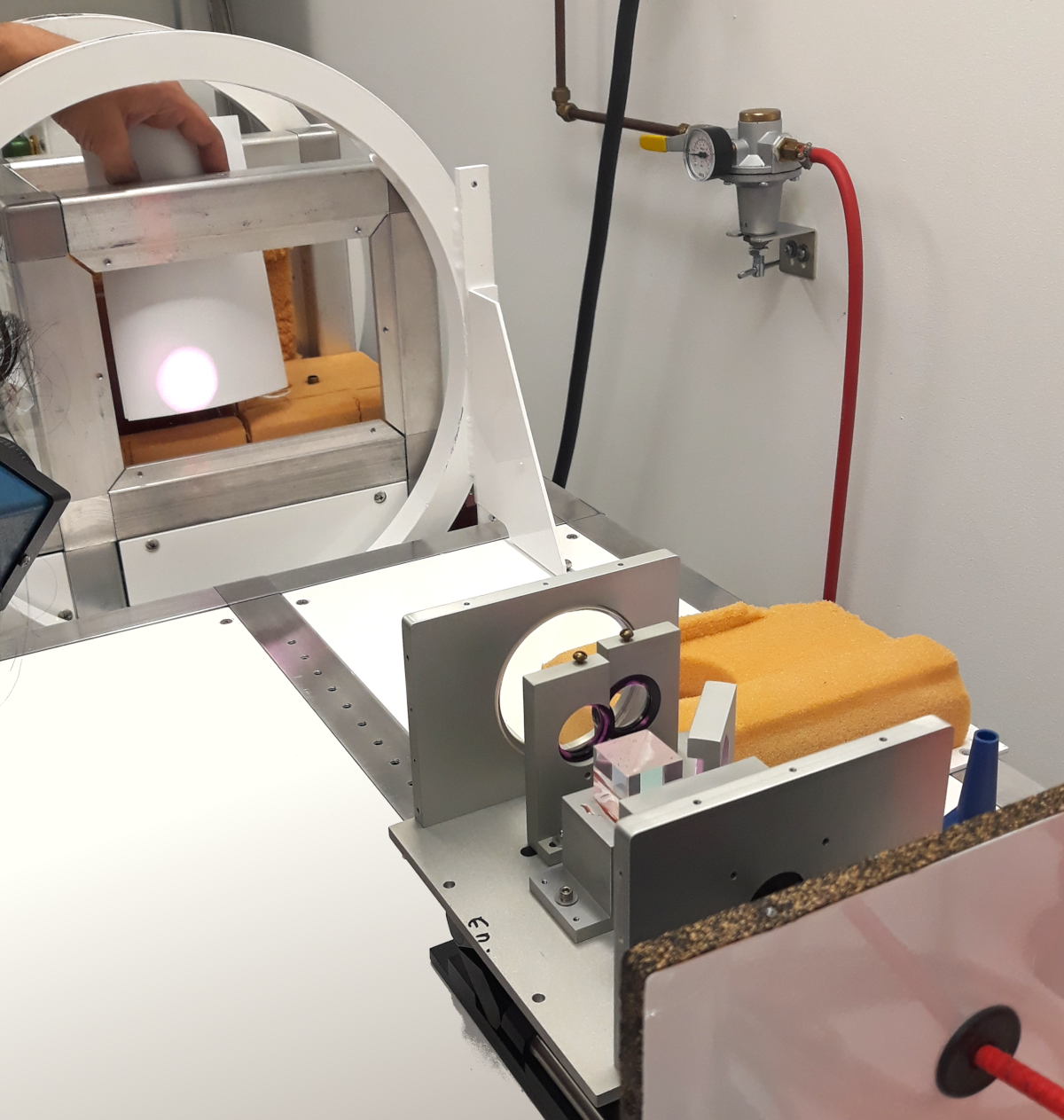
Research in the field of hyperpolarization has shown several possibilities to increase the polarization of substances outside the MRI by many orders of magnitude, for example to be able to display them as a detection substance after inhalation or injection. Together with the Fraunhofer Institute for Toxicology and Experimental Medicine (ITEM), the Institute of Diagnostic and Interventional Radiology operates a hyperpolarizer for the atomic nucleus xenon-129, which is based on the principle of optical pumping of rubidium by circularly polarized laser light with subsequent spin exchange.
The Hannover site is one of the few in Europe where hyperpolarized xenon-129 can be used to produce a hyperpolarized medium for use in humans for research purposes. A 1.5T and a 3T MRI are available at the CRC Hannover for measurements on test subjects and patients; 2 3T MRIs and a 1.5T MRI are also equipped at the MHH for recording hyperpolarized MRI images.
Functional lung MRI
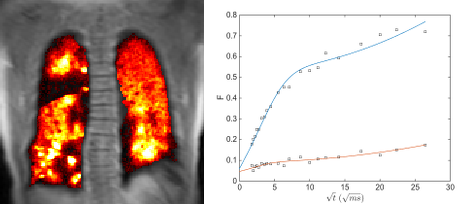
After the inhalation of hyperpolarized xenon-129 by a test person or patient, the location-dependent ventilation can be shown by displaying the gas density. This has proven to be particularly useful in the field of chronic obstructive pulmonary disease to assess regional lung function. Due to the good solubility of xenon in lung tissue and blood, there is also the unique possibility of determining local gas uptake. The diffusion properties of xenon atoms are also useful in detecting early signs of disruption of lung tissue structure at the alveolar level. Functional lung MRI with hyperpolarized xenon-129 is used in clinical studies.
Absolute temperature measurements
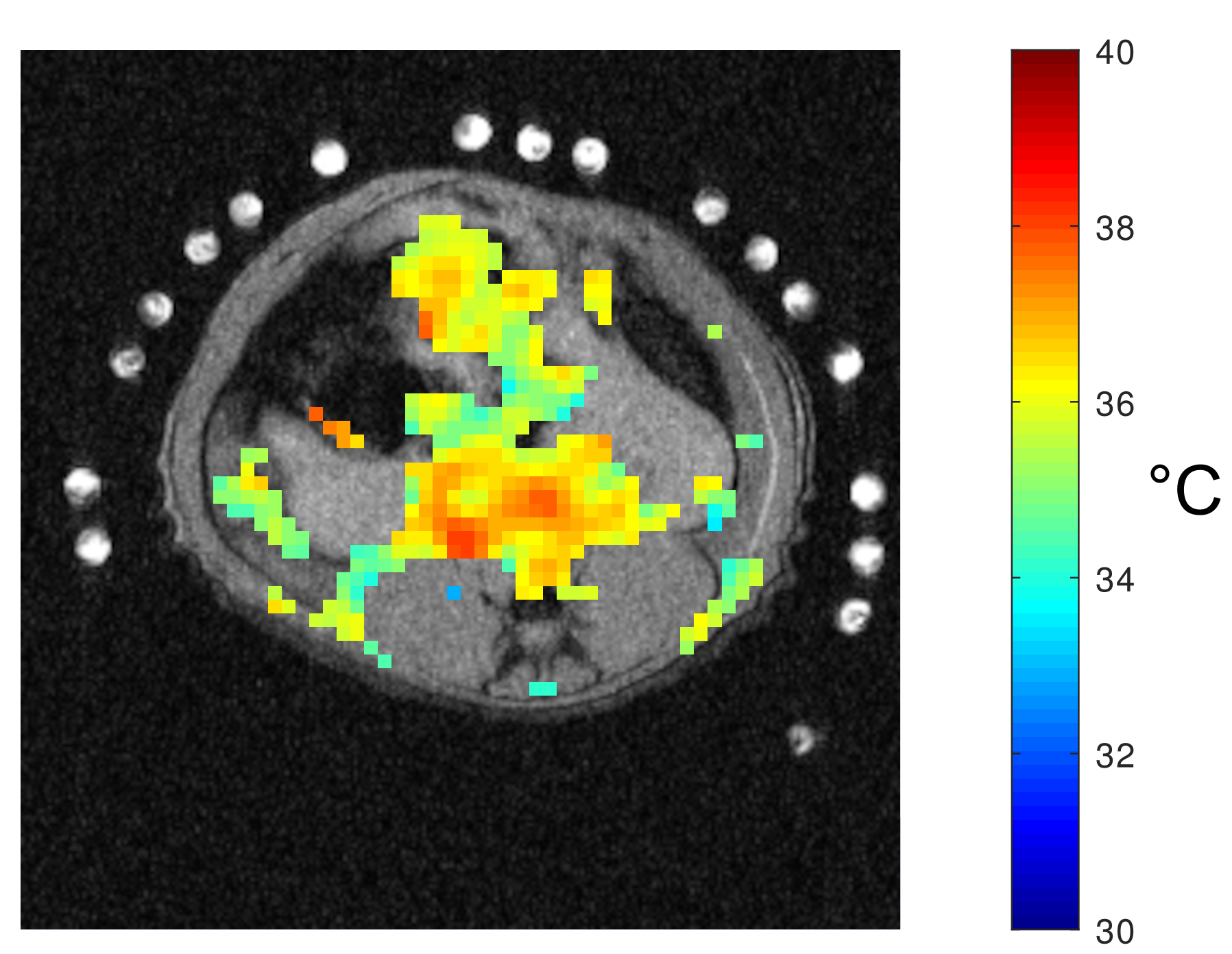
After the xenon-129 has entered the bloodstream in the lungs, it is transported from there to the entire body. In this way,
structures that are well supplied with blood and, due to the high fat solubility of xenon, also structures containing fat can be visualized.
One application of 129Xe MRI is temperature measurement. With proton MRI, it is possible to measure the temperature, e.g. based on the change in resonance frequency due to a change in temperature. Such measurements are used, for example, to monitor the destruction of tumor tissue through heat treatment (thermal ablation) while at the same time protecting healthy tissue. Due to the very small change in the resonance frequency of hydrogen protons, particularly in fatty tissue, such temperature measurements in conventional MRI are sometimes error-prone and inaccurate.
The resonance frequency of xenon-129 in fatty tissue, on the other hand, changes many times more than that of hydrogen protons, which enables a much more accurate measurement. Furthermore, by measuring the difference in frequency of xenon-129 in fat and other resonance lines, it is even possible to measure temperature in absolute units rather than temperature differences. The feasibility and relative accuracy of temperature measurement in abdominal structures is the subject of current research in a small animal model, which could later benefit tumor patients, for example.
Molecular imaging
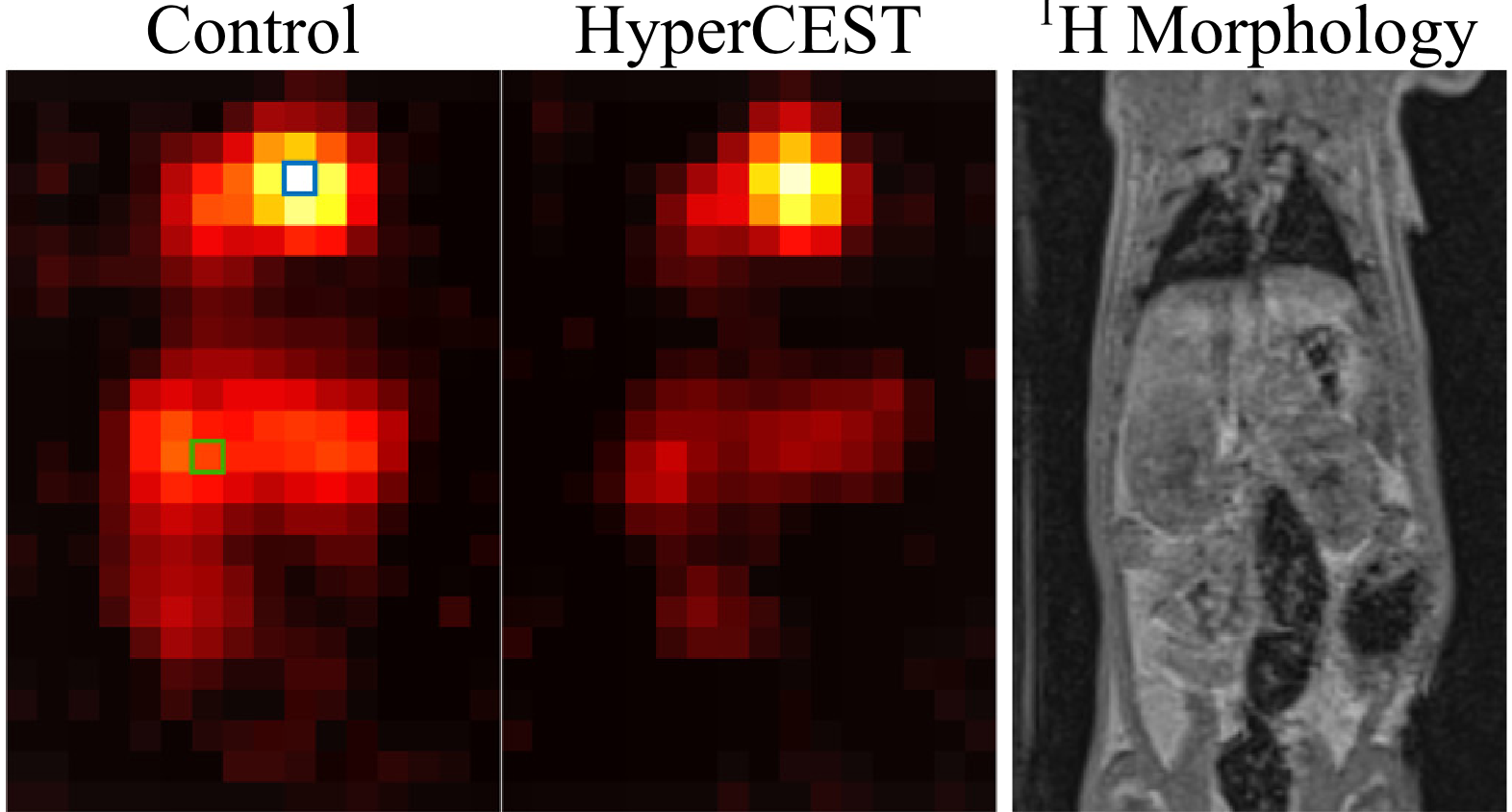
Despite the hyperpolarization of the detection substance xenon-129, the detection limit is still relatively high compared to other imaging methods such as positron emission tomography using radioactive detection substances. This makes direct imaging of low-concentration substances, which could indicate the presence of proteins indicative of tumor cells, for example, more difficult.
Despite its chemical inertness as a noble gas, xenon-129 can interact with other molecules and temporarily fill cavities in certain molecules. After high-frequency pulses at the frequency corresponding to the xenon-129 bound in the molecule, the local MR signal is reduced. This interaction allows potentially very low concentration molecules to be detected as a second tracer. This methodology, known as HyperCEST, is the subject of our research in a small animal model with the aim of creating opportunities for molecular imaging without harmful radiation for patients in the future.