Magnetic resonance imaging (MR)
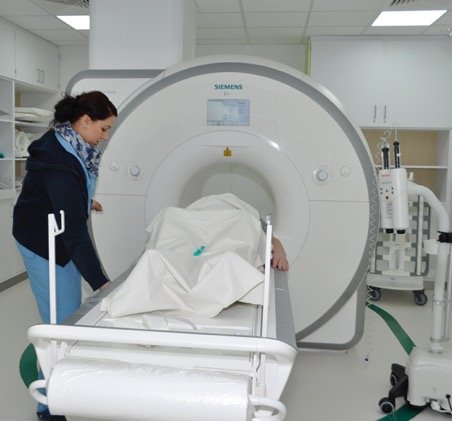
MRI is primarily used to visualize soft tissue. The technology of our MRI enables precise and differentiated imaging of the entire body tissue. Soft tissue and organs, the brain and spinal cord as well as the musculoskeletal system are particularly suitable for an MRI examination. Due to the variety of different contrasts, structures such as meniscus, tendons and ligaments, but also inflammation or edema can be detected particularly well. Furthermore, by using a contrast agent, for example, the blood flow in the tissue can be assessed in order to check the vitality of the heart or to detect tumors, as these can have an increased blood flow compared to the surrounding tissue. As the magnetic fields and radio waves used in MRI are harmless to humans, the technique is particularly suitable for examining children, who are potentially more at risk from X-rays than adults.
We also offer the latest examination techniques for the heart and MRI-supported interventions.
As magnetic fields and radio waves can interact with electrical devices, certain implants and pacemakers are not suitable for MRI, or only to a limited extent. The radiologist therefore clarifies in a preparatory discussion with the patient whether there is a potential risk from implants such as pacemakers or artificial joints. As with any medication, there may also be an intolerance to the contrast medium. Fortunately, such complications are extremely rare. To be on the safe side, contrast medium is not administered to patients with impaired kidney function.
During the MRI examination, the patient must remove all metal objects, e.g. glasses, jewelry or hearing aids, in order to rule out possible interactions with the magnetic field and the radio waves and to avoid interference with the imaging. The patient, who is positioned on a mobile table, is then fitted with an appropriate radio antenna for optimal measurement of the MR signal, depending on the region being examined. As the MRI can be very loud during the measurement, the patient is given hearing protection. The patient is brought into the center of the magnet with the table through a tube. Some people experience discomfort due to the narrowness in the opening of the magnet. In this case, it is possible to administer a sedative. However, this should be planned before the examination, as the ability to drive is restricted afterwards.
Our Institute has four modern MR tomographs with field strengths of 1.5 and 3 Tesla. During the measurement, the patient can alert us at any time with an alarm bell. Communications with our staff are also possible at any time via a microphone. The duration of an examination is usually between 20 and 45 minutes.