MHH-ITT
CROSS-OVER LIVING DONATION
There are currently over 6,500 patients in Germany waiting for a donor kidney, with the current waiting time for a post-mortem kidney donation averaging 6 to 8 years.
Living donation is a life-saving alternative to post-mortem organ donation for those waiting for a kidney.
In Germany, around one in five kidney donations is a living donation, which is regulated in §8 of the Transplantation Act (TPG).
On the basis of this legislation, a living donation can usually be made by close relatives (existence of a close relationship). In some cases, however, medical reasons (e.g. blood group or tissue incompatibilities) mean that a transplant is not possible even if the donor is willing to donate a living kidney.
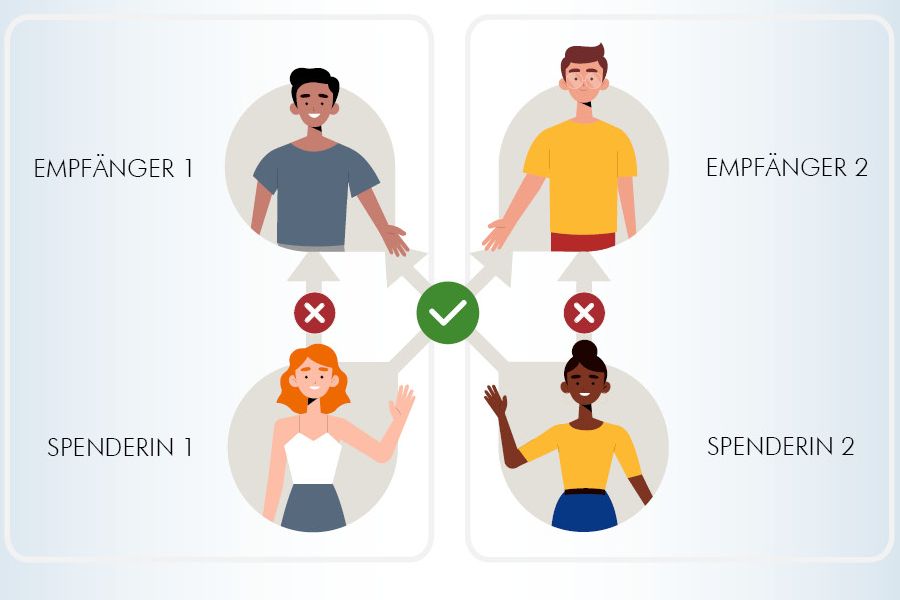
One solution to this is cross-over donation (cross-over living donation). In this case, the organ does not go from the donor to the person close to them, but "crosses over" to a more suitable person from a second transplant couple who are also not sufficiently compatible with each other.
Accordingly, the donor of transplant couple 1 donates their organ to the recipient of transplant couple 2 and vice versa.
Although cross-over living donation is permitted in Germany in principle, it is hardly feasible due to the requirement of a close relationship.
In countries with more modern transplantation laws than Germany, cross-over living donation goes even further. The need for living kidney donation in Germany is primarily a consequence of the organ shortage caused by the German Transplantation Act (no objection regulation). In the case of living donation, it is generally unavoidable to accept a particularly large number of mismatches. This makes subsequent transplants (re-transplants) more difficult due to immunizations. In countries with more highly developed transplant programs, cross-over living donation is therefore generally sought in order to keep the number of mismatches as low as possible and thus significantly improve the prospects of a successful re-transplantation.
It therefore seems particularly contradictory that in Germany, of all places, a statutory organ shortage is also hindering cross-over living donation as a possible way out.
Cross-over living donation databases, in which couples can register in order to find immunologically suitable donor-recipient pairs, provide help for those affected.
In Germany, it is possible to register in a cross-over living donation database. The computer program on which this database is based was developed at Stanford University (USA) and already serves as the basis for many cross-over programs worldwide.
A cross-over living donation is then made possible either by creating an artificial proximity relationship or through cooperation with foreign transplant programs.