Pathogenesis research and development of new therapeutic approaches
Prof. Dr. med. S. Petri
Staff members:
Prof. Dr. med. S. Körner, Senior Physician
Dr. med. Anastasia Sarikidi, Medical Specialist
Dr. med. Lars Volk, Assistant Physician
Dr. rer. nat. Nadine Thau-Habermann, postdoctoral researcher
Dr. rer. nat. Thomas Gschwendtberger, postdoctoral researcher
Carola Kassebaum, MTA
Pathogenesis research
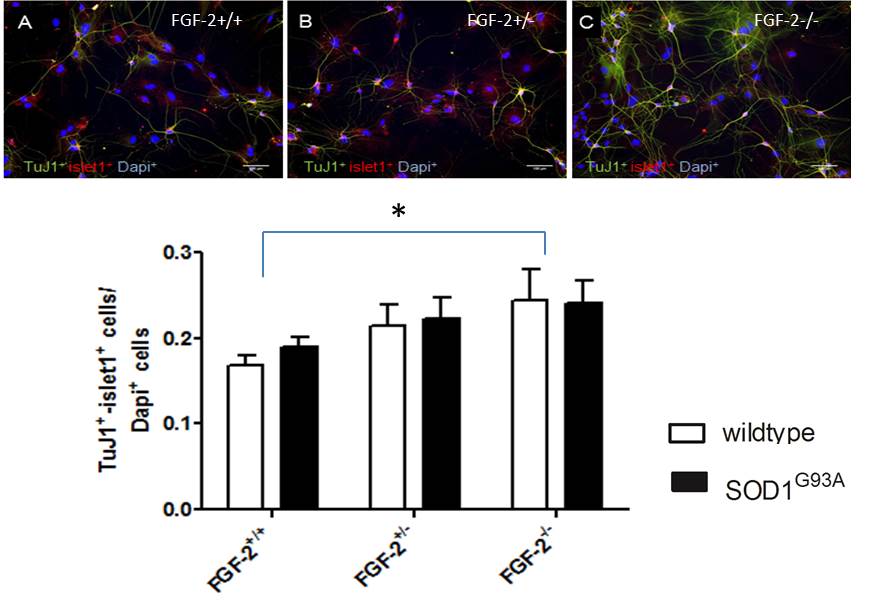
By studying primary motor neuron cultures, in monoculture and in co-culture with astrocytes/microglia obtained from the transgenic ALS animal model or healthy control animals, as well as in vivo studies in the G93A-SOD1 mouse model and neuropathological studies in muscle biopsy material and in post-mortem brain and spinal cord tissue, we are trying to better understand the pathomechanisms of ALS. Current studies focus on the interaction of various growth factors such as FGF-2 (fibroblast growth factor-2), which can have both neuroprotective and neurotoxic effects after embryonic development, as well as on the causes of actin cytoskeleton dysregulation and motor neuron/glia cell interaction.
Inducible pluripotent stem cells (iPSC)
A very promising new human in vitro model is represented by inducible pluripotent stem cells (iPSC) obtained from patients, which we differentiate into motor neurons in the laboratory and in which we have already established the first new pharmacological treatment approaches using electrophysiological and molecular biological techniques and are conducting research into disease-specific epigenetic regulatory mechanisms (collaboration Prof. Dr. F. Wegner, Neurology). Dr. F. Wegner, Neurology; Prof. Dr. H. Frieling, Psychiatry; Prof. Dr. Dr. A. Hermann, Neurology, Rostock University Medical Center).
Cell therapy
Following the widespread failure of previous drug trials, the transplantation of stem/progenitor cells appears to be a promising new therapeutic option for neurodegenerative diseases such as amyotrophic lateral sclerosis (ALS). Within the BMBF-funded Integrated Research and Treatment Center Transplantation (IFB-Tx), a GMP-compliant protocol for the isolation and expansion of mesenchymal stromal cells (MSC) from bone marrow was developed in cooperation with the GMPDU (Good Manufacturing Practice Development Unit) (Prof. Dr. U. Köhl, Dr. R. Esser) in order to initiate an initial clinical evaluation following the completion of ongoing animal studies.
Contact:
Prof. Dr. med. Susanne Petri
Senior Physician
Clinical Department of Neurology
Hannover Medical School
Carl-Neuberg-Str. 1
30625 Hanover
Phone: 0511 - 532 3740
Fax: 0511 - 532 3115
E-Mail: Petri.Susanne@MH-Hannover.de