VASCULAR TISSUE ENGINEERING
Prof. Dr. Mathias Wilhelmi | PD Dr. Thomas Aper
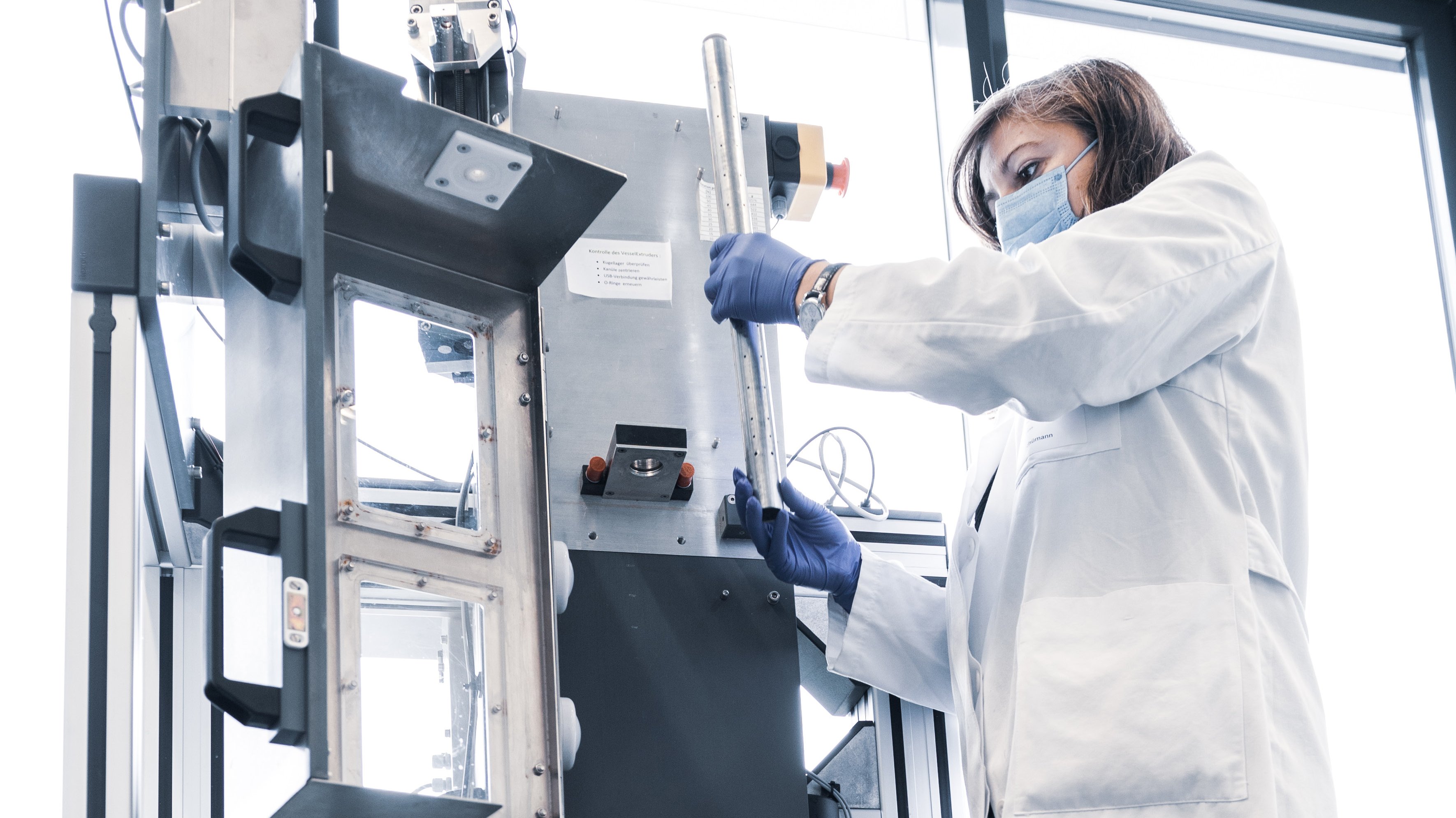
We deal with the tissue engineering of vascular prostheses, a promising replacement for arteries or veins. Such artificially produced vessels, especially if they are based on the body's own starting products such as fibrin, have a low risk of thrombosis and infection, as they have a high potential for regeneration and remodeling.
In our research group we pursue 2 different ways to produce biological scaffolds for tissue engineering. On the one hand, we use decellularized animal arteries, in this case from horses, because of their high mechanical stability and low immunogenicity.
On the other hand, we use special molds and centrifuges to form vessels for arterial replacement from the blood component fibrin. These fibrin vessels can then be colonized with endothelial cells and smooth muscle cells to resemble the original. It is also important to colonize the outer surface of the artificially produced arteries before implantation.
In our working group, we are also working on the production of fibrin patches for dilatation plasty in the treatment of children with congenital heart defects, where no foreign material should be used if possible. We are also working on the characterization of vascular stents with regard to possible cell colonization, the determination of graft-specific serum antibodies and an ex-vivo perfusion system for research into arteriosclerosis.
1.
Complete Myogenic Differentiation of Adipogenic Stem Cells Requires Both Biochemical and Mechanical Stimulation.
Helms F, Lau S, Klingenberg M, Aper T, Haverich A, Wilhelmi M, Böer U. Ann Biomed Eng. 2020 Mar;48(3):913-926. doi: 10.1007/s10439-019-02234-z. Epub 2019 Feb 27. PMID: 30815762
2.
Biochemical Myogenic Differentiation of Adipogenic Stem Cells Is Donor Dependent and Requires Sound Characterization.
Lau S, Klingenberg M, Mrugalla A, Helms F, Sedding D, Haverich A, Wilhelmi M, Böer U. Tissue Eng Part A. 2019 Jul;25(13-14):936-948. doi: 10.1089/ten.TEA.2018.0172. Epub 2019 Jun 14. PMID: 30648499
3.
A 3-Layered Bioartificial Blood Vessel with Physiological Wall Architecture Generated by Mechanical Stimulation.
Helms F, Lau S, Aper T, Zippusch S, Klingenberg M, Haverich A, Wilhelmi M, Böer U. Ann Biomed Eng. 2021 Sep;49(9):2066-2079. doi: 10.1007/s10439-021-02728-9. Epub 2021 Jan 22. PMID: 33483842
4.
Perfusion promotes endothelialized pore formation in high concentration fibrin gels otherwise unsuitable for tube development.
Zippusch S, Helms F, Lau S, Klingenberg M, Schrimpf C, Haverich A, Wilhelmi M, Böer U. Int J Artif Organs. 2021 Feb;44(2):130-138. doi: 10.1177/0391398820936700. Epub 2020 Jul 2. PMID: 32611278
5.
Low Immunogenic Endothelial Cells Maintain Morphological and Functional Properties Required for Vascular Tissue Engineering.
Lau S, Eicke D, Carvalho Oliveira M, Wiegmann B, Schrimpf C, Haverich A, Blasczyk R, Wilhelmi M, Figueiredo C, Böer U. Tissue Eng Part A. 2018 Mar;24(5-6):432-447. doi: 10.1089/ten.TEA.2016.0541. Epub 2017 Dec 19. PMID: 28978275
6.
Dehydration improves biomechanical strength of bioartificial vascular graft material and allows its long-term storage.
Aper T, Wilhelmi M, Boer U, Lau S, Benecke N, Hilfiker A, Haverich A. Innov Surg Sci. 2018 Jul 23;3(3):215-224. doi: 10.1515/iss-2018-0017. eCollection 2018 Sep. PMID: 31579785 Free PMC article.
7.
TIMP3 is Regulated by Pericytes upon Shear Stress Detection Leading to a Modified Endothelial Cell Response.
Schrimpf C, Koppen T, Duffield JS, Böer U, David S, Ziegler W, Haverich A, Teebken OE, Wilhelmi M. Eur J Vasc Endovasc Surg. 2017 Oct;54(4):524-533. doi: 10.1016/j.ejvs.2017.07.002. Epub 2017 Aug 12. PMID: 28807411 Free article
AG Vascular Tissue Engineering
Melanie Klingenberg
Phone: +49 (0) 511 - 532 1436
Mail: klingenberg.melanie@mh-hannover.de