
All about breastfeeding
Breastfeeding preparation courses and advice on breastfeeding difficulties
At the Parents' School at Hannover Medical School's Perinatal Centre, we provide you with in-depth information about natural baby nutrition and answer all your questions about breastfeeding and life with your newborn. Because:
Breast milk makes the difference
And, did you know? Simply the best. Breast milk is the best choice for diabetes!
We are also happy to support you after you have been discharged from the MHH!
Attend our breastfeeding preparation courses during your pregnancy. Once the baby is born, we offer you the opportunity to get advice and exchange ideas with other breastfeeding mothers in our open breastfeeding groups if you have any questions about breastfeeding or breastfeeding difficulties.
Please contact the MHH breastfeeding hotline at 017615328559. Monday to Wednesday from 9 am to 12 pm.
Courses and more
Congratulations on your pregnancy! You've come to the right place to prepare yourself for the upcoming breastfeeding period with lots of knowledge as well as the birth.
Breastfeeding begins immediately after the birth and will accompany you and your baby for quite some time. To counteract possible pitfalls, course instructor Birthe would like to prepare you and your companion for this time in the best possible way.
You will talk about:
Changes in your breast during pregnancy and breastfeeding,
innate reflexes that your baby will use to find your breast,
breastfeeding in the first hours and days after birth,
signs by which you can recognize whether your baby is thriving,
demand and need-oriented breastfeeding,
meaningful support from your social environment and
we discuss the benefits of so-called breastfeeding "aids"
Participation fee:
for expectant mothers €45.00
for couples €70.00.
To register, please click on the desired course number
Have you recently become a mom and have questions about breast milk feeding or problems with breastfeeding? Are you looking for contact with other women with babies? You are pregnant and would like to find out more about life with a newborn and breastfeeding? Would you like to know why your baby often wakes up at night? Are you wondering whether your baby is getting enough milk and how you can tell?
Then our free and open breastfeeding group is the right place for you!
In a cozy atmosphere, we talk about the everyday joys and challenges with our babies. Very different topics such as
-
Baby's sleeping behavior,
-
the right time to introduce complementary foods,
-
everything to do with carrying, baby carriers,
-
breastfeeding and work,
-
traveling with the baby
-
... and much more
are discussed.
The open breastfeeding groups meet every Thursday from 10.00-11.30 am.
The open breastfeeding group will be canceled on 30.10.25!
The group is led by breastfeeding expert Lisa Hahn.
Participation is free of charge.
We are also happy to be there for you.
If you have any questions about breastfeeding, please contact the breastfeeding hotline from Monday to Wednesday from 9 a.m. to 12 noon!
Phone: 017615328559
If you are looking for a contact person outside these times due to acute breastfeeding problems, please contact the MHH Parent School team. We will be happy to help you quickly.
Phone: 017615326682
Breast milk does the trick
Find out about the importance of breastfeeding, colostrum - the power milk of the first days, nipple care and more...
Breast milk costs nothing, is always optimally formulated and comes in environmentally friendly packaging.
Achieving love and trust through physical contact is the basis of every breastfeeding relationship. We would like to advise, guide and support you from the very beginning and throughout your breastfeeding period.
We recommend exclusive breastfeeding for the first six months of your baby's life, followed by the gradual introduction of suitable complementary foods for as long as mother and child wish.
The importance of breastfeeding for you and your baby
- Promotion of the mother-child relationship through skin-to-skin contact
- Strengthening your self-confidence as parents
- Practical, time-saving, cost-effective and always at the right temperature
- Child-friendly, age-appropriate nutrition for your child through continuous adjustment of the breast milk composition
- Breastfeeding hormones help the uterus to regress, thereby reducing blood loss after delivery and having a calming effect on you as a mother and on your child
- Reduces the risk of obesity, diabetes and some other diseases for mother and child
- Reduces the risk of neonatal jaundice through early lactation
- Strengthens the immune system through the immune substances in breast milk. As a result, breastfed children are more resilient and recover more quickly
- Natural training of the mouth muscles
- Stimulation of all senses (touch, smell, hearing, sight, taste)
Colostrum - The power milk of the first days
Colostrum is the first and individually unique milk for your child. It is produced during pregnancy and is available to your baby immediately after delivery. With its many immune substances, it protects your baby from infections, stabilizes the metabolism and mobilizes intestinal activity, making it the best start in life. Even if you are not breastfeeding your baby, you can still give him or her this valuable milk.
Breastfeeding is an interactive process between mother and child
The breastfeeding relationship begins immediately after birth. If there are no medical reasons not to do so, undisturbed skin-to-skin contact (for 1 hour) takes place after the birth with the first attempt at breastfeeding. Only then are routine measures such as weighing and measuring carried out. Even after a caesarean section, breastfeeding is possible in the delivery room with a little help.
- After the first day of life, you will breastfeed 8 - 12 times in 24 hours, possibly more often. Frequent breastfeeding stimulates milk production, prevents pain and tightness in the breast and also has a positive effect on milk production during the later months of your baby's life.
- Sometimes your child demands many short, consecutive feeds. Such behavior often occurs in the evening and at night. In this way, the baby ensures that it has enough milk for the next few days. This is called cluster feeding.
- Be sure: you always produce enough milk. The quantity and composition of milk varies depending on the baby's drinking behavior and age and thus adapts to his needs.
- Always breastfeed your baby when it asks for it.
Respond to the following signals:
→ Frowning or rapid eye movements
→ Sucking movements
→ Smacking and licking
→ Fist pumping
→ Searching movements
Your baby will only start crying if you do not recognize these signals from your baby early on.
Breast milk is sufficient for a healthy, mature child. It does not need any other food or liquids. If possible, avoid using a pacifier or bottle teat for the first 6 weeks. His need to suck should be satisfied exclusively at the breast, as this will help him to learn how to suck correctly and prevent sore nipples, milk stasis and breast inflammation.
Intuitive breastfeeding - your baby's skills
Your newborn baby is already born with many skills. With a little support and with the help of its reflexes, it will find your breast to feed.
- Sit down comfortably with your baby, your upper body leaning back in a relaxed position. The holding arm is well supported on a cushion.
- Your baby is lying on your body facing you.
- Your baby's mouth is at nipple level.
- Your baby's head is in the crook of your arm directly in front of your breast and your hand is holding the buttocks.
- Due to your baby's reflexes, your baby begins to search for and grasp the breast to suckle.
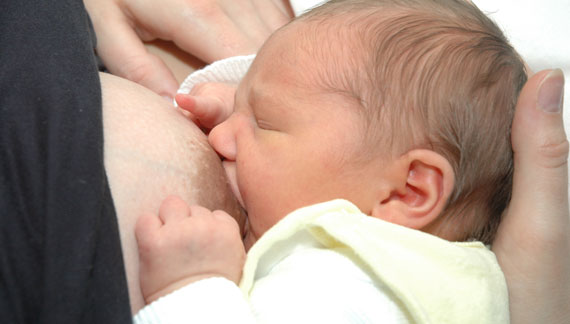
- Your baby should open its mouth wide, grasp the nipple and as much of the areola as possible. This will allow him to empty the breast effectively and stimulate milk production in the best possible way. Sore nipples are avoided.
- If breastfeeding hurts, carefully remove your baby from the breast. To do this, slide your little finger into the corner of the mouth between the baby's teeth.
Mother and child as a unit in rooming-in
Rooming-in means that you are together with your child around the clock, with your partner if you wish (family rooming-in). This enables continuous contact and close proximity to your baby and promotes the bond between you and your child. You gain more confidence in dealing with your baby and become more familiar with signals and early signs of breastfeeding. Feeding your baby frequently supports milk production so that your child grows well right from the start.
Nipple care
It is not normally necessary to prepare the breasts for breastfeeding. Only wash your breasts with clean water and do not use lotion. After breastfeeding, you can let some of the baby's saliva and breast milk dry on the nipple.
Nutrition while breastfeeding
A balanced, regular diet is also important while breastfeeding. Make sure you have three main meals and two snacks. There are basically no restrictions, except for alcohol and nicotine. Have a drink ready with your breastfeeding meals and drink according to how thirsty you feel. Please note that sage tea can reduce the amount of milk you produce. How can you tell if your baby is getting enough breast milk?
- 5-6 heavy diapers in 24 hours
- At least 1 bowel movement per day in the first 4-6 weeks of life
- After 4-6 weeks, an interval of up to 10 days between 2 bowel movements is normal →milk stools are mustard-colored, grainy, possibly thin and smell sweet and aromatic.
- Weight gain of 200g/week 28
Emptying the breast by hand
- Please clean your hands before emptying your breasts
- Gently massage the breast to trigger the flow of milk.
- Now place the fingertips of your thumb and index finger approx. 3 cm away from the nipple, above and below the nipple.
- Press the fingers lightly towards the ribcage and lift the breast slightly.
- Guide your fingers towards the nipple with gentle pressure without sliding on the skin.
- Repeat this "milking movement" rhythmically until the flow of milk stops.
- Now gradually change the position of the fingers so that all areas of the breast are emptied. You can find more information on the topic of "manual breast emptying" in the following movie from 2:40 to 4:30min:
Storing breast milk
Store the collected breast milk in suitable, clean containers. The milk can be stored for a maximum of 6 hours at room temperature, 72 hours in the refrigerator at 4°C or 6 months at -18°C in the freezer, after which it must no longer be used! Defrost gently in the refrigerator or in a water bath. Heating in the microwave destroys important components of breast milk and heats the milk unevenly. For information on expressing breast milk, please refer to our instructions on obtaining, collecting and transporting breast milk.
Dear mothers,
this checklist should help you to see clearly once again what new knowledge you have gained for yourself and your baby during your stay in hospital. Please ask us if anything is still unclear.
1 I breastfeed, feed my baby 8-10 times or more in 24 hours as needed
2 I know that I can wake the baby if it sleeps too long.
3. i know that i put the baby to the breast before it cries, when it looks, turns its head, smacks, licks its lips, puts its fingers to its mouth.
4 I know that it is important that I bring the baby to the breast quickly when his mouth is wide open. I can help by offering him the breast. ATTENTION - DO NOT put the breast into the baby!
5. breastfeeding must not hurt! I know that my baby is sucking properly at the breast when it
- has its mouth wide open,
- has its lips open on the breast,
- makes puffs,
- makes sucking spurts with pauses,
- falls asleep at the breast or lets go of the breast on its own.
6. i know that my child is thriving if
- it has 4-6 heavy diapers and at least 1 bowel movement a day, (children who are fed infant formula every 2 - 3 days)
- it is gaining about 200 g a week,
- it is happy and relaxed.
7 - I know that complementary foods are offered from 6 months of age
8 - I know where I can get help if I have questions about the baby.
Things to know for women who are not breastfeeding:
- I always hold my baby in my arms to feed.
- I wait until it opens its mouth on its own.
- I change sides when the baby takes a break.
- I feed infant formula with the prefix PRE, or HA PRE if there is an increased risk of allergies.
- I know that the baby can drink as much and as often as it wants from the PRE HA formula (see also the manufacturer's instructions on the packaging).
- I use age-appropriate teats and also offer my baby a pacifier for sucking satisfaction.