At the COFONI closing symposium, researchers presented findings from 38 projects—and drew lessons for future pandemics.
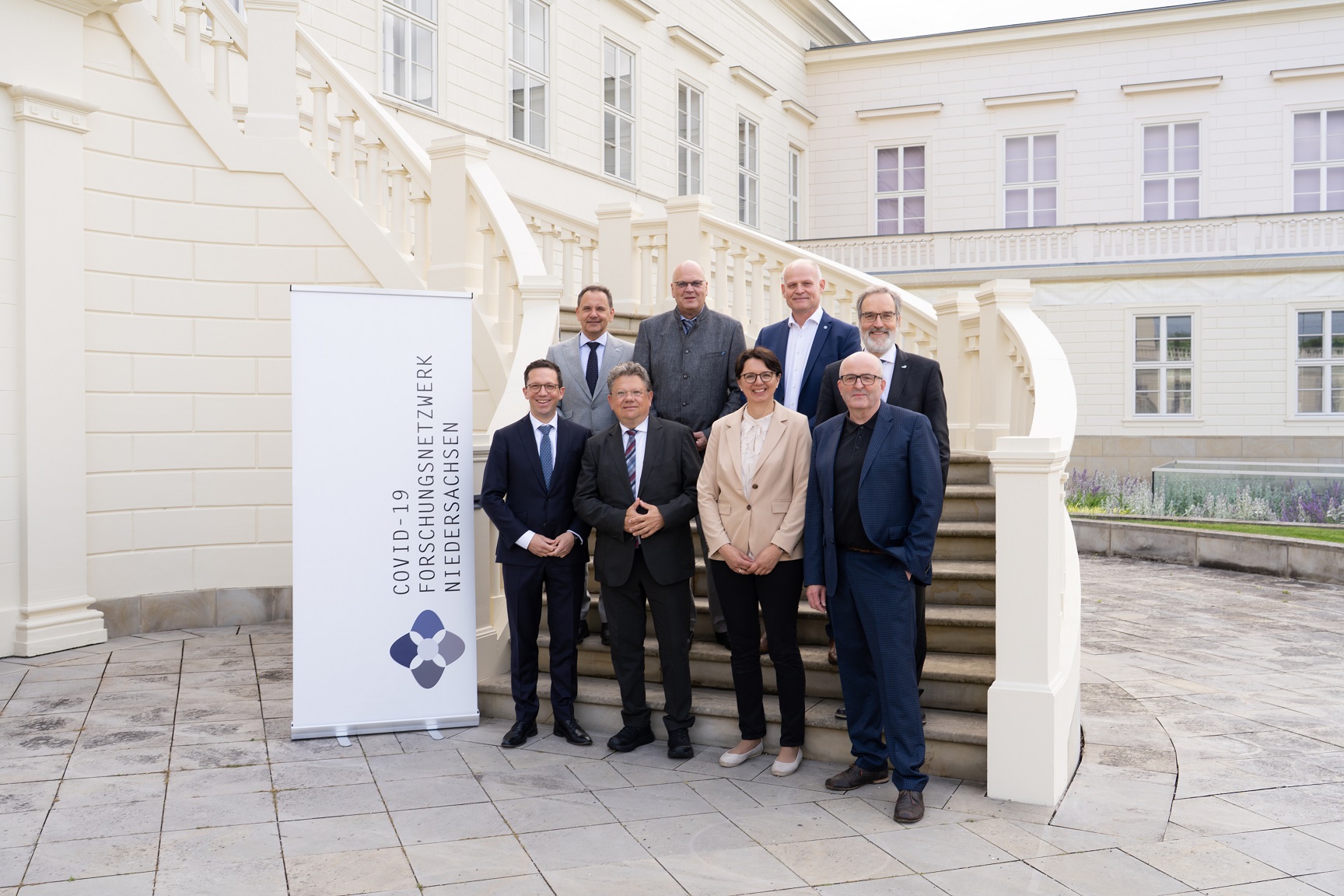
COFONI Final Symposium in Hanover (from left to right; front row): Falko Mohrs, Lower Saxony Minister for Science and Culture, Dr. Andreas Philippi, Lower Saxony Minister for Social Affairs, Labor, Health, and Equality, Prof. Dr. Maren von Köckritz-Blickwede, COFONI Co-Spokesperson and Head of the Institute of Biochemistry at the TiHo Foundation, Prof. Dr. Berthold Vogel, Co-Chair of the COFONI Long/Post-COVID Committee and Managing Director of the Göttingen Institute for Sociological Research (SOFI); (from left to right; back row): Prof. Dr. Jürgen Wienands, COFONI Spokesperson and Dean of Research at the Faculty of Medicine at UMG, Prof. Dr. Wolfgang Brück, Spokesperson for the Executive Board and Executive Director of Research and Teaching at UMG, Prof. Dr. Klaus Osterrieder, President of TiHo, Prof. Dr. Stefan Treue, Director of the German Primate Center – Leibniz Institute for Primate Research (DPZ). Photo: medJUNGE
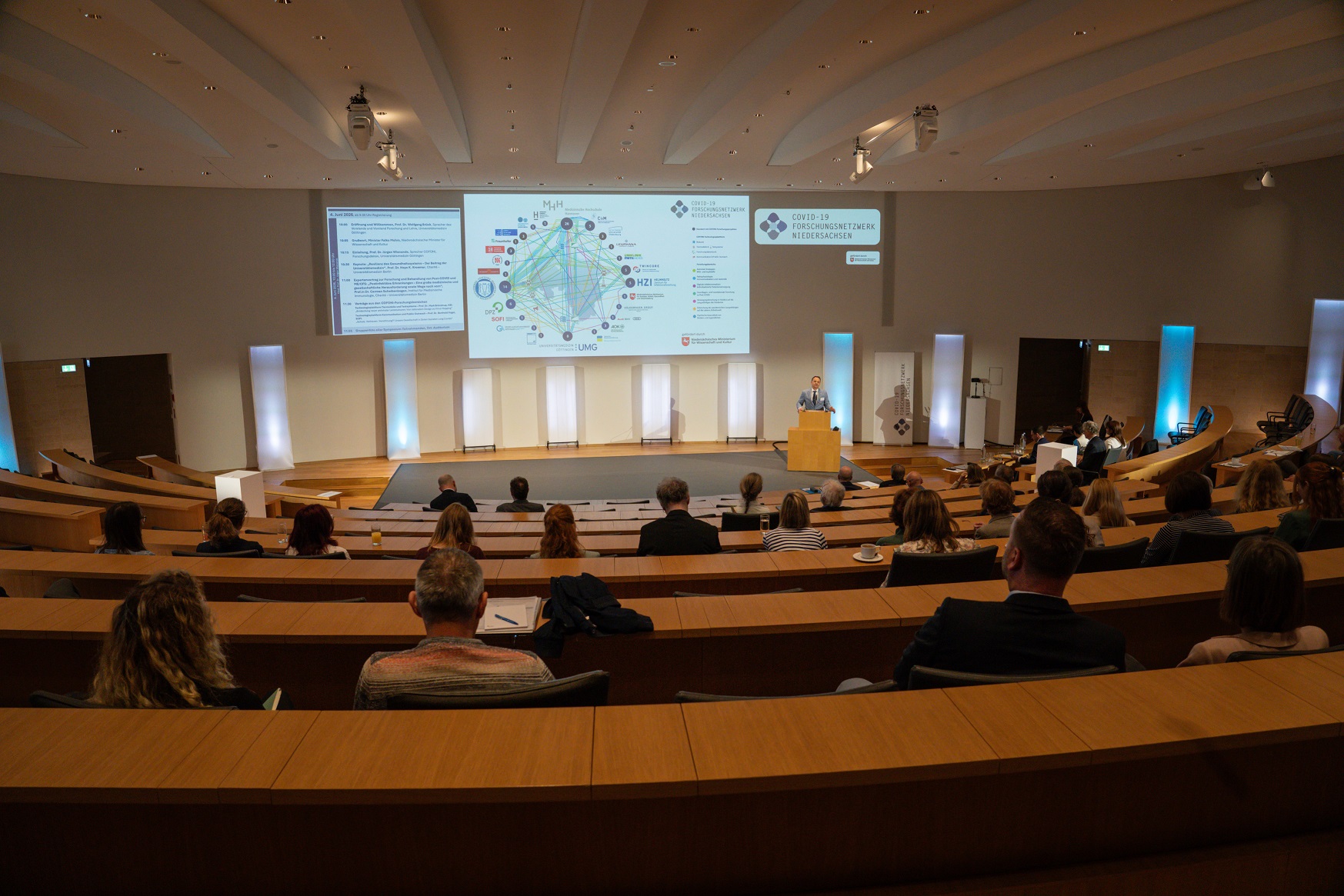
Start of the COFONI closing symposium in Hanover on the first day of the event. Photo: medJUNGE
With the establishment of the COVID-19 Research Network of Lower Saxony (COFONI) in October 2020, the state of Lower Saxony created structures to manage the COVID-19 pandemic and prepare for future health crises. New clinical presentations such as COVID-19 and Long/Post-COVID, lasting changes in professional and private life, and an increase in mental health disorders—particularly among children and adolescents—are consequences of the pandemic. The goal of this entirely new collaborative project in Lower Saxony was to address these impacts through coordinated collaboration between basic, clinical, and health services research, as well as the social and behavioral sciences—an approach that is unique even on a national scale. In addition to fundamental questions regarding the SARS-CoV-2 coronavirus, the project aimed to decipher molecular disease mechanisms, identify therapeutic targets, and develop recommendations for action in the event of future health crises. A particular focus was placed on researching the societal and social consequences of the pandemic. Since its founding, the University Medicine Network has been coordinated by the University Medical Center Göttingen (UMG) and funded by the state of Lower Saxony with a total of approximately 19 million euros.
To conclude the project, scientists and experts from politics, healthcare, and society presented and discussed results and findings before 150 guests on June 4 and 5, 2026, at the Schloss Herrenhausen Conference Center in Hanover. Prof. Dr. Wolfgang Brück, Spokesperson for the Executive Board and Executive Director of Research and Teaching at UMG, opened the event.
Falko Mohrs, Lower Saxony’s Minister of Science and Culture, emphasized in his welcoming remarks: “COFONI impressively demonstrates how networked, science-driven, and at the same time practice-oriented research can succeed. Today’s symposium marks the conclusion of an important phase in Lower Saxony’s infection research. By closely combining scientific and clinical expertise and consistently adopting an interdisciplinary approach to key research questions, researchers in Lower Saxony have made a decisive contribution to overcoming the COVID-19 pandemic. It is particularly noteworthy that by including Long COVID in the research program at an early stage, the long-term consequences of the pandemic were already being addressed as early as 2021. This clearly demonstrates that researchers in Lower Saxony have the potential to make a significant contribution to the National Decade Against Post-Infectious Diseases recently proclaimed by the federal government.”
8 research priorities, 38 collaborative projects, 25 partner institutions
Prof. Dr. Jürgen Wienands, spokesperson for the COFONI network and Dean of Research at UMG, summarized: “Over the past five years, we have pooled a wide range of expertise from across Lower Saxony in interdisciplinary projects to understand the SARS-CoV-2 coronavirus and its disease mechanisms. Our biomedical research in COFONI has focused in particular on characterizing the complex immune mechanisms and deciphering the molecular basis for new drugs. For example, we have identified antibodies that offer broad-spectrum protection. In addition, we specifically blocked a cellular ‘door opener’ in the lungs that the virus uses to enter, and we also investigated whether existing active compounds can be modified to suppress the virus’s replication. Overall, we have laid important groundwork that will help us prepare for future pandemic threats as well.”
Prof. Dr. Maren von Köckritz-Blickwede, deputy COFONI spokesperson and head of the Institute of Biochemistry at the University of Veterinary Medicine Hannover Foundation, added : “An essential component of this foundation is our COFONI technology platform, which forms a scientific basis for future pandemic preparedness and is structured into four core areas: the development of animal models and in vitro test systems under high-security conditions, the establishment of sustainable biobanks for patient samples and a central research database, as well as public communications for outreach to the public. For example, we were able to develop an age-dependent hamster model that represents particularly vulnerable patient groups, as well as establish humane testing methods such as video analysis to record animal behavior or suitable alternatives to animal testing.”
As a new clinical picture emerged during the course of the COVID-19 crisis in the form of Long/Post-COVID, and the pandemic’s impact on nearly all areas of life and work became clearer, the research consortium expanded. Additional expertise from healthcare as well as the social and behavioral sciences was integrated into the research project.
Prof. Dr. Christine S. Falk, Chair of the COFONI Long/Post-COVID Committee and Director of the Institute for Transplant Immunology at Hannover Medical School, explained: “COFONI research combines immunological, virological, and pathophysiological research on clinically well-characterized COVID-19 cohorts from the acute phase of the COVID-19 pandemic. Early on, it also incorporated Long COVID syndrome, which was initially defined by affected COVID-19 patients. From the very beginning, social science perspectives were incorporated into the projects alongside the biomedical aspects. This not only gave the entire field of post-infection diseases significantly greater visibility but also brought other post-infection syndromes—such as fatigue syndrome, characterized by persistent physical and mental exhaustion—into the focus of research. These unique selling points are not only remarkable in a national comparison but demonstrate once again how valuable interdisciplinary and sustainable networking is for those affected.”
Prof. Dr. Berthold Vogel, Co-Chair of the COFONI Long/Post-COVID Committee and Managing Director of the Göttingen Institute for Sociological Research (SOFI) at Georg August University, outlined the research in the area of living and working conditions: “COFONI research also addresses the societal consequences of the pandemic. A key focus has been the workplace. Here, for example, we see that the majority of those affected by post-COVID continue to work without appropriate adjustments to their working conditions. Workplace practices must become more attentive to this, especially since international studies also show that the economic damage caused by post-COVID-related illnesses is significant. Another key point is that the pandemic has led to a significant loss of institutional and social trust. The long-term social consequences of the pandemic threaten social cohesion.”
During the closing event, various dialogue formats focused on the question of what society and politics have learned from the COVID-19 pandemic, and how well prepared we are for future crises with social and health impacts. Moderated by Dr. Christina Berndt, science editor of the Süddeutsche Zeitung, the discussion brought together stakeholders from politics, academia, healthcare, business, local governments, social organizations, and churches, as well as patients and youth representatives.
Among the panelists were, for example, Dr. Georg Schütte, Executive Director of the Volkswagen Foundation; Ralf Meister, Regional Bishop of the Evangelical Lutheran Church of Hanover; and Dr. Andreas Philippi, Lower Saxony’s Minister for Social Affairs, Labor, Health, and Equality, who assessed the situation from a political perspective as follows: “The COVID-19 pandemic has placed heavy demands on politics and society. Sometimes unpopular decisions had to be made, which were particularly challenging because we were dealing with a novel and initially unexplored type of virus. Today we know that the clinical picture of COVID-19, as well as its long-term effects, are highly diverse and complex. In some cases, they go far beyond the scope of traditional primary and specialist care, making timely, structured, and interdisciplinary treatment urgently necessary. This is precisely where COFONI’s work comes in, providing crucial insights to support patients with Long or Post-COVID in a way that meets their specific needs. At the same time, clear recommendations for action in future health crises can be derived from these findings. I thank everyone involved in the network for this extremely important commitment!”
COVID-19 Research Network Lower Saxony (COFONI)
The network was founded in October 2020 on the initiative of University Medicine Göttingen, Georg-August University of Göttingen, the Helmholtz Centre for Infection Research, Hannover Medical School, and the Foundation of the University of Veterinary Medicine Hannover. In addition, the network includes TWINCORE (Centre for Experimental and Clinical Infection Research), the German Primate Center – Leibniz Institute for Primate Research, the Centre for Individualised Infection Medicine, the Technical University of Braunschweig, and Leibniz University Hannover. To investigate the long-term societal and social consequences, the network was joined by, among others, the Göttingen Institute for Sociological Research at Georg-August University, Carl von Ossietzky University of Oldenburg, the University of Osnabrück, the University of Hildesheim, and Leuphana University of Lüneburg.
The research network’s unique strategy was to bring together Lower Saxony’s expertise in pandemic research in order to make optimal use of the existing interdisciplinary and complementary expertise. The necessary technical capabilities are consolidated through a central technology platform. This platform provides all network participants with access to data and biobanks, as well as cross-disciplinary methods and animal models.
Further information on the COVID-19 Research Network of Lower Saxony (COFONI) can be found here.
Departmental contact:
Dr. Katja Lidschreiber, COFONI Coordination Office, Phone 0551 / 39-65878, cofoni@med.uni-goettingen.de
Press contact:
University Medical Center Göttingen, Georg-August-University
Head of Corporate Communications
Lena Bösch
Von-Siebold-Str. 3, 37075 Göttingen
Phone 0551 / 39-61020
Fax 0551 / 39-61023
presse.medizin(at)med.uni-goettingen.de
www.umg.eu