For the first time, MHH plans to produce blood stem cells on a large scale for transplants. The BMFTR is funding the “smartiBONE” project with one million euros.
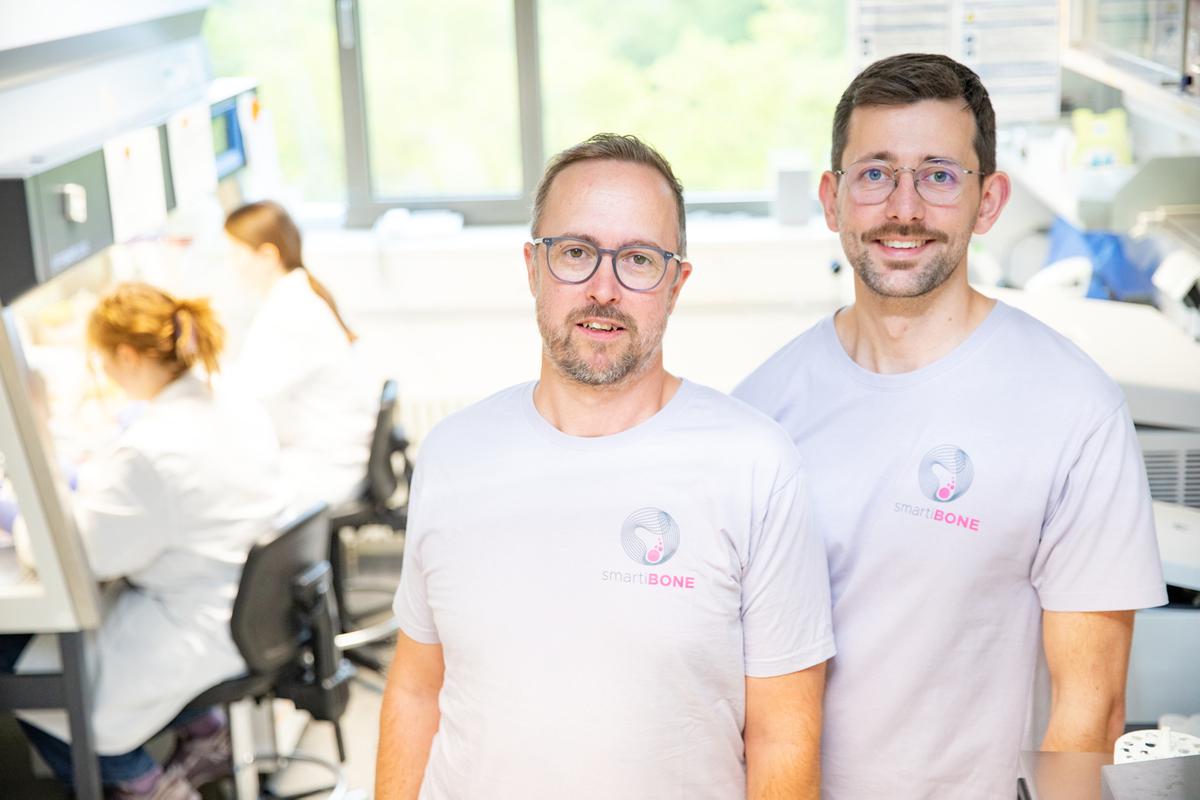
Seeking to produce blood stem cells: Prof. Dr. Nico Lachmann and Dr. Mark Klassen (from left). Copyright: Karin Kaiser/MHH
For people with leukemia, rare immunodeficiencies, and severe autoimmune diseases, a blood stem cell transplant can be life-saving. However, there is a shortage of suitable donor cells. This is because, for a transplant to be successful, the tissue characteristics of the donor and the recipient must match as closely as possible. Although more than 90,000 blood stem cell transplants are performed worldwide each year, finding a suitable donor remains difficult for many patients. And even when suitable cells are available, medicine faces another hurdle: Outside the body, blood stem cells from the bone marrow lose their ability to self-renew and simultaneously produce all types of blood cells. Yet it is precisely these properties that are crucial for a successful transplant.
To date, there is no reliable and reproducible method for producing functional blood stem cells in large numbers outside the human body. This is where the new research project “smartiBONE” comes in: A team from Hannover Medical School (MHH), led by Prof. Dr. Nico Lachmann, is collaborating with a team from Ludwig Maximilian University of Munich (LMU) to take a decisive step toward the production of blood stem cells. The Federal Ministry of Research, Technology, and Space (BMFTR) is providing a total of one million euros for the project. The project is scheduled to begin in November 2026.
The MHH team has already developed a technology that enables the production of various types of immune cells in different quantities from induced pluripotent stem cells (iPS cells)—body cells that have been “reprogrammed” using biotechnology and from which any cell type in the body can be developed. This technology will now be used to produce functional blood stem cells on a large scale with the help of bone marrow-like organoids. This has already been achieved on a small scale.
“With ‘smartiBONE,’ we aim to take a decisive step toward a sustainable and accessible cell therapy for patients with severe blood and immune disorders,” emphasizes Professor Lachmann of the MHH Clinical Department of Paediatric Pneumology, Allergology and Neonatology. “We are not only working on new treatment options, but also on a new infrastructure for the medicine of the future.” The blood stem cells developed are intended to complement existing therapy with donor cells and also serve as a research resource.
The production of blood stem cells could create a personalized, accessible, and ethically sound cell source in the future—in addition to the availability of suitable donors. The team’s research is conducted within the MHH Centre for Cell and Gene Therapies, as well as in the RESIST Cluster of Excellence and the German Center for Lung Research.
Text: Bettina Bandel