Platelets, coagulation, and the complement system must work together optimally to allow the placenta to form.
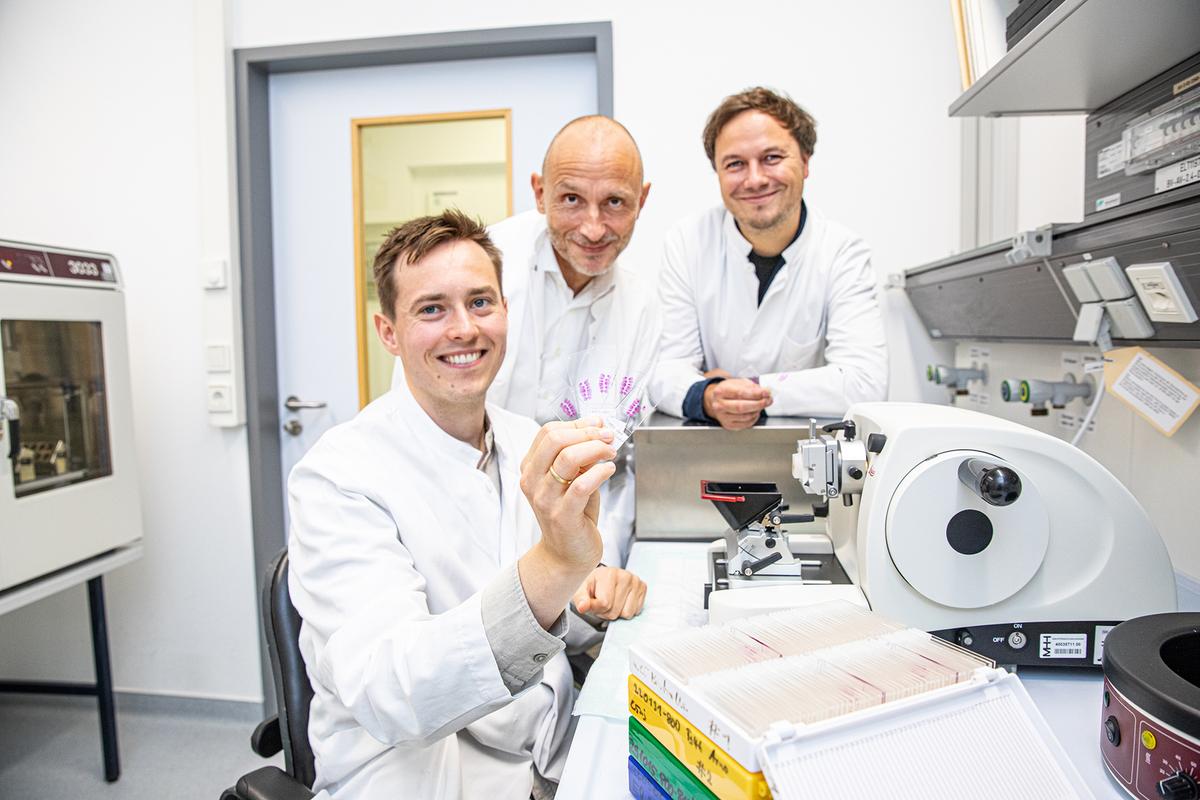
In the lab: Dr. Arno Smid, Prof. Dr. Andreas Tiede, and Dr. Markus Abeln (from left). They are showing glass slides with sections of placental tissue from the mouse model. Copyright: Karin Kaiser/MHH
During pregnancy, the human embryo is initially supplied with nutrients via the yolk sac; later, the placenta takes over this task. It consists of maternal and embryonic tissue, through whose vessels the mother’s blood flows. An interdisciplinary research team at Hannover Medical School (MHH) has now demonstrated in a mouse model that, during placental development, tiny, localized blood clots at the interface between maternal and embryonic tissue play an important regulatory role. The physiological significance of these microthrombi for a successful pregnancy is a new finding. Previously, these blood clots were primarily viewed as a cause of pregnancy complications.
“These so-called placental microthrombi play a crucial role: Like small temporary dams, they restrict the flow of maternal blood at specific points. In this way, they help direct blood flow through the developing placenta,” says Dr. Markus Abeln ofthe MHH Institute of Clinical Chemistry and Central Laboratory. Together with Dr. Arno Smid, he led this study, which was published in the *Journal of Clinical Investigation*. To conduct the study, the scientists collaborated with several MHH institutes and Clinical Departments, including Prof. Dr. Andreas Tiede from theMHH Department of Hematology, Hemostasiology, Oncology, and Cell Therapy, as well as Cardiff University. The German Research Foundation (DFG) funded this work as part of the research group “Sialic Acid as Regulator in Development and Immunity.”
Pregnancy requires a precise balance
The researchers were also able to show that the microthrombi contain maternal platelets as well as proteins that regulate blood clotting (coagulation factors). In addition, they consist of the complement protein C3, a central element of the innate immune system. The scientists investigated how platelets, clotting factors, and the complement system interact to form the microthrombi: First, the clotting enzyme thrombin activates the platelets. These then form a surface on which the complement system can be stimulated in a localized manner.
The absence of a specific sugar molecule (sialic acid) on the surface of the placenta led to excessive activation of the complement system, widespread deposits of platelets and clotting factors, excessive thrombosis, and severely impaired placental development.
The results show that a successful pregnancy requires a delicate balance: platelets, coagulation, and the complement system must be sufficiently active to regulate blood flow, but must not trigger an uncontrolled inflammatory and coagulation response. This interaction is necessary to prevent bleeding in early pregnancy.
A dysregulation of these systems could also play a role in pregnancy complications in humans. Alterations in the complement and coagulation systems have already been described in preeclampsia—a serious pregnancy-related condition that can endanger both mother and child—as well as in recurrent miscarriages and adverse pregnancy outcomes associated with autoimmune diseases. However, since the current study was conducted using mouse models, further investigations using human placental tissue and appropriate human models are necessary. In the long term, the findings could help develop more targeted approaches to treat placental thrombosis and excessive complement reactions.
As part of this collaboration, Dr. Abeln joined the Hemostaseology Research Group, led by associate professor Dr. Sonja Werwitzke and Professor Tiede. There, he continues to investigate how blood coagulation, the immune system, and glycosylation interact.
The placenta
The placenta is a tissue that develops on the wall of the uterus during pregnancy. It forms when embryonic tissue invades the uterine lining and consists of both embryonic and maternal tissue. Through the placenta, the embryo (referred to as a fetus in later stages of development) is connected to the mother’s bloodstream. Starting in the twelfth week of pregnancy, the placenta supplies the embryo with nutrients and oxygen. It performs hormonal functions and facilitates the elimination of waste products. The placenta influences the mother’s immune system so that it does not reject the child as foreign tissue while continuing to protect the mother from infections. The connection between the embryo and the placenta is via the umbilical cord. After delivery, the placenta is expelled as the afterbirth.
Text: Bettina Bandel
The original publication, “Platelets link coagulation and complement in regulating murine placental vascular development,” Journal of Clinical Investigation, 2026, can be found here.