Helping people help themselves: MHH researchers are using an mRNA blueprint to enable heart muscle cells to produce the enzyme missing in Fabry disease on their own.
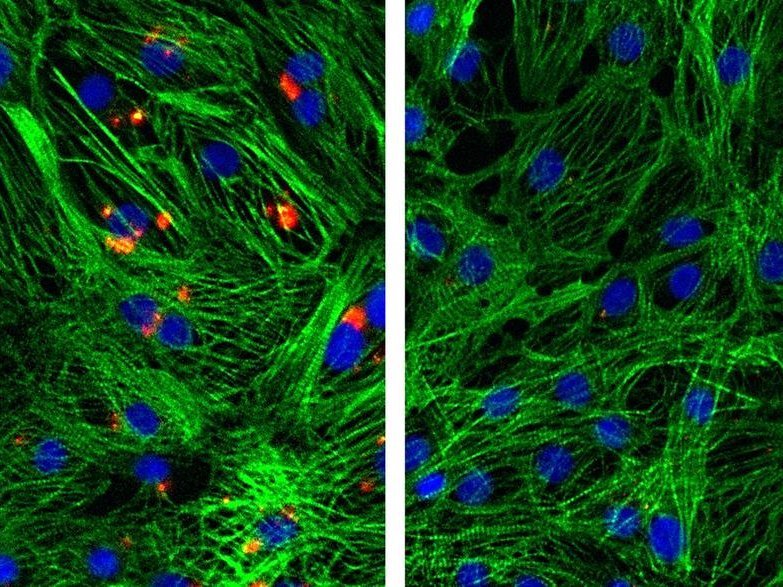
In heart muscle cells affected by Fabry disease (left), the fat deposits characteristic of the disease—marked in red—are clearly visible. After RNA therapy, however, they are barely present (right). Copyright: IMTTS; Malte Juchem/MHH
Fabry disease, also known as Morbus Fabry, is an inherited metabolic disorder in which certain fatty substances cannot be broken down sufficiently. These substances then accumulate in various organs and can cause severe damage there. The kidneys, heart, and nervous system are among the organs most frequently affected. Those affected lack the enzyme alpha-galactosidase A (GLA) or have only limited amounts of it. This is caused by mutations in the GLA gene. The disease is currently incurable and, if left untreated, can significantly shorten life expectancy. Cardiac complications are among the leading causes of death. Current therapies can positively influence the course of the disease but do not eliminate the underlying cause. Now, a team led by Prof. Dr. Dr. Thomas Thum, director of the Institute of Molecular and Translational Therapy Strategies at Hannover Medical School (MHH), has investigated a new treatment strategy in human heart muscle cells. The researchers used a genetically modified messenger RNA (mRNA) that contained the GLA blueprint. This enabled the cells to produce the missing enzyme on their own and significantly reduce the fat deposits characteristic of the disease. The study has been published in the journal “Advanced Science.”
Enzyme Is missing due to a genetic defect
Fabry disease is one of the so-called lysosomal storage disorders. Lysosomes are cell organelles—tiny, specialized compartments within a cell that perform specific tasks much like an organ. They function as recycling stations: they break down substances or cellular components that are no longer needed and release building blocks that can be utilized for cellular metabolism. To do this, they require specific enzymes. If, due to a genetic defect, the lysosomes lack an important enzyme or if that enzyme does not function properly, the corresponding substances accumulate in the cells, which can trigger serious diseases. In the case of GLA deficiency, two forms of therapy are currently available: enzyme replacement therapy, in which synthetically produced GLA is injected into the patient’s vein, and a tablet that delivers special proteins called chaperones. These proteins stabilize certain altered forms of the GLA enzyme and improve its function. However, this treatment is only possible for patients with specific GLA mutations.
GLA activity restored
The approach taken by Professor Thum’s research team relies on the cells themselves becoming active. “We use what is known as nucleoside-modified GLA mRNA—or modGLA for short—which is a laboratory-produced and chemically optimized mRNA that delivers the blueprint for the human GLA enzyme directly into the affected cells,” explains the cardiologist. This method is familiar from mRNA vaccines, such as those used to protect against COVID-19. To determine whether the principle also works for Fabry disease, the researchers tested it in two cell culture models using human heart muscle cells. In the first model, they used body cells from people with Fabry disease and reprogrammed them biotechnologically into so-called induced pluripotent stem cells (iPSCs). From these iPSCs, they were then able to isolate heart muscle cells exhibiting the characteristics of Fabry disease. In the second model, the GLA gene was completely removed from human heart muscle cells. “We treated both cell culture models with our modGLA and observed that the cells subsequently restored GLA activity and the lipid deposits decreased significantly. At the same time, other symptoms characteristic of the disease regressed, such as impaired processing of harmful oxygen free radicals or reduced energy production in the cells,” says Professor Thum.
Further research needed
The experimental results of the preclinical study show that the mRNA approach can not only correct the enzyme defect but also positively influence disease-related changes in the heart muscle cells. “Thus, the data provide important evidence that the progressive heart muscle damage associated with Fabry disease may be treatable in a more targeted manner than before,” notes Professor Thum. Further studies are now needed to determine whether these effects can be confirmed in living organisms and whether they can be applied to humans in the long term. The results thus form a basis for the further development of this therapeutic approach with a view to bringing it into clinical use in the future.
Keyword: Fabry disease
Fabry disease is a rare, genetically caused disorder that is currently incurable. It primarily affects the kidneys, the heart, and the nervous system. The most severe symptoms include impaired kidney function, strokes, and hypertrophic cardiomyopathy, in which the heart muscle pathologically thickens, which can lead to heart failure. The GLA gene is located on the X chromosome. As a result, men often develop the disease earlier and experience more severe symptoms. Ms, who have two X chromosomes, are often less severely affected.
SERVICE
The original publication, “Nucleoside-Modified mRNA Encoding Alpha-Galactosidase A Ameliorates Fabry Disease Phenotypes in Human IPSC-Derived Cardiomyocytes,” can be found here.
Text: Kirsten Pötzke