MHH and the State Health Department are participating in the international PREPAIR-VAC project for the development and adaptation of vaccines.
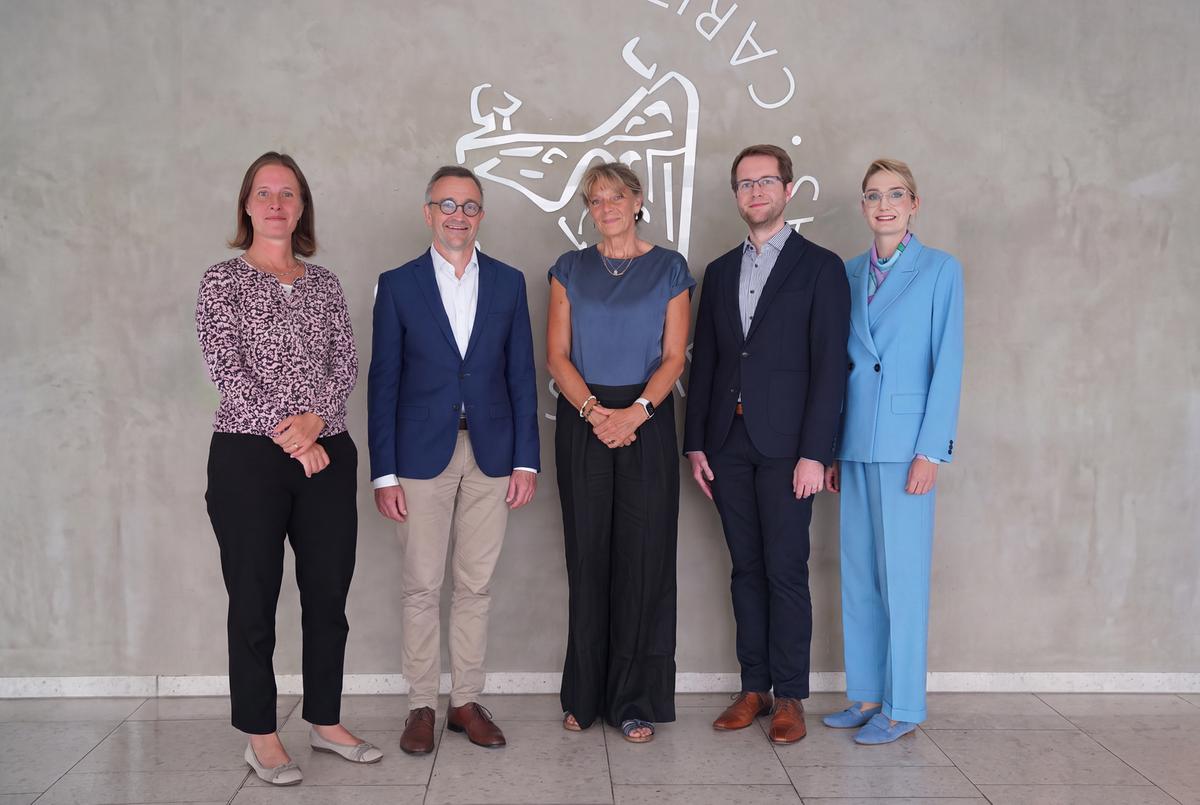
At the MHH (from left): Prof. Dr. Dr. Sabine Salloch, Director of the MHH Institute of History, Ethics and Philosophy of Medicine, NLGA President Dr. Fabian Feil, MHH President Prof. Dr. Denise Hilfiker-Kleiner, Dr. Richard Egelkamp, Head of the Next Generation Sequencing Division at the NLGA, Prof. Dr. Dr. Ricarda Schmithausen, Head of Department 3: Hygiene and Environmental Medicine at the NLGA. Copyright: Lower Saxony State Health Office
Emerging pathogens can often spread faster than effective vaccines can be developed. The European research project PREPAIR-VAC therefore aims to significantly shorten the time between the emergence of new virus variants and the development of a suitable vaccine. To achieve this, a rapid, AI-supported development platform will be used to facilitate key steps in vaccine development—from predicting viral evolution to manufacturing the vaccine. This will allow vaccines to be adapted more quickly to new virus variants, even for well-known pathogens such as influenza. Currently, this process takes several months—time during which viruses can continue to mutate and reduce the effectiveness of vaccines.
Two institutions from Lower Saxony—the Hannover Medical School (MHH) and the Lower Saxony State Health Office (NLGA)—are part of the international consortium. The project is funded by the European Union’s “Horizon Europe” research and innovation program—one of the most prestigious research programs dedicated to promoting excellence in research and international collaboration. Of the total funding of 6.57 million euros, approximately ten percent (650,000 euros) will go to Hannover. The project will conclude in August 2030.
The goal: concrete recommendations for action
Prof. Dr. Dr. Sabine Salloch, Director of the Institute of History, Ethics and Philosophy of Medicine at MHH, is investigating ethical, legal, and societal issues surrounding the use of AI-supported vaccine technologies in collaboration with the NLGA. The NLGA is contributing its expertise at the intersection of public health and genomics to the project: Among the NLGA’s tasks is the creation of an influenza sequence database containing information on the genetic material of hundreds of thousands of viruses, which will serve as the basis for AI training. The goal is to translate scientific findings into concrete recommendations for action for public health services and health policy.
“By submitting a joint proposal for the EU project PREPAIR-VAC, the MHH and the NLGA have set an example for future collaborations that transcend the boundaries between research, teaching, and health care, thereby sustainably improving public health and advancing cutting-edge medical research,” says MHH President Prof. Dr. Denise Hilfiker-Kleiner.
“Pandemics do not stop at national borders. That is why we need international research and strong partnerships. During the COVID-19 pandemic, effective vaccines marked a turning point that has saved countless lives worldwide. Accelerating this progress is essential for future infectious disease emergencies. We are therefore pleased to contribute our public health expertise to PREPAIR-VAC, a leading European project, and to help shape scientific innovations in a way that benefits people as quickly and responsibly as possible. Ultimately, this contributes to our overarching goal—to sustainably strengthen the health protection of the population,” says NLGA President Dr. Fabian Feil.
PREPAIR-VAC
PREPAIR-VAC stands for “PREParedness using Artificial Intelligence for Rapid VACcine design.” It brings together leading partners from the fields of AI, vaccine development, public health, and biotechnology. It is coordinated by the European Vaccine Initiative (Germany), further strengthening Germany’s contribution to the project. PREPAIR-VAC brings together leading partners from the fields of AI, vaccine development, public health, and biotechnology. In addition to the MHH and the NLGA, the following institutions are collaborating on the project: Croda Denmark A/S (Denmark), European Vaccine Initiative (Germany), NEC Bio Therapeutics GmbH (Germany), NEC OncoImmunity AS (Norway), NEVEZYNE SAS (France), Université Jean Monnet – Saint-Étienne (France), and Uppsala University (Sweden).
Grant agreement No. 101289538
Funded by the European Union. The views and opinions expressed are solely those of the authors and do not necessarily reflect those of the European Union or the European Executive Agency for Health and Digital. Neither the European Union nor the funding authority can be held liable for them.
Text: Administrative unit for communications