As part of the C-TIP-HCC research consortium, the MHH team is searching for biomarkers for the tipping point and for new therapeutic approaches.
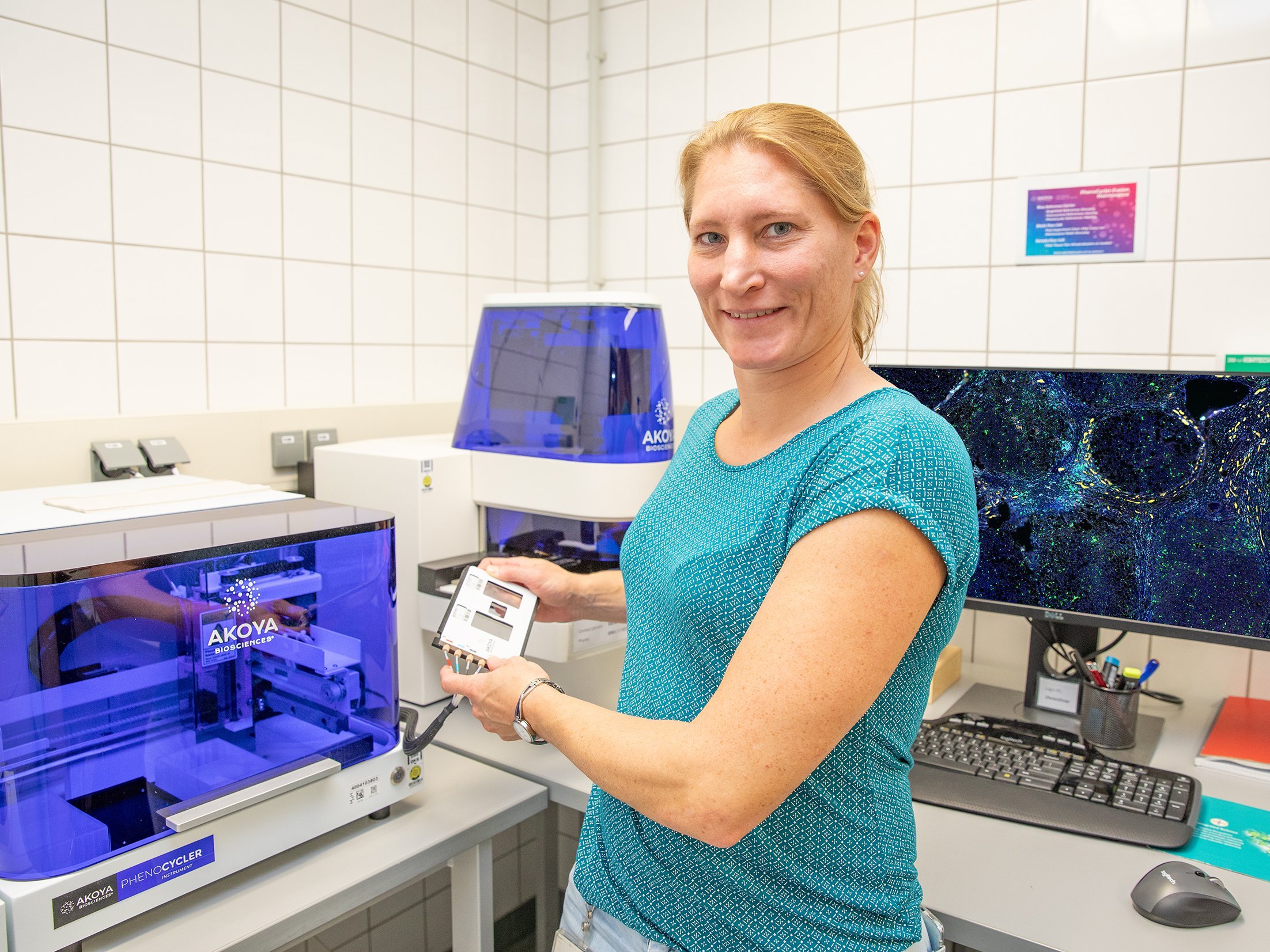
On the trail of biomarkers for early liver cancer diagnosis: Dr. Katharina John, research associate in the “Translational Hepatology” research group. Copyright: Karin Kaiser/MHH
In Germany, approximately 10,000 people are diagnosed with liver cancer each year. A particular problem with this disease—also known in medical terminology as hepatocellular carcinoma (HCC)—is that it causes no symptoms for a long time. As a result, HCC is often not diagnosed until it has reached an advanced stage, when it is already too late for a cure. The liver tumor usually develops from cirrhosis of the liver, which arises as a long-term consequence of chronic liver damage. Exactly when cirrhosis progresses to a tumor remains unclear. Identifying this tipping point is the goal of the C-TIP-HCC project, which is coordinated by the Hannover Medical School (MHH) in collaboration with the University Hospitals of Heidelberg, Mannheim, and Düsseldorf, as well as the Leibniz Institute for Work Research at the Technical University of Dortmund.
The subproject at the MHH is led by Prof. Dr. Heike Bantel, a senior physician in the Clinical Department of Gastroenterology, Hepatology, Infectious Diseases and Endocrinology and head of the “Translational Hepatology” research group. The research team is analyzing signaling pathways at various stages of liver remodeling and searching for biomarkers that indicate the development of hepatocellular carcinoma at an early stage. The project is in its second funding phase and is receiving a total of 10.4 million euros in funding from the Federal Ministry of Research, Technology, and Space (BMBFTR). Of this amount, the MHH is receiving approximately one million euros.
Symptoms are usually nonspecific
In liver cirrhosis, liver tissue becomes scarred and transforms into connective tissue. As a result, the organ shrinks and can no longer perform its vital functions as the body’s central metabolic and detoxification system. Symptoms are usually nonspecific. Those affected are often tired, have reduced energy levels, and may lose weight or, if ascites develops, gain weight. People with liver cirrhosis have an increased risk of developing HCC over time. In the C-TIP-HCC project, researchers aim to identify the tipping points that signal the development of HCC. To this end, they investigated structural changes in the extracellular matrix—the “supporting framework” between cells—and in cell-cell interactions, specifically the signals that cells exchange with one another.
Analysis using state-of-the-art technology
Professor Bantel’s team compared connective tissue cells and certain immune cells that play an important role in liver cancer. The researchers focused on both the environment surrounding the HCC and the tumor-free cirrhotic liver tissue. With the help of the grant funds, they were able to purchase a multispectral microscope featuring so-called PhenoCycler technology for the analysis. This cutting-edge technology makes it possible to visualize up to 100 biomarkers simultaneously in a tissue sample at the single-cell level through multiple automated staining cycles. “This allows us to identify a large number of proteins and potential candidate markers for HCC development,” says Dr. Katharina John, a research associate in the “Translational Hepatology” research group.
Blood sample aims to indicate tipping point
The researchers also searched for markers in the blood that indicate early changes in liver tissue. “We are now investigating whether and how the markers from tissue and blood are related,” says Professor Bantel. Bioinformaticians are using the data to create mathematical models designed to help identify patients at high risk for hepatocellular carcinoma at an early stage. Based on these findings, a so-called TIP score will be developed to indicate the tipping point, making it possible in the future to detect early signs of liver cancer development with high accuracy using a single blood sample. “However, our goal is not only to develop new diagnostic strategies in the fight against hepatocellular carcinoma,” says Professor Bantel. “Based on our findings, we also want to contribute to the development of new therapeutic approaches to combat or even prevent the onset of cancer at an early stage.”
Hepatocellular carcinoma is greatly underestimated
“Hepatocellular carcinoma is a severely underestimated health problem worldwide and in Germany, where the timely detection of tumors as small as possible is particularly crucial,” explains Clinic Director Prof. Dr. Heiner Wedemeyer. “The collaboration of scientists from various fields—including data scientists and mathematicians—within C-TIP-HCC offers entirely new opportunities to fundamentally improve early diagnosis and treatment options. Many patients could benefit directly from this.”
C-TIP-HCC
In addition to the MHH, the University Hospitals of Heidelberg,Mannheim, and Düsseldorf, as well as the Leibniz Institute for Work Research in Dortmund, the Universities of Freiburg and Leipzig, the German Cancer Research Center in Heidelberg, the Heidelberg Institute for Computational Biomedicine, Saarland University Hospital, Bochum University Hospital, and RWTH Aachen University.
Text: Kirsten Pötzke