A 3.8-billion-year-old quantum machine controls our immune system: MHH research team discovers ancient mechanism that still works.
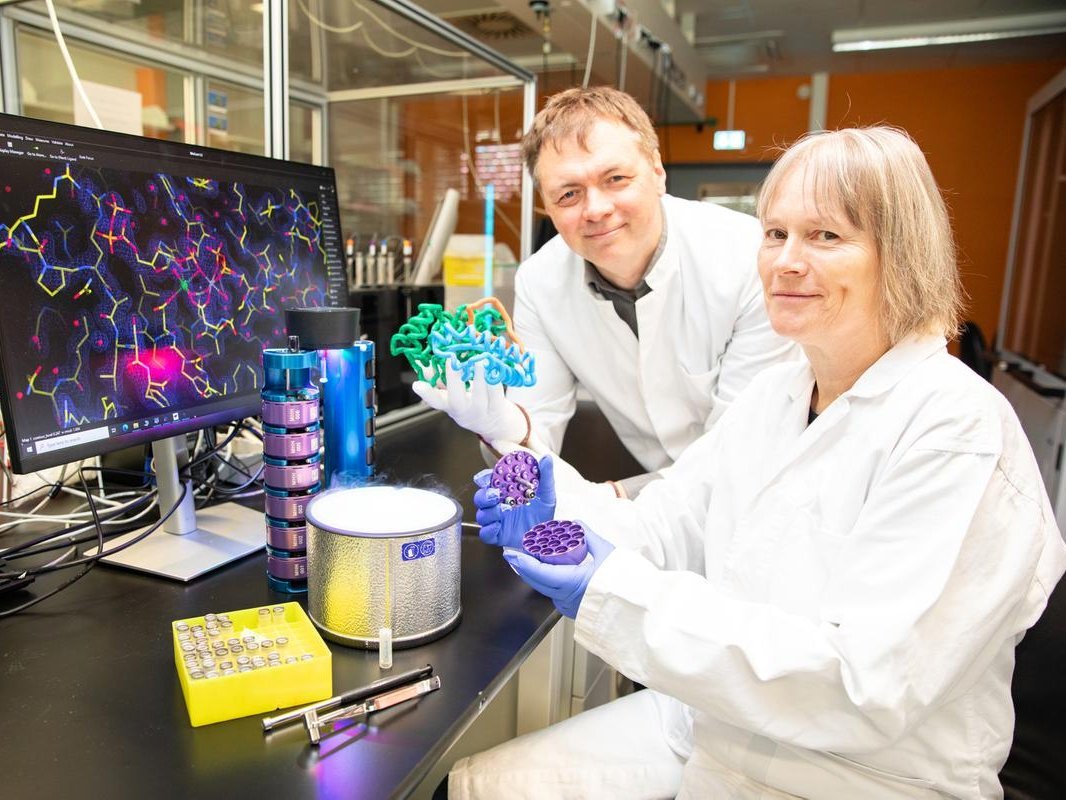
Prof. Dr. Roman Fedorov (left) and Petra Baruch at the MHH Institute of Biophysical Chemistry. Prof. Fedorov is showing a model of the protein oligoadenylate synthase, whose structure is also visible on the screen. Petra Baruch is holding a container in which the protein crystals are stored and transported. Copyright: Karin Kaiser/MHH
Our immune system is much older than we think. Long before dinosaurs existed, early life forms had developed a powerful defense system. Innate immunity has existed since the Cambrian period—that is, since the time when nearly all of today’s animal phyla emerged. This ancient mechanism has been passed down through evolution and continues to protect us today from viruses, cancer, and other diseases.
A research team at Hannover Medical School (MHH) has now discovered a fundamental mechanism that activates the innate immune response. It likely originated more than three and a half billion years ago and has thus existed for as long as life has existed on Earth. This mechanism activates the immune system through quantum mechanical phenomena.
The research findings of the team led by Prof. Dr. Roman Fedorov from the MHH Institute of Biophysical Chemistry can serve as a basis for the development of drugs against viral infectious diseases such as COVID-19, autoimmune diseases, and cancer. Furthermore, they demonstrate that quantum phenomena play a significant role in biology. They were published in the scientific journal ACS Omega of the American Chemical Society (ACS).
Proteins that function like smoke detectors
The scientists focused on a group of very ancient proteins found in all our cells. These oligoadenylate synthetases (OAS) function like smoke detectors: they detect a viral infection or damage to the body’s own tissue and then activate the immune response. These molecular sensors are found, for example, in the cells of the nasal mucosa, where they are involved in the first line of defense against SARS-CoV-2 viruses.
Using methods from structural biology, biochemistry, and quantum chemistry, the team discovered that the function of these proteins is controlled by their so-called metal center—a region of the protein that contains magnesium. The researchers found that quantum mechanical processes in the metal center ensure that OAS trigger the defense processes against viruses or damaged tissue. The results confirm, as do many other recent research findings, that quantum phenomena play a significant role in biology.
Highly optimized quantum machines
Quantum mechanics describes how nature functions at its deepest, most fundamental level—where the rules of everyday life no longer apply. In our familiar world, objects behave predictably: a ball follows a clear path, and a switch is either on or off. But in the quantum world, particles can behave simultaneously as waves and as particles, exist in multiple states at once, and only “choose” a specific outcome when they interact with their environment. Quantum effects enable matter to perform tasks with extraordinary precision and efficiency. “When such principles operate in biological molecules—as our work shows—they transform proteins into tiny, highly optimized ‘quantum machines’ that can control complex processes such as immune responses with remarkable accuracy,” says Professor Fedorov.
Ancient immune building blocks control our lives
“We assume that the metal center likely originated more than three and a half billion years ago, that is, almost at the dawn of life—perhaps even earlier,” says Professor Fedorov. They determined this because it is nearly identical to the catalytic center of ancient organisms. Thus, our immune system relies on a billion-year-old quantum machine that has been preserved throughout evolution and continues to actively protect us today.
Building on these research findings, drugs can now be developed that activate OAS in viral infections and cancer, or inhibit it in autoimmune diseases. This process will take several more years.
SERVICE
The original publication “The Enzymatic Mechanism of OAS: How Metal Ions and Quantum Effects Help Activate Innate Immunity” can be found here.
Text: Bettina Bandel