Macrophages could usher in a new era in medicine for the treatment of inflammation, cancer, and blood disorders
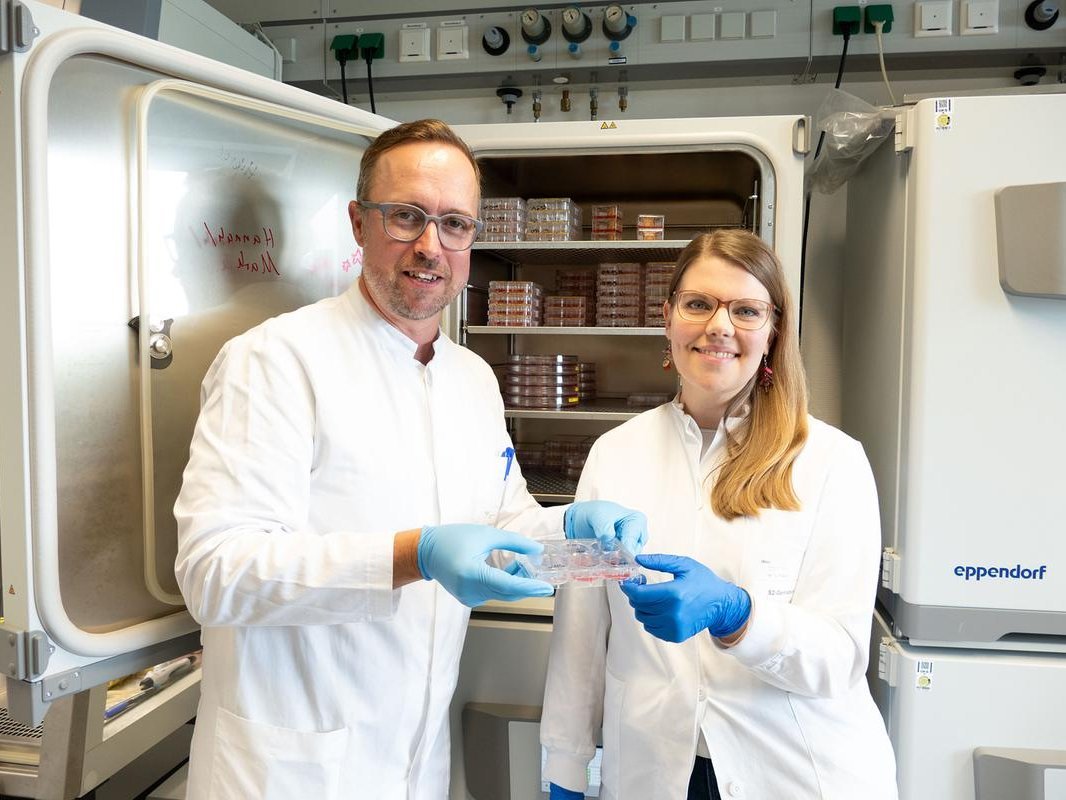
In the lab: Prof. Dr. Nico Lachmann and Dr. Daniela Paasch. Copyright: Bettina Bandel/MHH
Macrophages could revolutionize the treatment of inflammation, cancer, and blood disorders. An MHH team highlights the current state of research in a high-impact peer-reviewed journal. The researchers are able to produce these immune cells themselves from stem cells.
Cell therapies are among the most promising developments in modern medicine. They are already well established for certain diseases. For example, T cells are successfully used to treat certain types of cancer; they can recognize and destroy foreign cells. Hematopoietic stem cells can help treat blood disorders.
Now, other cell types are also coming into the spotlight of research: macrophages, the so-called “scavenger cells.” These immune cells recognize and eliminate pathogens, dead cells, and harmful substances. What is particularly remarkable is that macrophages can promote inflammation to fight infections, but they can also act as anti-inflammatory agents to regenerate tissue. These properties make them promising candidates for the treatment of cancer, chronic inflammation, cardiovascular diseases, and neurodegenerative diseases such as Alzheimer’s.
A step toward a new heneration of immunotherapies
A team of experts led by Prof. Dr. Nico Lachmann of the Clinical Department of Paediatric Pneumology, Allergology and Neonatology at Hannover Medical School (MHH) has now published an article highlighting the current state of research on macrophage therapies. The publication appeared in “Signal Transduction and Targeted Therapy,” one of the leading journals in the life sciences. The first author is Dr. Daniela Paasch.
In the article, the team describes therapies using so-called CAR macrophages. These are macrophages into which “antennas” (chimeric antigen receptors—CARs) have been engineered using modern genetic technology. Initial clinical trials in humans show that these immune cells can be effectively used to treat breast cancer. Further clinical trials are currently being prepared, for example, for the treatment of liver, heart, and lung fibrosis, as well as neurodegenerative diseases such as Alzheimer’s.
From cell culture to therapy: macrophages fight tumors from the inside
“The development of CAR macrophages is a crucial step toward a new generation of immunotherapies,” says Professor Lachmann. “Conventional immunotherapies such as CAR-T cells face particular difficulties with solid tumors, such as breast cancer. So far, these cells have often been unable to penetrate the tumor effectively, or the tumor microenvironment ‘suppresses’ them. This is where macrophages could be used.”
The challenges now include producing the cells on a large scale and cost-effectively so that they are available in many Clinical Departments and can be used for further research. In addition, clear regulations must be in place governing how such cell therapies are approved and monitored.
The MHH team has already developed a technology that allows it to produce macrophages from induced pluripotent stem cells (iPS cells) on various scales. These are somatic cells that have been “reprogrammed” using biotechnology and from which any cell type in the body can be developed. The team is now combining large-scale cell production with various methods to test the potential of this new immunotherapy for different diseases. As part of the MHH’s Centre for Cell and Gene Therapies, the team is also conducting research on iPSC macrophages within the RESIST Cluster of Excellence and at the German Center for Lung Research.
Text: Bettina Bandel
SERVICE
You can findthe original publication here.