A quality agreement between the MHH and the TK is intended to improve care for those affected and thereby close a gap in care.
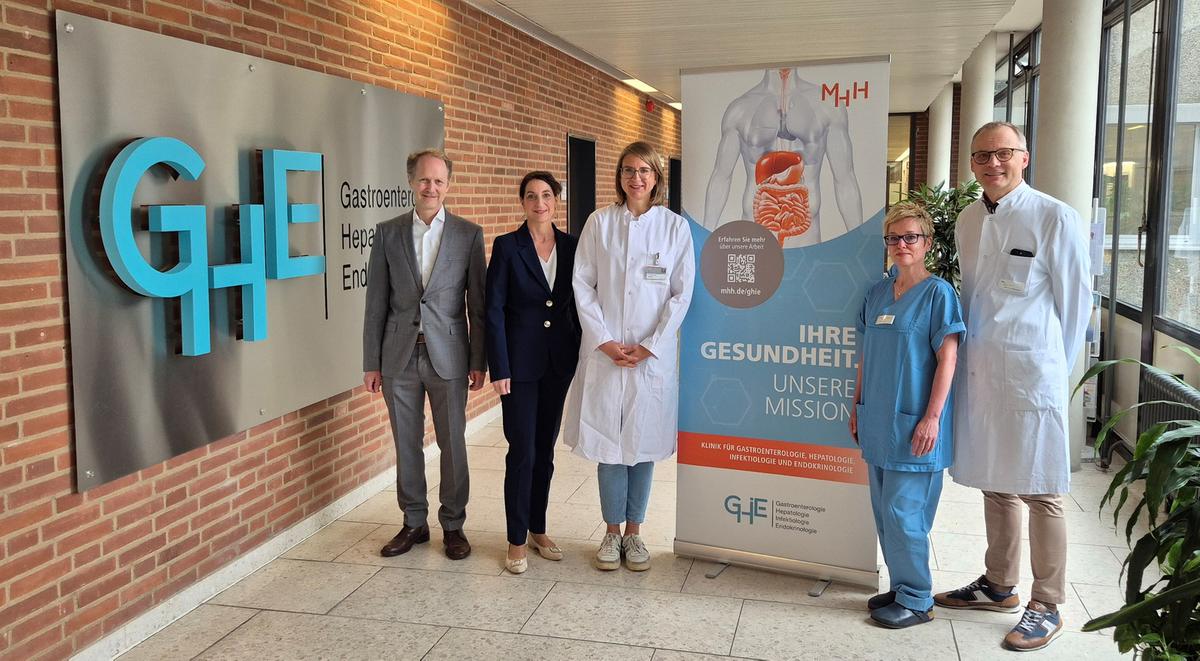
Focusing on malnutrition: Jochen Blaser and Annette Hempen from Techniker Krankenkasse, PD Dr. Katharina Hupa-Breier, Claudia Seipt from the Office of Academic Affairs, and Clinic Director Prof. Dr. Heiner Wedemeyer (from left). Copyright: Inga Budde/MHH
Many patients in German hospitals are malnourished. As a result, they face an increased risk of a poorer recovery and earlier death. Nevertheless, malnutrition is rarely diagnosed in Clinical Departments and even more rarely treated. “Malnutrition is an underestimated problem in German Clinical Departments,” explains nutrition specialist and associate professor (PD) Dr. Katharina Hupa-Breier of the Clinical Department of Gastroenterology, Hepatology, Infectious Diseases and Endocrinology at Hannover Medical School (MHH). To optimize care for affected patients, the Clinical Department has entered into a so-called quality agreement with the Techniker Krankenkasse (TK). Among other things, the agreement includes systematic nutritional screening. “The contract is a significant step forward. It enables us to identify patients affected by malnutrition at an early stage and treat them accordingly. As a result, nutritional medicine is given greater priority in patient care,” says Clinic Director Prof. Dr. Heiner Wedemeyer.
High rate of affected patients
Malnutrition is not just about body weight. Rather, the term refers to a persistent nutrient deficiency—for example, a lack of vitamins, minerals, or proteins. This deficiency leads to changes in body composition and a decline in physical and mental functions. “The intake of nutrients and calories can be reduced by cancer, gastrointestinal disorders, infectious diseases, or even the use of certain medications,” explains PD Dr. Hupa-Breier, who heads the interdisciplinary team for nutritional medicine at the MHH. Malnourished patients are not uncommon in German hospitals. In prospective studies, the rate ranges from at least 30 to 70 percent. However, PD Dr. Hupa-Breier, together with her colleagues from Würzburg, was able to demonstrate that there is currently a significant discrepancy between the clinical risk of malnutrition and the actual documented detection and treatment of malnutrition.
Significant gap in diagnosis and treatment
In a recent analysis of representative health insurance data from the database of the Institute for Applied Health Research in Berlin, the researchers were able to show that malnutrition was diagnosed in only 1.16 to 1.30 percent of inpatients. “These data indicate that a significant proportion of malnourished patients in Clinical Departments are currently not being adequately diagnosed,” explains PD Dr. Hupa-Breier. Of the diagnosed cases, in turn, only 2.77 to 4.45 percent were treated with appropriate nutritional therapy.
The study also showed that patients diagnosed with malnutrition were more likely to die or be readmitted to the hospital. In a control group analysis adjusted for age, sex, and comorbidities, the 90-day mortality rate was 18.2 percent compared to 7.3 percent in the control group. The readmission rate was also higher: Within 90 days of discharge, 44.9 percent of malnourished patients were readmitted to the hospital, compared to 37.8 percent in the control group. Furthermore, the average healthcare costs within one year of a malnutrition diagnosis were 18,052 euros per person—4,396 euros higher than those in the control group. “Our study reveals a significant gap between the actual nutritional risk and the documented diagnosis and treatment. We must identify at-risk patients early on and provide them with better care through structured screenings and individualized nutritional therapy. After all, good nutrition is an essential component of good medical care,” says PD Dr. Hupa-Breier.
MHH gastroenterology as a pioneer
To address the problem, the Clinical Department of Gastroenterology, Hepatology, Infectious Diseases and Endocrinology entered into a quality agreement with TK. Under this agreement, TK policyholders are assessed for their nutritional status upon admission to the hospital and, if necessary, receive individualized counseling and treatment. Additional screenings are conducted during longer hospital stays and upon discharge. TK finances these services through specially agreed-upon surcharges.
With this quality agreement, the Clinical Department is among the pioneers in Germany. Until now, only a few Clinical Departments have addressed this issue. This is due, on the one hand, to a lack of awareness of the problem and, on the other hand, to the absence of reimbursement structures within the statutory health insurance system. “Together with TK, we want to help change that,” explains PD Dr. Hupa-Breier. The data and findings obtained through the quality agreement will also be made available to the Joint Federal Committee (G-BA). In April 2026, the G-BA was tasked by the Hospital Reform Adjustment Act with defining measures to ensure quality in the detection and treatment of malnutrition in hospitals. PD Dr. Hupa-Breier sees this as an important step. She hopes that structured screenings and corresponding care pathways will be made mandatory in hospitals as soon as possible.
The original publication can be found here.
Text: Tina Götting