MHH researchers have deciphered the signaling pathway that controls the movement of mitochondria within cells during heart development.
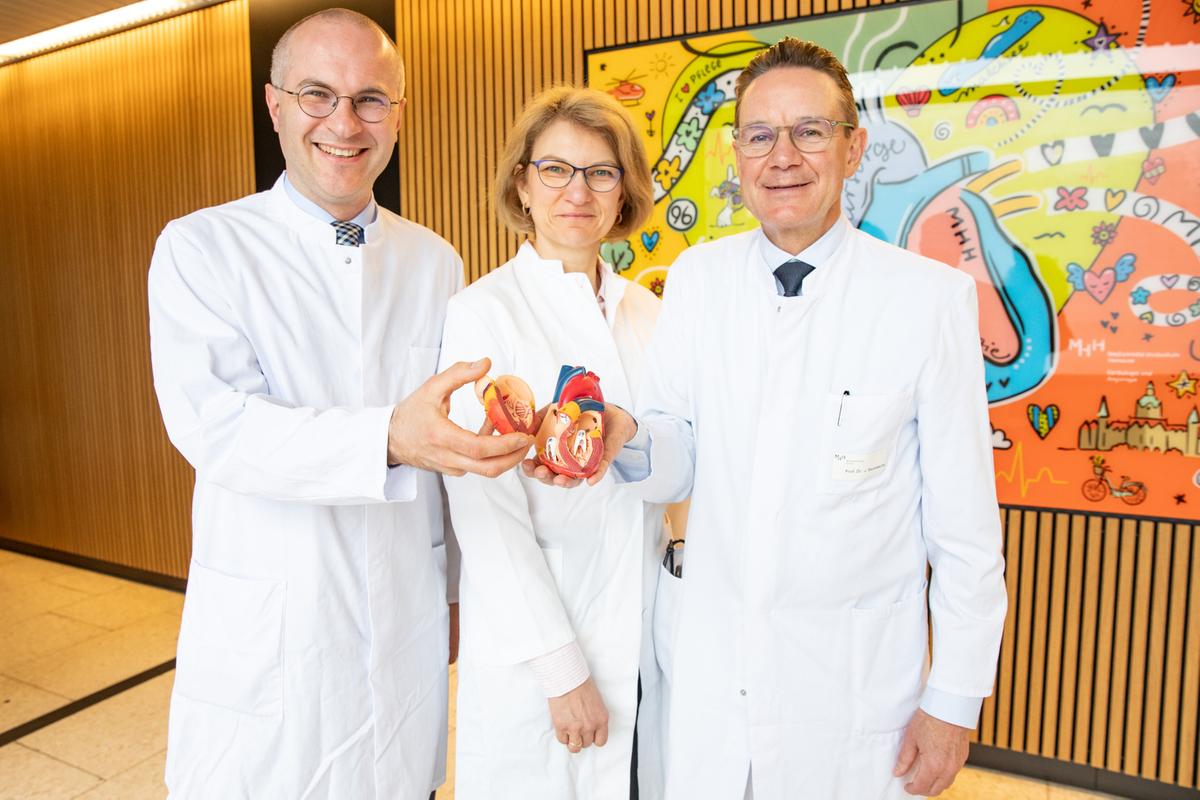
Have explained how the powerhouses of heart muscle cells reach their destination (from left): Associate Professor Dr. Christian Riehle, Dr. Natali Froese, and Prof. Dr. Johann Bauersachs. Copyright: Karin Kaiser/MHH
Our heart beats about 100,000 times a day—and does so throughout our entire lives. It draws the energy for this activity from the mitochondria. As the “powerhouses of the cells,” they produce 95 percent of adenosine triphosphate (ATP), the body’s most important energy currency. If the mitochondria are impaired and cannot function properly, the heart muscle cells lack the strength to pump enough blood, oxygen, and nutrients throughout the body. Due to its high energy requirements, the heart has the highest mitochondrial density of all organs, accounting for about one-third of its cell volume. During heart development, the mitochondria migrate to the so-called sarcomeres. These smallest components of the muscle cell enable contraction and require energy to do so.
Researchers led by associate professor Dr. Christian Riehle, head of the Myocardial Energetics research group at the Clinical Department of Cardiology and Angiology at Hannover Medical School (MHH), and Clinic Director Prof. Dr. Johann Bauersachs have now discovered how the mitochondria find their way to the sarcomeres. They have demonstrated that the movement of mitochondria within heart muscle cells is controlled by so-called RHOT proteins. This process plays a key role when the heart grows and is under particular strain. This may also occur during competitive sports, but also during disease-related remodeling processes in the heart muscle, such as after a heart attack. Therefore, RHOT proteins represent a promising new approach for treating heart failure. The study’s findings have been published in the journal “Circulation Research.”
Without RHOT, the heart cannot develop
The research team discovered the proteins through bioinformatic gene analysis. “We observed that a great deal of RHOT1 and RHOT2 is produced in the heart,” says PD Dr. Riehle. The function of the proteins in the heart had been largely unknown until then. “However, their high abundance was a clear indication to us that they must be responsible for a key mechanism.” The researchers then investigated the biological signaling pathway in a mouse model. “We knocked out the two proteins RHOT1 and RHOT2 in the heart muscle cells during embryonic development,” explains Dr. Natali Froese, a research associate in the group and first author of the study. “As a result, the mitochondria did not migrate to the sarcomeres but instead clustered around the cell nucleus.” Because the mitochondria could no longer bind to the muscle fiber proteins, the sarcomeres lacked the energy for further development, leading to heart weakness and heart failure.
Also important under increased workload
The researchers also knocked out RHOT1 and RHOT2 in adult mice. Here, however, the loss of these molecular switches did not have the same lethal effect. Although mitochondrial mobility was similarly restricted, ATP production at the sarcomeres was maintained. “This means that in mature heart muscle cells, the mitochondria are already at their intended location,” explains PD Dr. Riehle. The migration toward the sarcomeres thus takes place during embryonic development. The second finding from the study is that RHOT proteins may also play an important role during increased cardiac workload—for example, after a heart attack, when dead heart muscle tissue is replaced by non-functional connective tissue and the remaining heart muscle cells must compensate for the loss. “In this context, RHOT proteins represent an attractive therapeutic target,” explains PD Dr. Riehle. One possibility would be to increase the activity of RHOT proteins so that more energy is available to the heart muscle cells. A gene therapy approach is conceivable here.
Possible therapeutic approach for PPCM
Heart muscle cells also face increased strain during pregnancy. The heart muscle then enlarges by up to 30 percent. This is completely normal, but in rare cases can lead to life-threatening peripartum cardiomyopathy (PPCM). This condition can occur in women with previously healthy hearts a few weeks before or after childbirth and can lead to severe heart failure and even death within a short period of time. “Our Clinical Department is Europe’s leading PPCM center with a specialized outpatient clinic that cares for patients through a multidisciplinary team,” emphasizes Professor Bauersachs. The condition is not only treated at the Clinical Department but is also one of its primary research focuses. “The RHOT proteins could also offer a therapeutic approach here to relieve the heart muscle cells of pregnant women and protect the heart,” hopes the Clinical Department director.
The original paper, “RHOT Proteins Link Mitochondrial Motility to Cardiomyocyte Sarcomere Maturation,” can be found here.
Text: Kirsten Pötzke