Researchers have been able to demonstrate how the virus interferes with the genetic programme of cells, suppresses the immune response and disrupts cell function.
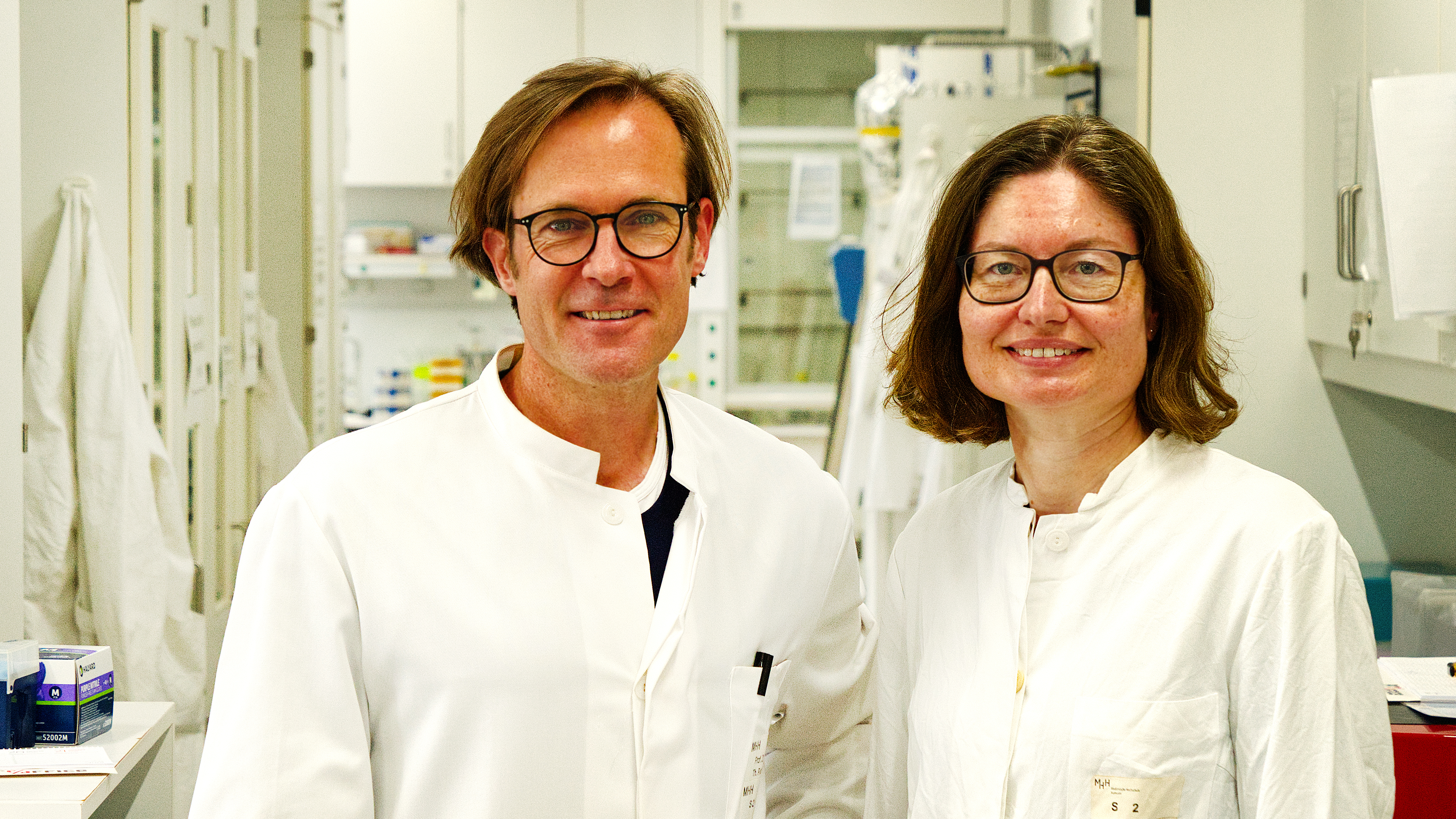
In the laboratory: Prof. Dr Thomas Pietschmann and Dr Sibylle Haid. Copyright: @TWINCORE
Respiratory syncytial virus (RSV) can cause severe lower respiratory tract infections, particularly in newborns and the elderly. How the virus manages to evade the immune system and what changes it triggers in infected cells had not yet been fully understood. Researchers at TWINCORE, the Centre for Experimental and Clinical Infection Research, have now demonstrated in a study how the virus interferes with the genetic programme of respiratory cells, inhibits the immune response and disrupts cell function. The study was led by Prof. Dr Thomas Pietschmann, Director of the TWINCORE Institute for Experimental Virology and Professor at Hanover Medical School (MHH). The team carried out the research in collaboration with interdisciplinary colleagues from Würzburg, Regensburg, Braunschweig and Hanover. These findings were published in the journal *Science Advances*.
Only a fraction of infected cells recognise the infection
According to estimates by the World Health Organisation (WHO), around 3.6 million children worldwide require hospital treatment for RSV each year. For 100,000 of them, the infection is fatal. “It was previously unclear exactly how the virus causes damage to the epithelial cells of the airways and why the immune response does not keep it more effectively in check,” says Professor Pietschmann.
To answer this question, the researchers used a specialised cell culture model. They cultured respiratory tract cells from donors – typically patients who were due to receive a donor lung. “In the laboratory, these cells then grow together to form a lung-like ciliated epithelium, complete with cilia beating and mucus production,” says Prof. Dr Bettina Wiegmann from the Department of Cardiac, Thoracic, Transplant and Vascular Surgery at MHH and co-author of the study. They then infected this tissue culture with RSV and subsequently analysed gene activity in each individual cell using RNA sequencing. “When compared with uninfected cells, we can see how thousands of genes are regulated by the infection,” says Prof. Dr Emmanuel Saliba, head of the ‘Single-Cell Analysis’ research group at the Helmholtz Institute for RNA-based Infection Research (HIRI) in Würzburg, a site of the Braunschweig-based Helmholtz Centre for Infection Research in cooperation with the Julius Maximilian University of Würzburg.
“Our data show that only a fraction of the infected cells even realise they have been infected,” says Dr Sibylle Haid, a scientist in Professor Pietschmann’s Institute. She is the first author of the paper, alongside Kevin Berg from the University of Regensburg. “This is probably because only some lung cells produce sufficient quantities of viral sensors and thus generate signalling molecules quickly enough to protect themselves and neighbouring cells.” If there are too few of these sensor molecules, the virus gains the upper hand, multiplies and then actively suppresses this defence mechanism. A key signalling molecule in the immune system is interferon, which both has a direct antiviral effect and activates the so-called interferon-stimulated genes (ISGs).
Key findings on RSV infection
“Even treating the cells with interferon cannot eliminate the virus,” says Dr Haid. With one exception: the team discovered that the antiviral transcription factor IRF1 is not suppressed by RSV and was then able to show that artificially activating this factor can curb the RSV infection – at least in the simplified model.
The researchers also found a possible explanation for the cell damage caused by RSV. “In the infected epithelial cells, the genes that control cilium formation were also inhibited,” says Dr Haid. Cilia are the tiny hair-like structures on cells that are responsible, amongst other things, for clearing mucus. When this function is disrupted by the infection, the typical symptoms of the disease arise.
“In this study, we were able to gain important insights into the Pathology of RSV infection at the cellular level and, furthermore, identify IRF1 as a potentially promising candidate for pharmaceutical intervention,” says Professor Pietschmann. “This would not have been possible without the interdisciplinary collaboration with our partners.” In addition to the research teams led by Professor Pietschmann, Professor Saliba and Prof. Dr Florian Erhard from the University of Regensburg and the MHH, the Helmholtz Centre for Infection Research in Braunschweig was also involved. The research project was funded by the Cluster of Excellence RESIST.
The original publication can be found here.
Text: This text is based on a press release from TWINCORE, Centre for Experimental and Clinical Infection Research