Between the lecture hall and the waiting list: When medical students teach their own transplant stories.
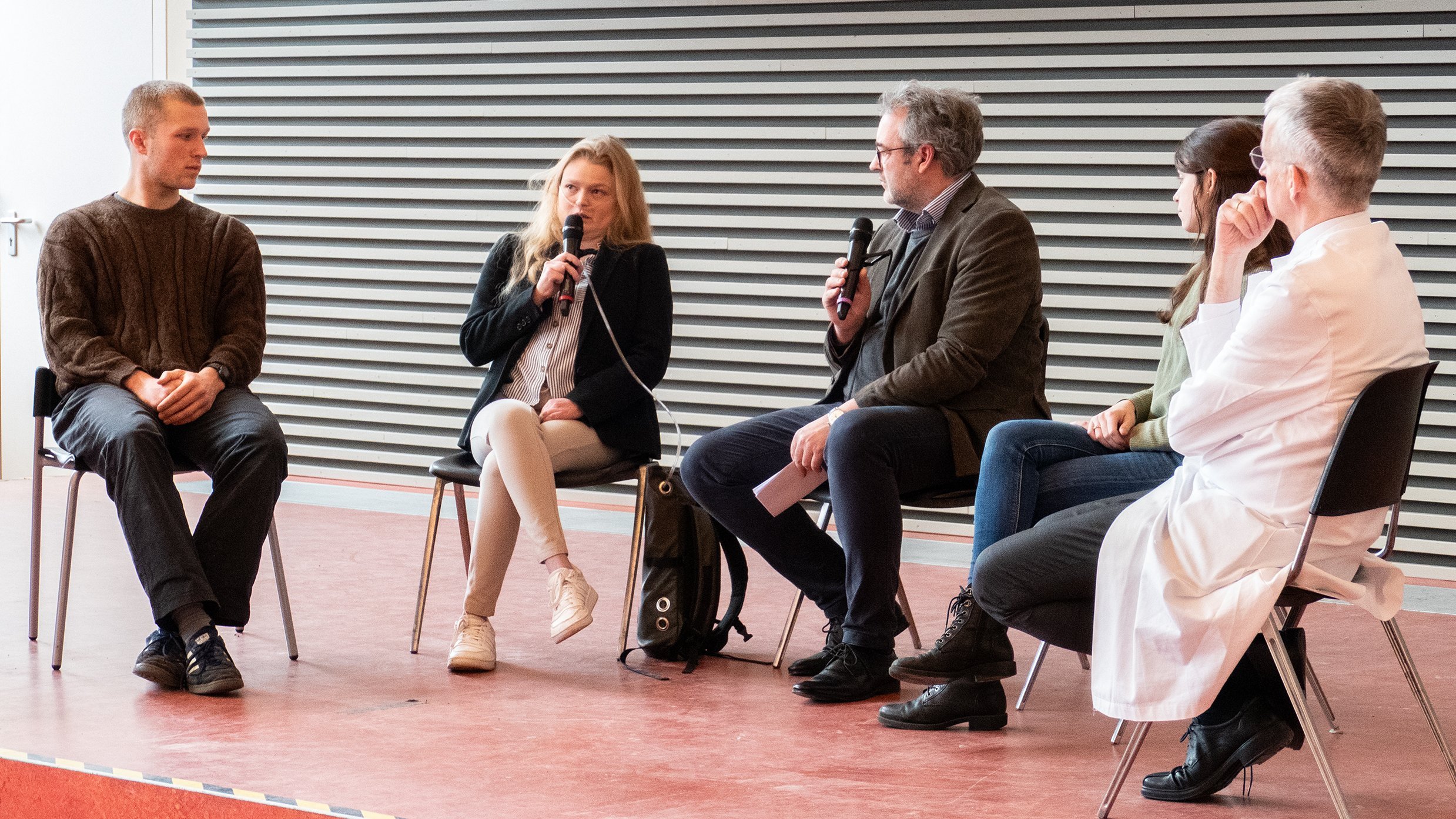
Panel discussion on organ donation and transplant medicine: (from left) Malte Storsberg, India Heilmann, Prof. Dr. Christian Mühlfeld, Lina Rosenboom, and Prof. Dr. Frank Lammert. Copyright: Bettina Dunker/MHH
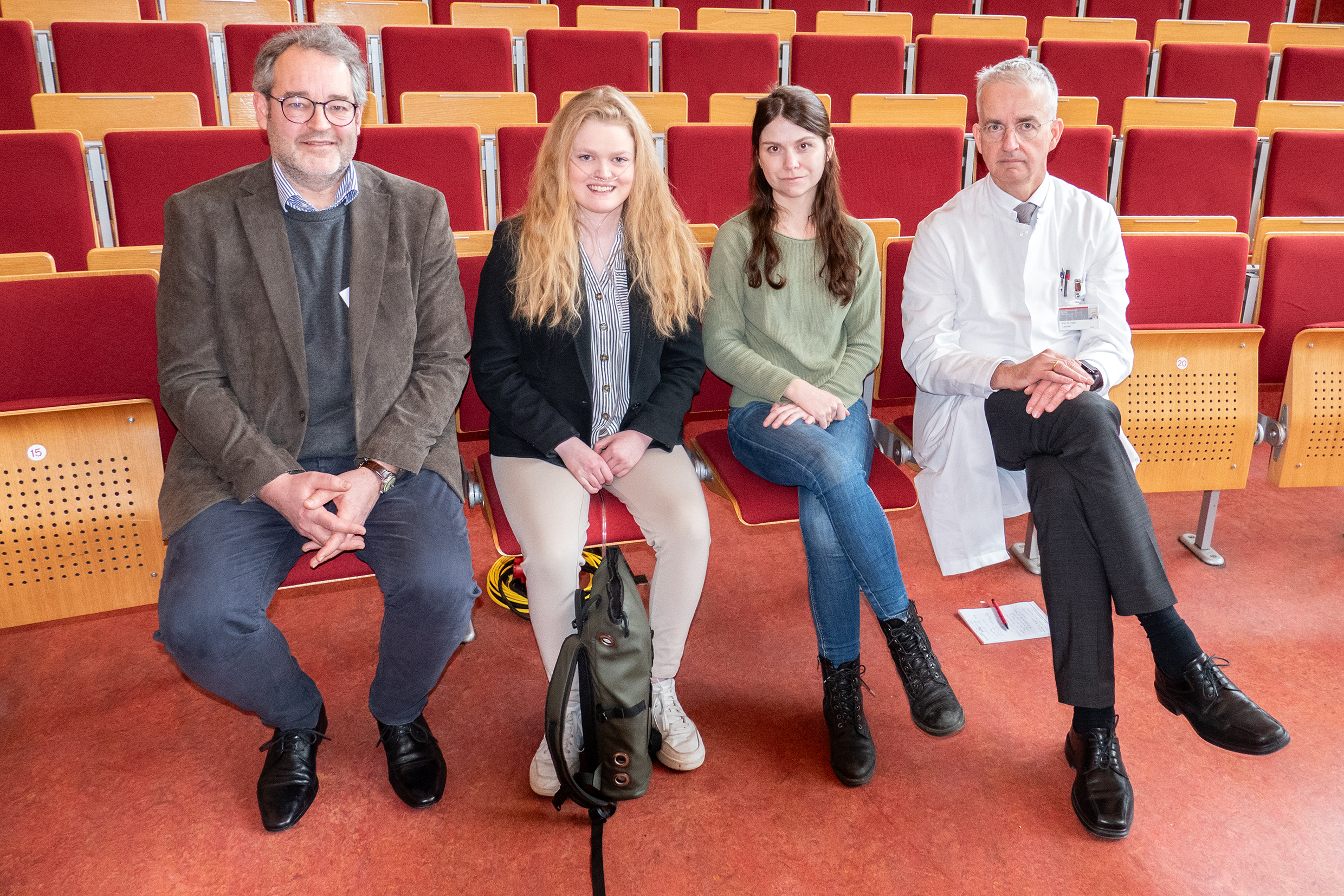
Medical students India Heilmann and Lina Rosenboom (2nd from right) shared their personal stories during the panel discussion with Prof. Dr. Christian Mühlfeld (left) and Prof. Dr. Frank Lammert (right). Copyright: Bettina Dunker/MHH
It was an extraordinary lecture in two respects: First, organ donation and transplantation are not listed as a separate module in the medical school curriculum because both topics are addressed in various specialties; second, there had been no similar offering to date in which affected students shared their personal stories. The two medical students, India Heilmann and Lina Rosenboom, thus enabled their fellow students to connect their basic anatomical knowledge from the anatomy course with personal experiences and a clinical perspective. To this end, they participated in a panel discussion with MHH Vice President and transplant specialist Prof. Dr. Frank Lammert, answering questions about their lives on the organ waiting list and after transplantation. Also present was Malte Storsberg, a third-year medical student involved in a project group dedicated to raising awareness about organ donation. MHH Dean of Studies Prof. Dr. Christian Mühlfeld had invited attendees to this new lecture in the anatomy module and served as moderator.
Voluntary initiative is well-received
The new lecture was well-received by many students. “I’m touched that so many fellow students showed up,” said India Heilmann during the introductory round. The 24-year-old is in her second year of human medicine and has been waiting for a donor lung for five years. “I have COPA syndrome, a rare genetic disorder that causes scarring in my lungs. As a result, it’s getting harder and harder for me to breathe, so I rely on liquid oxygen all the time. When I’m out and about, I use a portable oxygen tank.” Heilmann has long been committed to this cause. “Raising awareness is important to me because, unfortunately, organ donation rates are still too low.” When she attended Professor Mühlfeld’s anatomy lecture and the “prep course” (dissection course) last year, she struck up a conversation with him and expressed a desire to bring the topic closer to the students in her class. “Many people wondered why I ride an e-scooter from one lecture to the next. But without assistance, I wouldn’t be able to cover the distances. Depending on how I’m feeling that day and the situation, I get around campus either on the scooter or in a wheelchair.” The large lecture hall fell silent as she spoke; the shift in perspective fosters understanding, which was India Heilmann’s primary goal.
A Valuable Shift in Perspective
This was also important to Lina Rosenboom. “I consider this combination of basic anatomical knowledge with personal experiences and a clinical perspective to be particularly valuable and impactful.” The 26-year-old is in her fourth year of medical school. She has already received a new liver twice at the MHH, the first time when she was three years old. At that time, she received a partial organ transplant, but that caused problems in 2012. The connections were under tension, bacteria were entering the liver from the intestines, and she suffered from recurring bile duct infections that developed into peritonitis. “I’ve given birth to two children—that was nothing compared to this.” She was placed on the so-called high-priority list and received a new liver at the MHH within a few days in 2013. “Everything is fine now, I’m doing well, but it’s not a normal life.” For many years, she has been advocating for organ donation, including through the Transplant-Kids e.V. association.
Also on the panel was MHH student Malte Storsberg. “Two years ago, I took a part-time job at the German Organ Transplantation Foundation. In conversations with friends and my family, I realized how important it is to raise awareness about this issue.” Since then, he has been visiting schools and companies with the student project group “Organ Donation Awareness” to discuss the uncomfortable topics of organ donation and death, because: “It can happen to anyone, both as a donor and as a recipient. That’s why everyone should engage with this issue.” Rosenboom echoed this appeal: “Talk to your loved ones about organ donation and obtain an organ donor card where you state your wishes—no matter what.”
Insight into Transplant Medicine
“Every case is different; that’s how complex transplant medicine is,” explained Professor Lammert in his lecture. He also addressed Lina Rosenboom’s patient history: “You are an expert and know that bacteria pose risks for transplant recipients and make organs vulnerable. That is precisely our challenge, which is why we continue to conduct research.” He gave the students insight into the possibilities and challenges of transplant medicine and welcomed the lecture’s aim of linking knowledge from anatomy classes with knowledge from the Clinical Department. Finally, Professor Lammert urged all students to register in the online organ donation registry, which has been available for two years: “Become ambassadors for digital registration!”
► Further information: https://organspende-register.de/erklaerendenportal/
Text: Bettina Dunker