Three million euros for cardiac surgery: With the new surgical system, minimally invasive procedures can be performed with just a single incision.
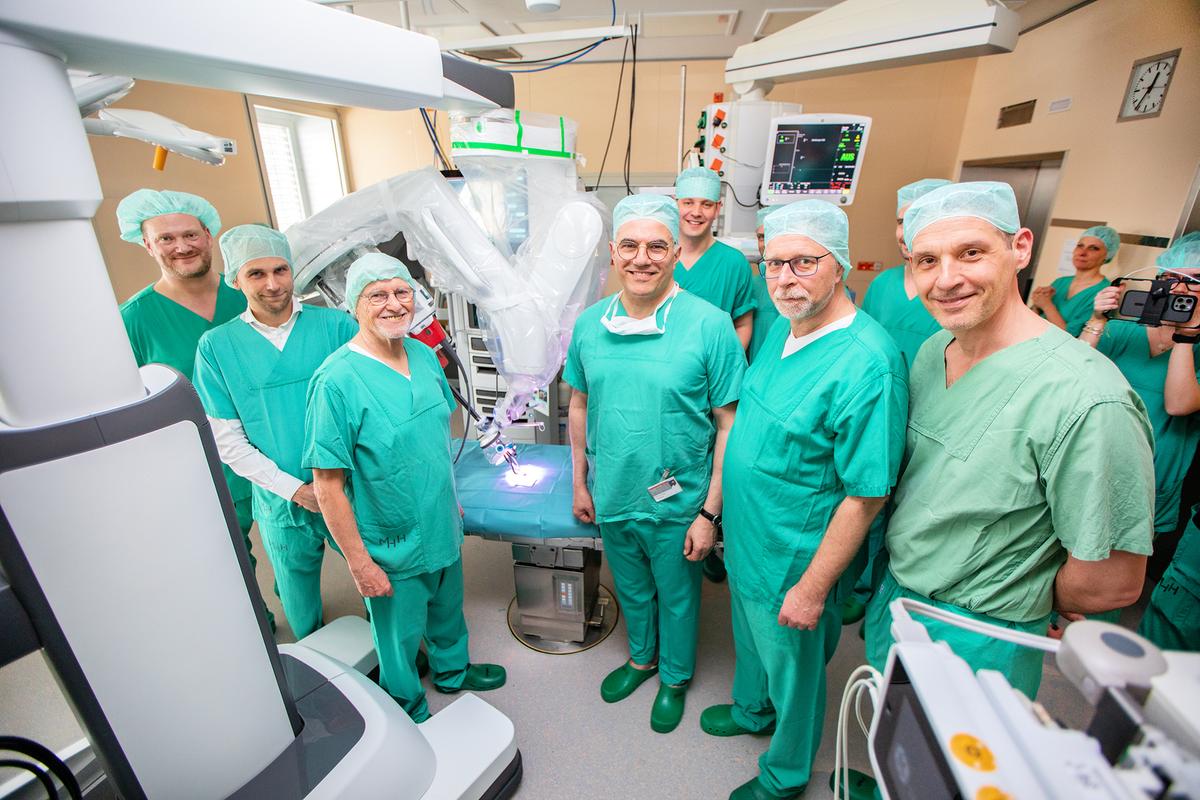
HTTG surgeons demonstrate the surgical robot to sponsors: Dr. Tobias Goecke, PhD, Raoul Roßmann, Dirk Roßmann, Prof. Dr. Arjang Ruhparwar, Prof. Dr. Bastian Schmack, Markus Schmieta, and Dr. Günes Dogan (from left). Copyright: Karin Kaiser/MHH
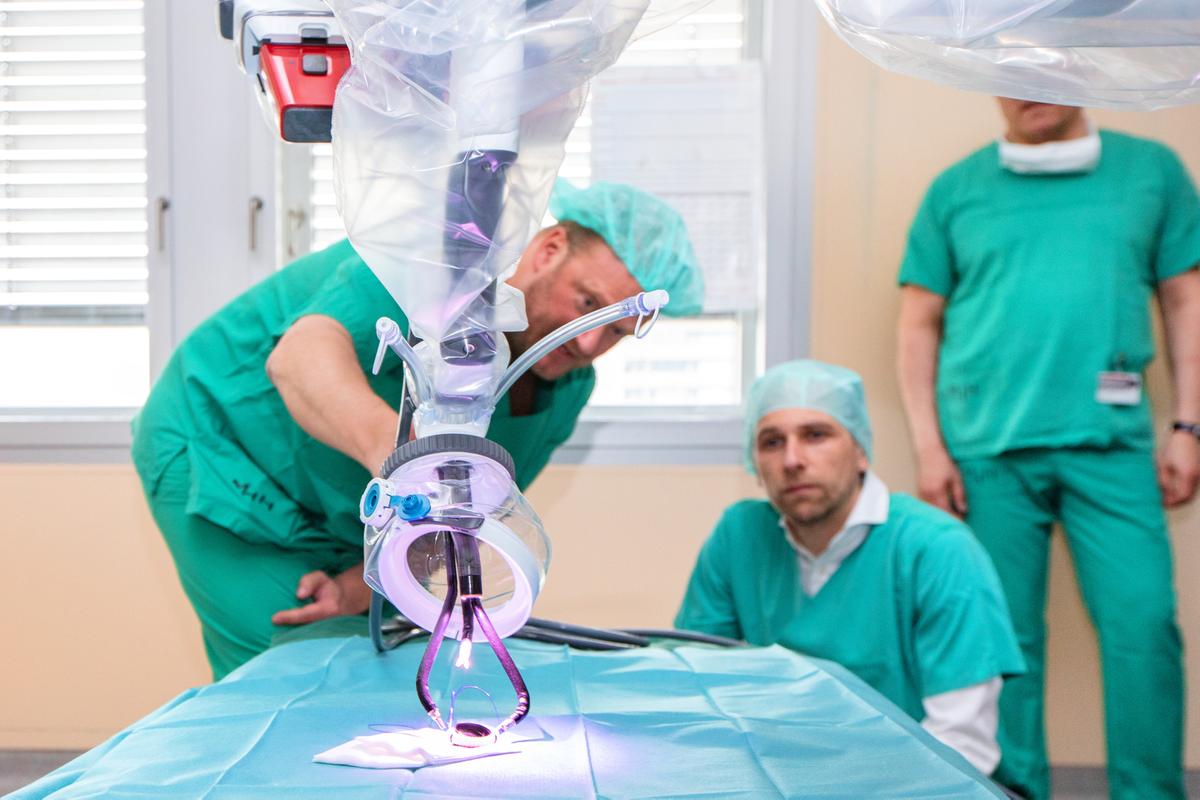
A closer look: Surgeon Dr. Tobias Goecke, PhD, shows Raoul Roßmann (right) how the single-arm da Vinci SP works. Copyright: Karin Kaiser/MHH
A personal experience or a tragedy in the family—often it is very personal reasons that motivate people to make a large donation for a specific cause. Thanks to two multi-million-euro donations, the Hannover Medical School (MHH) has now been able to put another surgical robot into operation. The new da Vinci SP system is available to the surgical teams at the Clinical Department of Cardiac, Thoracic, Transplantation and Vascular Surgery (HTTG). It is the first surgical robot of this type in Germany. The costs, totaling approximately three million euros, were jointly covered by the company ROSSMANN and the Braukmann-Wittenberg Heart Foundation, each contributing 1.5 million euros. In addition, ROSSMANN provided an additional 300,000 euros to cover the one-year rental fee for another surgical robot at the Clinical Department of Plastic, Aesthetic, Hand and Reconstructive Surgery (PÄHW).
Grateful Patient Dirk Roßmann
Behind ROSSMANN’s donation lies a personal motivation on the part of founder Dirk Roßmann. In January 2025, he underwent heart surgery at the HTTG Clinic performed by Clinic Director Prof. Dr. Arjang Ruhparwar. He had originally assumed that only a stent would need to be placed in a coronary artery. However, preliminary examinations showed that this would not be sufficient. As a result, the entrepreneur underwent open-heart surgery and received four bypasses. This was followed by further treatment in the intensive care unit and general ward, as well as three weeks of rehabilitation. “That was not a pleasant time,” recalls the 79-year-old. “I especially hated cycling during rehab. I’d rather play tennis or table tennis.” But the training paid off. Today, Dirk Roßmann feels fit again and is grateful that everything went well. His donation follows a simple principle that also shapes his son Raoul Roßmann’s commitment to the Hanover region: pragmatic help to ensure that patients have the chance to receive the best possible medical care.
A Foundation Established After a Successful Surgery
For the second donor, the Braukmann-Wittenberg Heart Foundation, personal experience and gratitude also play a role. In this case, the specific event took place some time ago, but its impact is still felt today. The foundation was established in the late 1980s by the couple Hildegard Braukmann and Albert Wittenberg to support cardiovascular research at the MHH. The background: Albert Wittenberg underwent heart valve surgery at the MHH in 1982. “The surgery enabled him to continue working at his own company until 1990 and to spend another eight happy years with his wife,” reports Markus Schmieta, vice chairman of the Braukmann-Wittenberg Heart Foundation. The couple ran the cosmetics company Hildegard Braukmann for many years—it is based in Burgwedel, just like ROSSMANN. Over the past decades, the foundation has donated many millions to MHH projects focused on heart health. For example, it provided 13 million euros to fund the construction of the Hans Borst Center for Heart and Stem Cell Research, which opened in 2008. With its donation for the surgical robot, the foundation is not only supporting modern patient care but also promoting research and teaching in cardiology.
Complex minimally invasive procedures through a single incision
The new surgical robot at the Clinical Department of Cardiac, Thoracic, Transplantation and Vascular Surgery (HTTG) is a da Vinci SP surgical system. The letters SP stand for Single Port. “Unlike other robotic systems, this device requires only a single incision, about three centimeters long, to perform the surgery,” explains Prof. Dr. Arjang Ruhparwar, Director of the Clinical Department. Through this single incision, surgeons insert a video camera and three robotic instrument arms simultaneously into the chest cavity. Only once inside are the individual arms spread apart from one another. “In cardiac surgery, we will initially use the new system during bypass operations for the preparation of the sternum artery. Later, the range of applications for the device will certainly expand,” says Professor Ruhparwar. For patients, the single-incision technique means less trauma and a faster recovery. Professor Ruhparwar expects that the da Vinci SP will be used approximately 100 times per year in cardiac and thoracic surgery during the initial phase. The HTTG surgical teams already have experience with robot-assisted surgical systems, but the new device is the Clinical Department’s first of its own.
Additional ROSSMANN Donation for Surgical Robots in Microsurgery
The surgical teams at the Clinical Department of Plastic, Aesthetic, Hand and Reconstructive Surgery (PÄHW) have also had positive experiences with surgical robots. Many procedures at this clinic fall within the realm of microsurgery—precision work involving the suturing of the finest nerves and vessels under an extremely high-magnification microscope. With an additional donation of 300,000 euros, ROSSMANN covered the rental fees for a microsurgical surgical robot for the PÄHW Clinical Department. Thanks to this funding, the PÄHW can use a modern Symani surgical system for one year. “The device features a new generation of instruments. It now also includes scissors for tissue preparation,” explains Prof. Dr. Peter Maria Vogt, Director of the PÄHW Clinical Department. The new system not only covers the entire spectrum of microsurgery on nerves and blood vessels. “It also represents the key technology for the new field of lymphatic surgery,” emphasizes Professor Vogt. Lymphatic surgical procedures are performed, for example, in cases of lymphatic system disorders following cancer treatments. The structures of the lymphatic system are extremely delicate and, until a few years ago, could not be operated on at all.
Robot-assisted surgical techniques on the rise
Minimally invasive robot-assisted surgical techniques generally offer many advantages. Patients benefit from fewer postoperative complications, faster wound healing, and a shorter hospital stay. But robotic systems also offer a number of advantages for surgeons: For example, the surgical field is perfectly illuminated and displayed on the screen in 3-D with high magnification. Additionally, ergonomic conditions are optimal, as procedures can be performed while seated. Furthermore, a tremor filter compensates for any trembling or unintended hand movements. A total of four surgical robots are currently in use at MHH. In addition to the HTTG and PÄHW, they are also used in visceral surgery, gynecology, and urology. Surgical robots have become indispensable in modern operating rooms; they will transform surgery in the long term—Professor Ruhparwar and Professor Vogt are convinced of this.
The cost of the new surgical robot at the HTTG Clinical Department, amounting to three million euros, was split equally between ROSSMANN and the foundation. ROSSMANN alone provided the 300,000-euro donation for the use of the surgical robot at the PÄHW Clinical Department. The MHH Fundraising Administrative Unit coordinated all donations and, for the ROSSMANN contributions, also handled the processing through the MHH plus Foundation, which it oversees. MHH plus is not only the right point of contact for donations in the millions. Smaller contributions are also in good hands there. Contact: www.mhh.de/plus
Text: Tina Götting