MHH project "ZUKUNFT" receives around 249,000 euros from the program of the state of Lower Saxony.
Copyright: Karin Kaiser / MHH
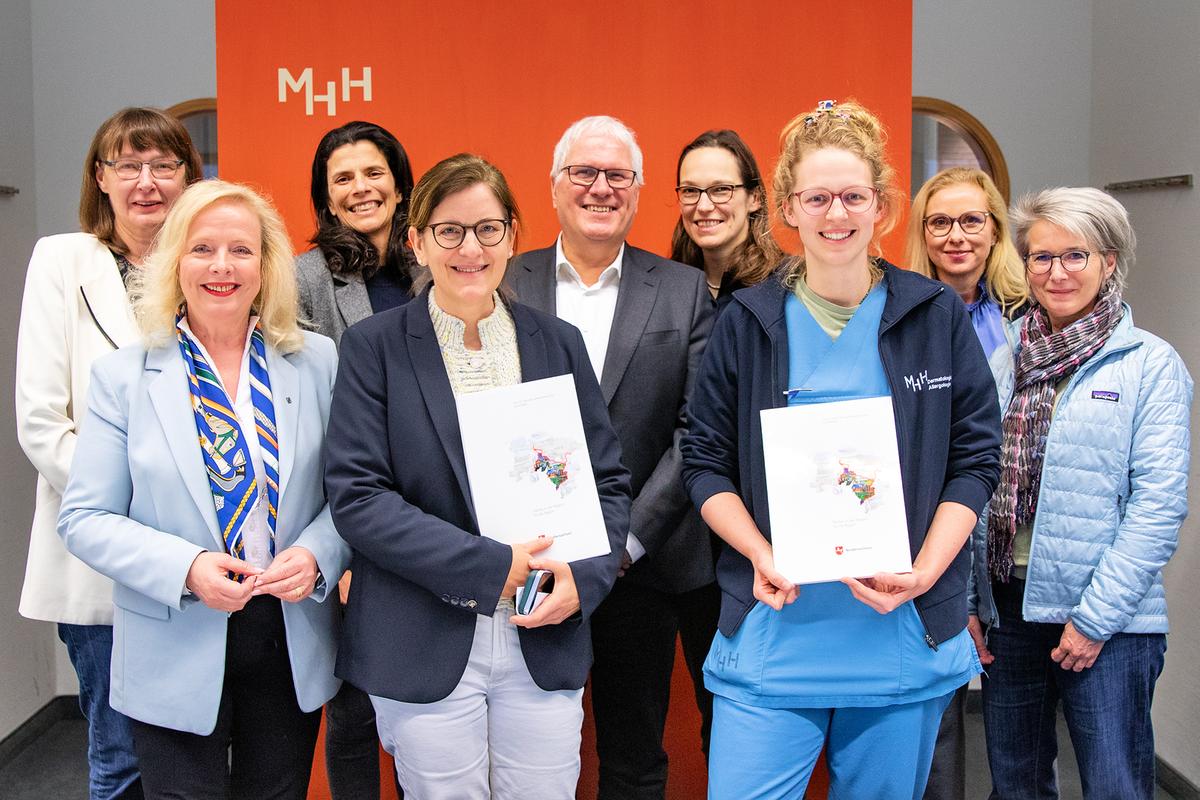
Increasing the practical relevance of medical studies, attracting more young people to the medical profession, improving the quality of care and countering the shortage of doctors - these are the goals of the MHH project "ZUKUNFT". The project has received recognition from the state of Lower Saxony: on 29 January 2026, Ottmar von Holtz, State Commissioner for Regional Development Leine-Weser, presented Prof. Dr. Sandra Steffens with a funding decision of around 249,000 euros from the "Social Innovation" program. Professor Steffens is head of the SkillsLAB and responsible for curriculum development at the MHH. She came up with the idea for the "ZUKUNFT" project.
"With ZUKUNFT, we bring medical students into real, long-term contact with older and chronically ill people right from the start. Everyone involved benefits from the continuous support, it makes medicine tangibly meaningful again - and enables students to think about healthcare in a truly holistic way," said Prof. Dr. Sandra Steffens. The project is to be launched as an elective course in cooperation with teaching practices and senior citizens' residences in the Hanover area. The rheumatology practice in Hanover is also involved.
Prof. Dr. Imke von Wasielewski from Iteachmed GmbH received a further grant. The "AWI" project, which she initiated, is an AI-supported platform that collects and communicates medical expertise. "AWI" is being supported with around 217,000 euros. The platform helps to shorten the training period for new employees, reduce sources of error and improve efficiency and quality of care. Modern technologies such as large language models and adaptive learning paths are intended to ensure the transfer of knowledge and strengthen the competitiveness of companies in Lower Saxony in the digital age. The project is being carried out in collaboration with Auftrag Mensch GmbH.
"By handing over the funding decisions, we are demonstrating how diverse the funding landscape of the European Union and the state of Lower Saxony is. In this way, we can contribute to promoting the innovative strength of our healthcare system. With 'ZUKUNFT' and 'AWI', we are not only promoting medical care and knowledge management, but are also focusing on sustainable solutions that actively meet the challenges of the healthcare system and directly benefit the people of Lower Saxony," said Ottmar von Holtz.
The "Social Innovation" guideline aims to develop and test innovative solutions that can contribute to overcoming specific social challenges. The focus is on two major topics:
- "Changing world of work" - adapting companies and the workforce to social changes
- "Social services of general interest" - improving and securing access to high-quality health and social services
The project must be fundamentally transferable to other regions. This means that new practices can be tested on a small scale in order to gain insights into their feasibility.
Text: Tina Götting