Research network FOR 5250 in cooperation with TU Dortmund University is being funded by the DFG for a further four years.
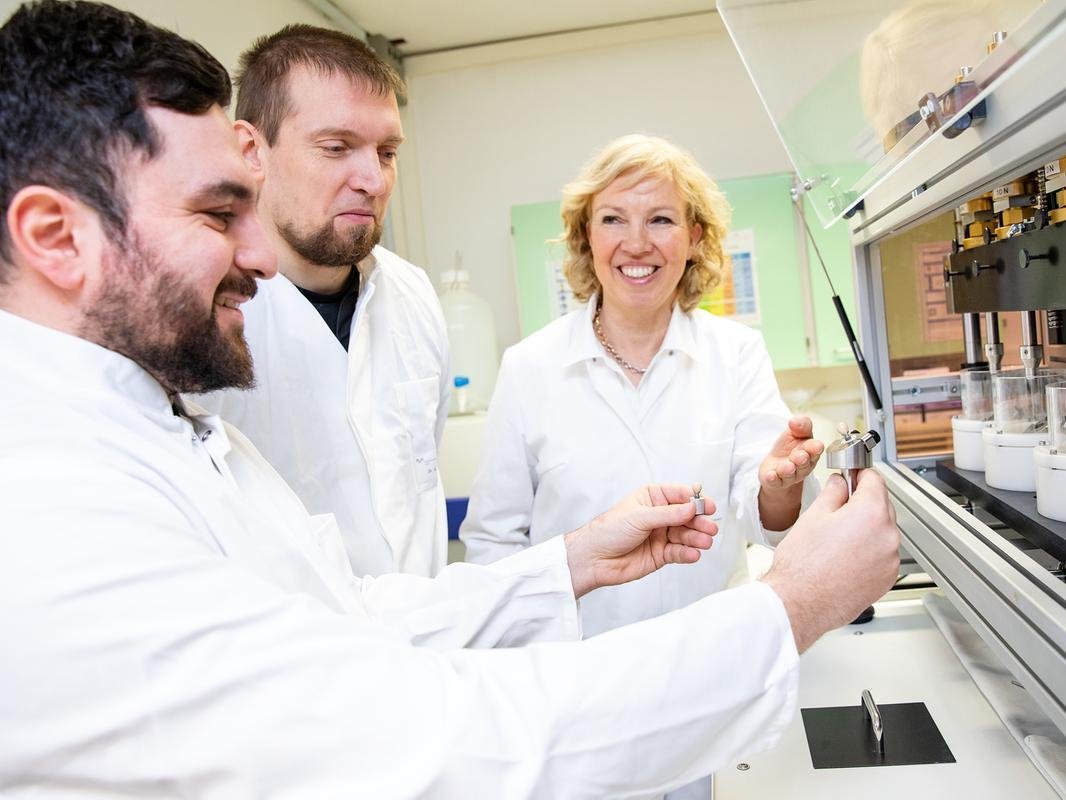
Load test on the chewing simulator: Osman Akbas (left), associate professor Dr. Andreas Greuling and Prof. Dr. Dr. Meike Stiesch test the long-term load-bearing capacity of the new implant models. Copyright: Karin Kaiser/MHH
Implants are becoming increasingly important for replacing missing teeth. As artificial tooth roots, the screws, which are usually made of titanium, are implanted into the jawbone and grow together there as stable supports for the visible dentures. The crown or larger restorations, such as bridges or removable dentures, are then attached via a small connecting element. Sometimes, however, the implant does not heal firmly in the jawbone or loses its hold at a later stage, meaning that the artificial tooth root has to be removed again. There are many reasons for this: tissue degradation in the surrounding bone due to inflammation, unfavorable biomechanical stress during the healing phase or insufficient bone substance due to age or predisposition.
The aim of the FOR 5250 research consortium is to prevent tooth loss wherever possible. In contrast to current "off-the-shelf" solutions, researchers from the fields of medicine and engineering are working on the development of tailor-made, personalized implants. These are designed to take into account the patient's individual bone situation, optimize the chewing load on the implant as far as possible and also prevent colonization with pathogenic bacteria in the oral flora and the resulting inflammation. Prof. Dr. Meike Stiesch, Director of the Clinical Department of Dental Prosthetics and Biomedical Materials at Hannover Medical School (MHH), is responsible for the medical side of the project. The Technical University of Dortmund is the partner institution for technical matters and the lead university (spokesperson: Prof. Dr Frank Walther). The German Research Foundation (DFG) extended the funding for a further four years in December 2025 and is supporting the project with 4.4 million euros.
Production using 3D printing
"An important factor for the long-term prognosis of dental implants is mechanical stress in the surrounding bone, which is triggered by masticatory forces," says Professor Stiesch. The researchers use a computer-aided simulation process to determine these stresses at the boundary between the bone and the implant in advance. This allows them to calculate the strength of the implant before it is manufactured, analyze possible stresses and deformations and determine the individual internal structure that is optimally adapted to the load. In the additive process - also known as 3D printing - a patient-specific, so-called graded implant is manufactured layer by layer according to the digital specifications. This is specially adapted to the various bone structures and tensions within the jawbone.
Antibacterial surfaces
It is not only important what the inside of the implant looks like. The surface also plays a decisive role in ensuring that the artificial tooth root grows in well and stays in place in the jawbone for as long as possible. To this end, the additively manufactured implants are treated mechanically and chemically by sandblasting and etching so that bone-forming cells can attach better to the surface. The researchers are also developing new coatings with magnesium alloys that ensure better bone healing. At the same time, the alloys have an antibacterial effect and prevent bacteria from attaching to the implant surface and forming biofilms that are difficult to treat.
Special requirements for older people
The researchers have already developed an initial model system for an improved standard implant in the first funding phase. Now they want to extend their calculations to special requirements, such as for older people whose jaws are often less stable due to the age-related loss of bone substance. "Implants are a wonderful way to create functional dentures without affecting the neighboring teeth," says Professor Stiesch. "We want to ensure that as many patients as possible receive optimal dentistry that is tailored to their needs, safe and long-lasting." However, more research work needs to be done before this is achieved. However, contact with interested medical technology companies already exists.
The interdisciplinary research network FOR 5250 is a cooperation between Hannover Medical School, Dortmund University of Technology, Leibniz University Hannover, the Laser Zentrum Hannover, the University Medical Center Hamburg-Eppendorf, Reutlingen University and the University of Rostock.
Text: Kirsten Pötzke