Endourological treatment
Endourology refers to diagnostic and therapeutic procedures in which the physician uses the patient's natural access to the inside of the body with the help of optical instruments. The main advantages are that the patient is only subjected to minimal stress and usually recovers quickly.
The different options
TURB is one of the oldest and most established procedures in the treatment of urinary bladder tumors. It is usually used after your urologist has discovered a tumor in the bladder during a cystoscopy.
You will usually be admitted to hospital the day before the procedure. On the day of admission, various blood tests will be carried out and your urine will be checked. The procedure is performed under general anesthesia or spinal anesthesia. The procedure itself is similar to a cystoscopy. The difference is that a so-called resectoscope is used. This allows the surgeon to insert a wire loop through which an electric current flows. This is used to remove the tumor in layers or completely, depending on its size. If there are several tumors in the bladder, an attempt is always made to remove all tumors during one procedure. The electric current can not only be used to remove tumors, but also to stop bleeding. In so-called monopolar TURB, an electrolyte solution must be used, and the current used flows through the body and is discharged elsewhere (e.g. a leg). This is not dangerous for you as a patient unless you have a pacemaker or a defibrillator implanted in your heart. In such cases, we use bipolar resection loops. This allows the current to be conducted directly via the instrument.
After the procedure, the bladder is flushed with water overnight. The indwelling catheter is removed 2 days after the procedure and you can leave our Clinical Department the next day after an ultrasound examination.
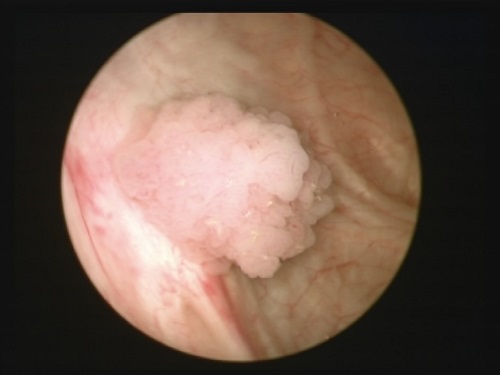
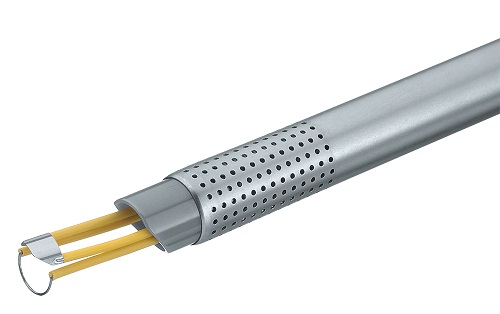
The resection of urinary bladder tumors with an electric snare is one of the oldest procedures in urology (see also "Transurethral resection of urinary bladder tumors (TURB)"). In conventional TURB, bladder tumors are removed in layers, i.e. fractionated. An alternative method for small bladder tumors is ablation using a laser. Here, the tumor is first cut around by laser energy and then peeled out from the depth. The special feature here is that an attempt is made to preserve the tumor as a whole and remove it in one piece. This method is a well-established procedure in endoscopic bowel surgery, which can be excellently applied to bladder cancer.
The thulium laser we use creates a precise incision surface and also enables incisions to be made with minimal bleeding. Its relatively low penetration depth prevents damage to deeper layers that are too gentle. Especially for patients undergoing surgery with ASA or other blood-thinning substances, the use of lasers is expected to reduce complications. If the tumor cannot be removed using laser technology, we will use the conventional snare technique.
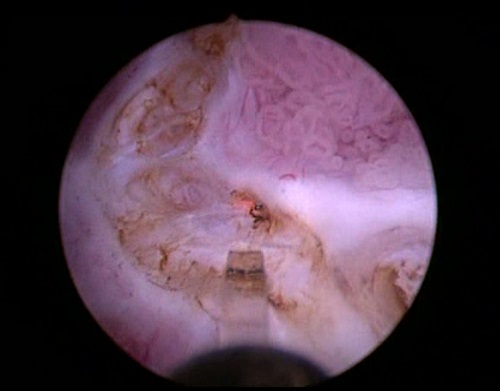
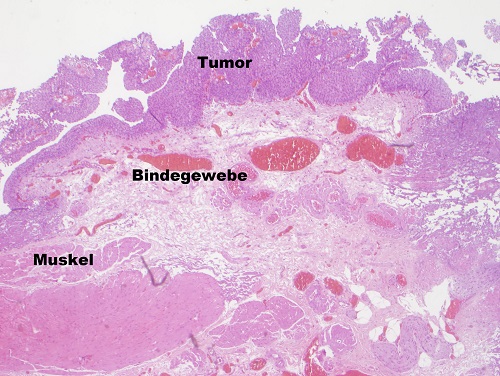
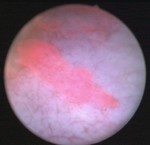
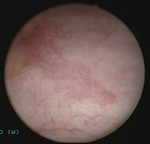
Bladder tumors have different growth characteristics. Superficial bladder carcinoma usually grows into the bladder cavity in a shaggy form and can be easily visualized by cystoscopy. The aggressive, muscle-invasive bladder carcinoma can also usually be easily detected. Carcinoma in situ (CIS) is an intermediate form of bladder cancer that grows over a large area and does not invade the muscles. It is usually difficult to recognize. Even tiny tumor findings of the first two tumor types may be difficult to visualize. However, in order to make the tumor visible and remove it as completely as possible during removal (resection), so-called photodynamic diagnostics can be useful.
HEXVIX® is the only drug currently approved for photodynamic diagnostics (PDD) to make urinary bladder tumors more visible during transurethral resection.
HEXVIX® cystoscopy can detect changes in the bladder that may not be visible with standard white light cystoscopy. After the drug is administered into the bladder, it is converted into a photoactive substance that accumulates in tumor cells. Under blue light, these cells fluoresce red and can be identified much more easily. This makes HEXVIX® cystoscopy a highly sensitive diagnostic method.