Novel organ replacement procedures for the treatment of severe burn injuries
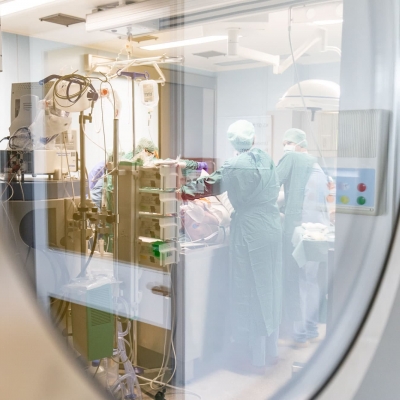
Burn injuries often affect more than just the skin as the largest human organ. The inhalation of hot gases or toxic substances that can be produced in fires can result in what is known as inhalation trauma, which has a significant impact on the likelihood of surviving a burn injury. In addition, as the size of the burnt body surface increases, there is also a strong generalized, partly immune-controlled reaction of the organism, the so-called burn disease, which can result in the failure of several organs such as the lungs, kidneys, liver and intestines.
Against this background, our Center for Severe Burn Injuries uses new therapeutic approaches to treat these intensive care challenges.
These include, for example, the use of new ventilators with laminar flow to treat lung failure caused by inhalation trauma. Here, a flow-controlled system is used to control the patient's exhalation and inhalation, thereby reducing the high ventilation pressures that would otherwise be necessary and thus limiting additional ventilation-associated damage to the lung tissue.
If lung function is impaired, this can lead not only to problems with the intake of oxygen but also to problems with the release of carbon dioxide. In extreme cases, extracorporeal lung replacement procedures must be used in such cases. However, we can now also use innovative therapeutic approaches for isolated carbon dioxide release problems, such as the Advanced Organ Support System (ADVOS).
The release of so-called cytokines as a reaction of the body to a burn can cause complications throughout the body if, for example, a cytokine storm occurs. One possible therapeutic approach is to filter these substances out of the bloodstream. To do this, we use innovative filter systems such as Cytosorb filters and even complete replacement of the blood plasma using plasmapheresis.
Burn injuries cause severe damage to the skin organ, and deeper injuries in particular often result in the loss of the entire skin, including subcutaneous fat and connective tissue. A functionally adequate reconstruction of these resulting defects ideally also includes restoration of the deeper skin and displacement layers. For this reason, we work together with innovative companies as well as international research institutions in order to be able to use dermal replacement plastics for our patients. These range from biological structural matrices to individually cultivated solutions, depending on the patient's requirements profile.
The combination of these sometimes very complex and innovative procedures allows us to improve the survival of severely burnt patients while at the same time reducing long-term complications and reconstructive follow-up procedures.