
Background
Difficult-to-treat depression (DTD) is a condition in which patients only respond after several weeks of treatment with antidepressants, psychotherapy or other procedures such as electroconvulsive therapy (ECT). However, the therapeutic response rates decrease with the duration of the disease and around 20% of patients develop a chronic course. Various influencing factors in the multicausal pathogenesis of depression have been identified, but a complete understanding of the pathophysiology is still the subject of research. Possible causes of DTD may include inadequate medication levels or undetected somatic or psychiatric comorbidities. In addition, clinical depression can be divided into different subtypes of the disease, each of which has a different underlying pathogenesis. Our working group is dedicated to researching DTD in order to identify clinical and molecular biological biomarkers of DTD in order to personalize the treatment of the disease and improve it in a targeted manner.
A particular focus is on the investigation of non-invasive brain stimulation methods such as electroconvulsive therapy (ECT). ECT is one of the most effective therapeutic procedures for the treatment of severe psychiatric disorders, such as subtypes of DTD or pharmacotherapy-resistant psychoses. For ECT, the patient is placed under brief anesthesia, during which a brief seizure is triggered. Many years of use and research into the procedure have confirmed that ECT causes several neuronal processes such as increased synaptogenesis (creation of new nerve cells) through the release of neurotransmitters and nerve growth factors. Another theory lies in the possible interruption of pathological neurotransmitter patterns associated with psychiatric illnesses, which are reorganized by ECT in a similar way to a "reboot" in a PC. However, the mechanism of action of ECT has not yet been fully clarified.
Other non-invasive brain stimulation methods are transcranial direct current stimulation (tDCS) and transcranial alternating current stimulation (tACS). The transcranial application of low currents can be used to specifically influence neuronal excitability (tDCS) or the oscillatory dynamics of nerve cell clusters (tACS). These brain stimulation methods enable the non-invasive testing of hypotheses regarding the relevance of cortical brain regions and specific oscillatory patterns for cognitive processing. In addition, research is currently being conducted into the extent to which dysfunctional neuronal networks in psychiatric disorders such as schizophrenia can be positively influenced by transcranial current stimulation.
Overarching goals
The overarching goal of our research group is to develop biomarkers for the subtyping of patients with severe affective disorders in order to enable personalized therapy. A main focus of the research group is the investigation of non-invasive brain stimulation methods such as electroconvulsive therapy.
- Deep phenotyping of difficult to treat depression
- Identification of epigenetic markers to predict the course of therapy in depressive patients
- Epigenetic imaging for response prediction
- Analysis of predictive biomarkers in ECT
In our prospective, longitudinal register study, patients receiving electroconvulsive therapy (ECT) are systematically examined at several points in time. The aim of the study is to investigate the influence of clinical and molecular biological factors on the course of the disease and therapy of the patients. Neurological soft signs of the patients and differentiated psychometrics are recorded in the register. Furthermore, the focus is on the identification of epigenetic response markers with the aim of subtyping patients who are most likely to benefit from ECT. The registry contributes to the Genetics of ECT International Consortium (GenECT-ic).
Further information can be found in our flyer.
Publications
- Moschny N, Zindler T, Jahn K, Dorda M, Davenport CF, Wiehlmann L, Maier HB, Eberle F, Bleich S, Neyazi A, Frieling H. Novel candidate genes for ECT response prediction-a pilot study analyzing the DNA methylome of depressed patients receiving electroconvulsive therapy. Clin Epigenetics. 2020 Jul 29;12(1):114. DOI
- Neyazi A, Theilmann W, Brandt C, Rantamäki T, Matsui N, Rhein M, Kornhuber J, Bajbouj M, Sperling W, Bleich S, Frieling H, Löscher W. P11 promoter methylation predicts the antidepressant effect of electroconvulsive therapy. Transl Psychiatry. 2018 Jan 22;8(1):25. DOI
- Maier H, Helm S, Toto S, Moschny N, Sperling W, Hillemacher T, Kahl KG, Jakubovski E, Bleich S, Frieling H, Neyazi A. S100B, Homocysteine, Vitamin B12, Folic Acid, and Procalcitonin Serum Levels in Remitters to Electroconvulsive Therapy: A Pilot Study. Dis Markers. 2018 Jan 10;2018:2358451. DOI
A proportion of patients suffering from a major depressive episode develop treatment-resistant depression (difficult to treat depression; DTD) in the course of their lives. Patients with DTD often do not achieve full remission despite multiple attempts at therapy. The reasons for this can be manifold: psychiatric or somatic comorbidities, genetic polymorphisms in a cytochrome P450 enzyme (CYP), as a result of which no effective drug level can be built up, or the presence of pseudoresistance (too short administration of a drug, too short duration of administration or non-administration of the drug). The aim of our registry study is a deep phenotyping and subtyping of patients with DTD, as well as the identification of epigenetic prediction parameters.
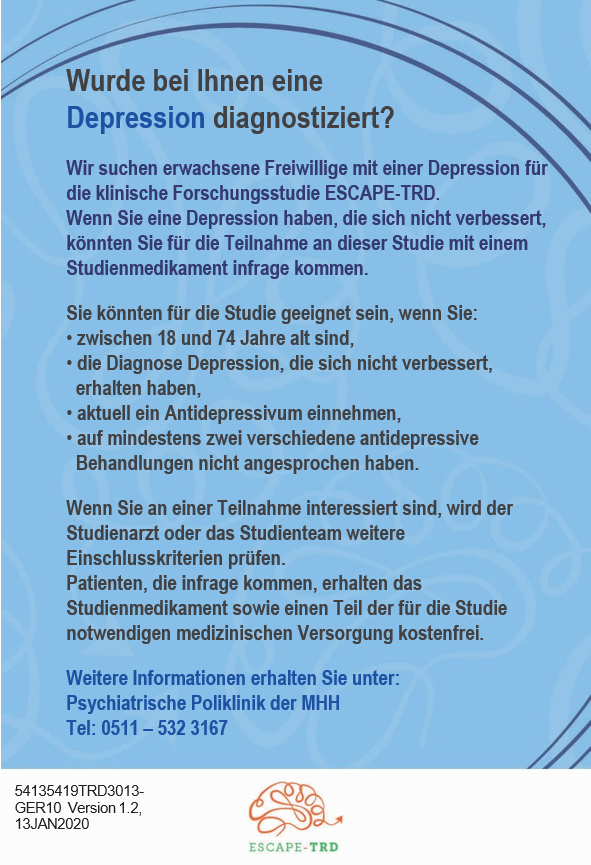
We are recruiting patients suffering from treatment-resistant depression or difficult-to-treat depression. As part of this study, a precise characterization and phenotyping of the current disease is carried out. If you are interested, please contact us via the flyer.
Research project resulting from the NEKTOR & DTD patient registers:
A subgroup of depressed patients is characterized by disturbances in neuronal synapse formation and/or immune system functioning. ECT influences both processes; the relationship to remission (i.e. the improvement of depressive symptoms) remains unclear, which is why we are investigating ECT responders and non-responders with regard to the composition of their immune system and their DNA methylation. Initial results have already been published and further investigations include the analysis of epigenetic changes in individual immune cell subpopulations (NK cells).
Publications
- Moschny N, Jahn K, Maier HB, Khan AQ, Ballmaier M, Liepach K, Sack M, Skripuletz T, Bleich S, Frieling H, Neyazi A. Electroconvulsive therapy, changes in immune cell ratios, and their association with seizure quality and clinical outcome in depressed patients. Eur Neuropsychopharmacol. 2020 Jul;36:18-28. DOI
- Moschny N, Jahn K, Bajbouj M, Maier HB, Ballmaier M, Khan AQ, Pollak C, Bleich S, Frieling H, Neyazi A. DNA Methylation of the t-PA Gene Differs Between Various Immune Cell Subtypes Isolated From Depressed Patients Receiving Electroconvulsive Therapy. Front Psychiatry. 2020 Jun 19;11:571. DOI
Research project resulting from the NEKTOR & DTD patient registries:
Advances in neuroimaging (e.g. magnetic resonance imaging; MRI) are essentially helping to uncover possible neural mechanisms underlying the major depressive episode. Image morphology studies (resting-state functional cerebral MRI; rs-fcMRI) have demonstrated changes in connectivity between different brain areas in patients with a major depressive episode compared to a healthy control group. In structural MRI images, a higher hippocampus and amygdala volume could often be detected in severely depressed patients. Image morphological analyses and, in particular, epigenetic imaging are used to further understand DTD. The aim of the study is to identify possible response predictors. The research group is currently recruiting patients suffering from difficult-to-treat depression and/or receiving electroconvulsive therapy as part of a prospective and longitudinal study.
In this clinical trial (Phase IIIB study), the efficacy, safety and tolerability of S-Ketin is being tested in collaboration with the manufacturer Janssen, safety and tolerability of S-ketamine nasal spray compared to quetiapine retard in adult patients with treatment-resistant major depression (previous treatment with at least two antidepressant medications from two different drug classes in sufficient doses and over a sufficient period of time) under ongoing therapy with a selective serotonin reuptake inhibitor/serotonin-norepinephrine reuptake inhibitor.
Scientific collaborations
MHH-internal
- Prof. Dr. Mike Wattjes, Clinical Department of Neuroradiology
- Prof. Dr. Dr. Tillmann Krüger, Clinical Psychology and Sexual Medicine
Germany-wide
- PD Dr. Franz-Josef Müller, Center for Integrative Psychiatry, Kiel
- Prof. Dr. Malek Bajbouj, Clinical Department of Psychiatry and Psychotherapy, Charité, Berlin
- Prof. Dr. Jürgen Deckert, Prof.'in Dr. Sarah Kittel-Schneider, Clinical Department of Psychiatry and Psychotherapy, University Hospital Würzburg, Germany
International
- The Global ECT-MRI Research Collaboration (GEMRIC)
- Genetics of ECT International Consortium (GenECT-ic)
Prizes, funding
- Prize of the German Society for Biological Psychiatry (DGBP; 2019). For the scientific contribution at the DGBP-AGNP Congress 2019 (poster & presentation), Nicole Moschny
- Prize of the Annika Liese Foundation for Depression Research (2018/2019). For the work "P11 promoter methylation predicts the antidepressant effect of electroconvulsive therapy", Alexandra Neyazi, endowed with: € 10,000
- Internal university performance funding (HiLF 1). For the project "Epigenetic regulation and expression of glia cell-derived neurotrophic factor (GDNF) in depressive patients under pharmacological and electroconvulsive treatment.", Alexandra Neyazi, funding: €22,397
- Poster prize of the German Society for Psychiatry and Psychotherapy, Psychosomatics and Neurology (DGPPN; 2016). For the project "Markers for the response of electroconvulsive therapy? Homocysteine, vitamin B12, vitamin B11 and S100 plasma levels in the course of treatment", Hannah Maier
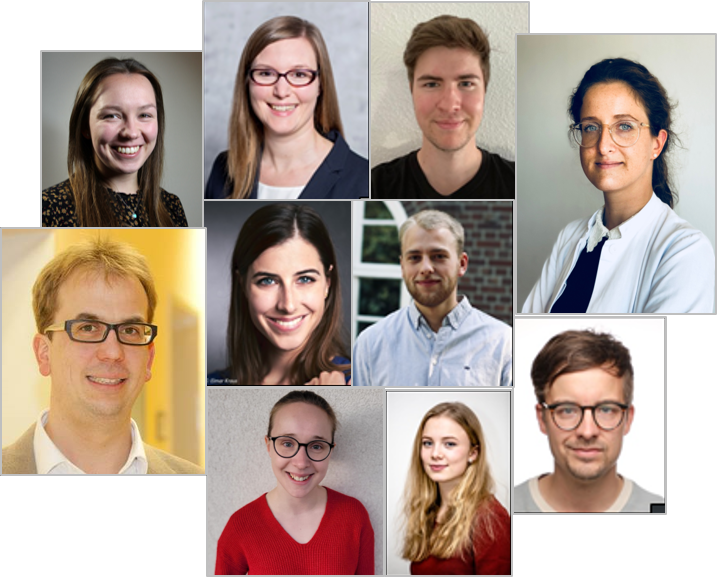
Research group members
Head of research group
Prof. Dr. Helge Frieling
Deputy Clinic Director
Publications: Pubmed
PD Dr. Alexandra Neyazi
Managing Senior Physician
Phone: +49 511 532 2397
neyazi.alexandra@mh-hannover.de
Excellence at a glance:
- Specialist in psychiatry and psychotherapy
- Medical representative for medical devices and stimulation procedures
Publications: Pubmed
Dr. Hannah Maier
Scientific and medical assistant
Phone: +49 511 532 3167
Main areas of research:
- Difficult to treat depression (DTD) and treatment-resistant depression
- Non-invasive brain stimulation procedures, e.g. electroconvulsive therapy (ECT), vagus nerve stimulation (VNS)
- Neuroimaging, in particular epigenetic imaging
Publications: Pubmed
Office
Phone: +49 511 532 2397
folsche.thorsten@mh-hannover.de
Main areas of research:
- Bipolar disorder
- Therapy-resistant depression
- Epigenetic analyses for response prediction
Main areas of research:
- Characterization of immune cells using FACS
- Epigenetic analyses using Sanger/NGS/nanopore sequencing
- Neuroimmunology
Publications: Pubmed
Main areas of research:
- Molecular basis of predictive biomarkers
- Modulation of methylation to understand its functional significance
Publications: Pubmed
schuelke.rasmus@mh-hannover.de
Publications: Pubmed
Main research interests:
- Neuronal correlates of coverbal gestures in schizophrenia
- Non-invasive brain stimulation: transcranial direct current stimulation (tDCS), transcranial alternating current stimulation (tACS)