Patient-specific implants
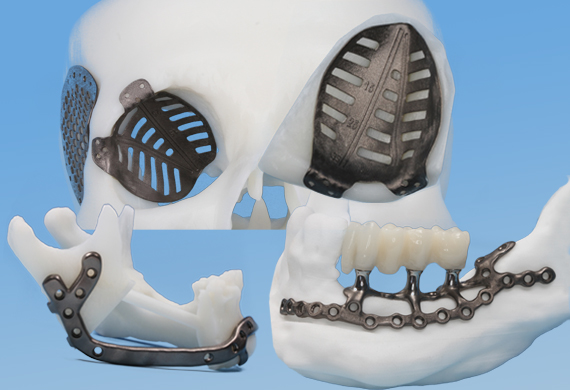
Current advances in the field of modern imaging, preoperative planning and computer-assisted surgery increasingly allow the use of individualized implants and osteosynthesis materials. Using these modern methods, it is possible to plan an operation precisely in advance and perform it on the patient using intraoperative navigation. It is also possible to use implants and constructs that are adapted to the patient's situation and allow complete anatomical and functional restoration. We combine our experience with digital planning and intraoperative navigation with modern three-dimensional manufacturing techniques.
Patient-specific implants are planned and manufactured using modern digital planning and manufacturing processes. Implants can be customized for specific patients using various 3D printing processes. The processing of titanium using laser beam melting (selective laser melting, SLM) allows implants to be manufactured in a completely freely plannable three-dimensional form.
This means that the patient-specific implant is perfectly adapted to the patient's needs. The advantages of this procedure are
- Significant reduction in the duration of the procedure, as the adjustments to the implant have already been made prior to the procedure
- Significant improvement of the functional and aesthetic result due to individual fit
Possible areas of application for patient-specific implants are
- Reconstructions in the area of the eye socket,
- Treatment of mandibular resections (caused, for example, by surgical tumor treatment),
- The basis for prosthetic treatment (e.g. if the use of dental implants is not possible due to a lack of bone substance).
The starting point for planning patient-specific implants is a three-dimensional image data set of the patient. Even if it is not possible to restore the original (e.g. in the case of missing areas due to an accident or as part of a malformation), planning is still possible on the basis of empirical values and special three-dimensional calculations (e.g. by mirroring the healthy opposite side).
" back to the research page
NDR report on the latest development at the Clinical Department of Oral and Maxillofacial Surgery:
"Visite" from 19.02.2019: Dental implants from the 3D printer