
More news on the homepage
80,000 euros for cancer research
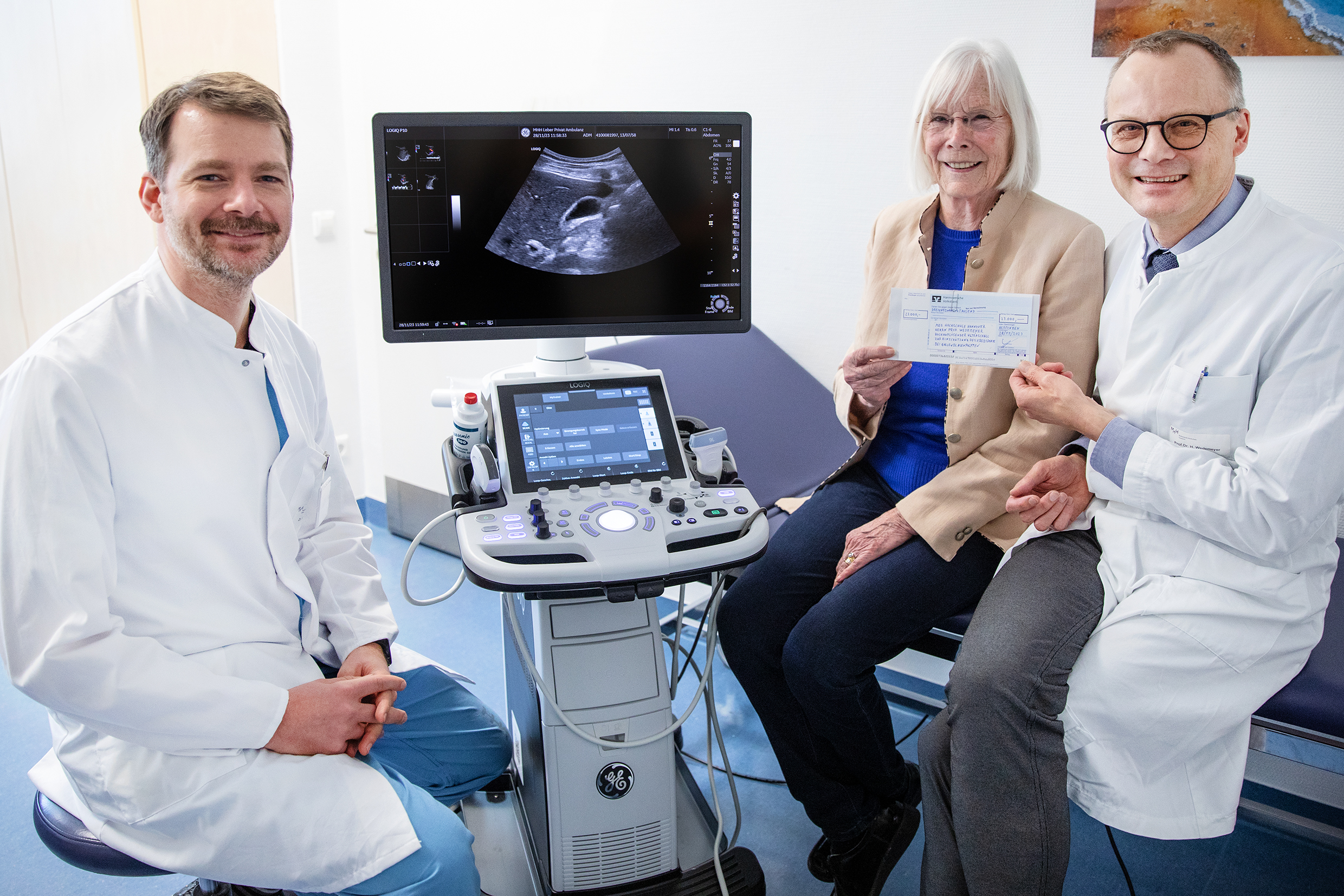
Erich and Emmy Hoselmann Foundation donates to projects at four Clinical Departments
Donations such as those from the Hoselmann Foundation cannot be valued highly enough. They help us to finance important projects without a lot of bureaucracy," says Prof. Dr. Heiner Wedemeyer. The Director of the Clinical Department of Gastroenterology, Hepatology, Infectious Diseases and Endocrinology is delighted to have received a donation of 23,000 euros from the foundation. This will be used to support a working group (WG) dealing with polyps of the gallbladder. By analyzing data, the working group hopes to gain new insights into the risk factors of gallbladder cancer. Ingrid Hild, representing the foundation, came to the Clinical Department at the end of last year to hand over the donation cheque. In addition to Professor Wedemeyer, she also visited Prof. Dr. Frank Bengel, Director of the Clinical Department of Nuclear Medicine, Prof. Dr. Christian Kratz, Director of the Clinical Department of Paediatric Haematology and Oncology, and Prof. Dr. Johann Bauersachs, Director of the Clinical Department of Cardiology and Angiology. Ingrid Hild also made generous donations to these three Clinical Departments. In 2023, the MHH received a total of 80,000 euros from the Hoselmann Foundation for cancer research projects.
The gallbladder is used to store bile. This is a fluid that is produced in the liver and released into the small intestine after eating to help digest fat. Polyps, i.e. protrusions of the mucous membrane on the gallbladder wall, can develop in the gallbladder. "Gallbladder polyps are not uncommon. Nevertheless, we know relatively little about their risk of gallbladder cancer," explains Professor Wedemeyer. The current treatment guidelines recommend removing the gallbladder prophylactically if polyps are more than one centimeter in diameter. Around 160,000 gallbladders are removed in Germany every year. If the polyps are smaller than one centimeter, patients are scheduled for check-ups. But are the many operations and close monitoring even necessary? "So far, there is no scientifically proven evidence on this," says Professor Wedemeyer. Dr. Patrick Behrendt and his team's project aims to change this. The team wants to evaluate a database with thousands of ultrasound images of gallbladder polyps and answer questions such as: Were the patients operated on or not? How did their state of health develop? What does the size of the polyps say about the risk of cancer? Are there other risk factors for gallbladder cancer?
"Analyzing the huge amounts of data is a huge effort. But we also expect the results to be of great benefit to our patients," explains Dr. Behrendt. Ultimately, the research group wants to confirm or classify the guidelines for the treatment of gallbladder polyps - patients throughout Germany would benefit from both.
Ingrid Hild had the two gastroenterologists explain the project to her in detail. "I'm sure that the foundation's money is in the right place here," she says. The money also goes towards cancer research in the other Clinical Departments supported by the Erich and Emmy Hoselmann Foundation. The foundation has been supporting the MHH for a long time. Over the years, it has donated a total of almost 2 million euros for cancer research.
Text: Tina Götting