
More news on the homepage
From the FWJ directly into medical studies
Lea Wagner discovered the world of science for herself as a volunteer
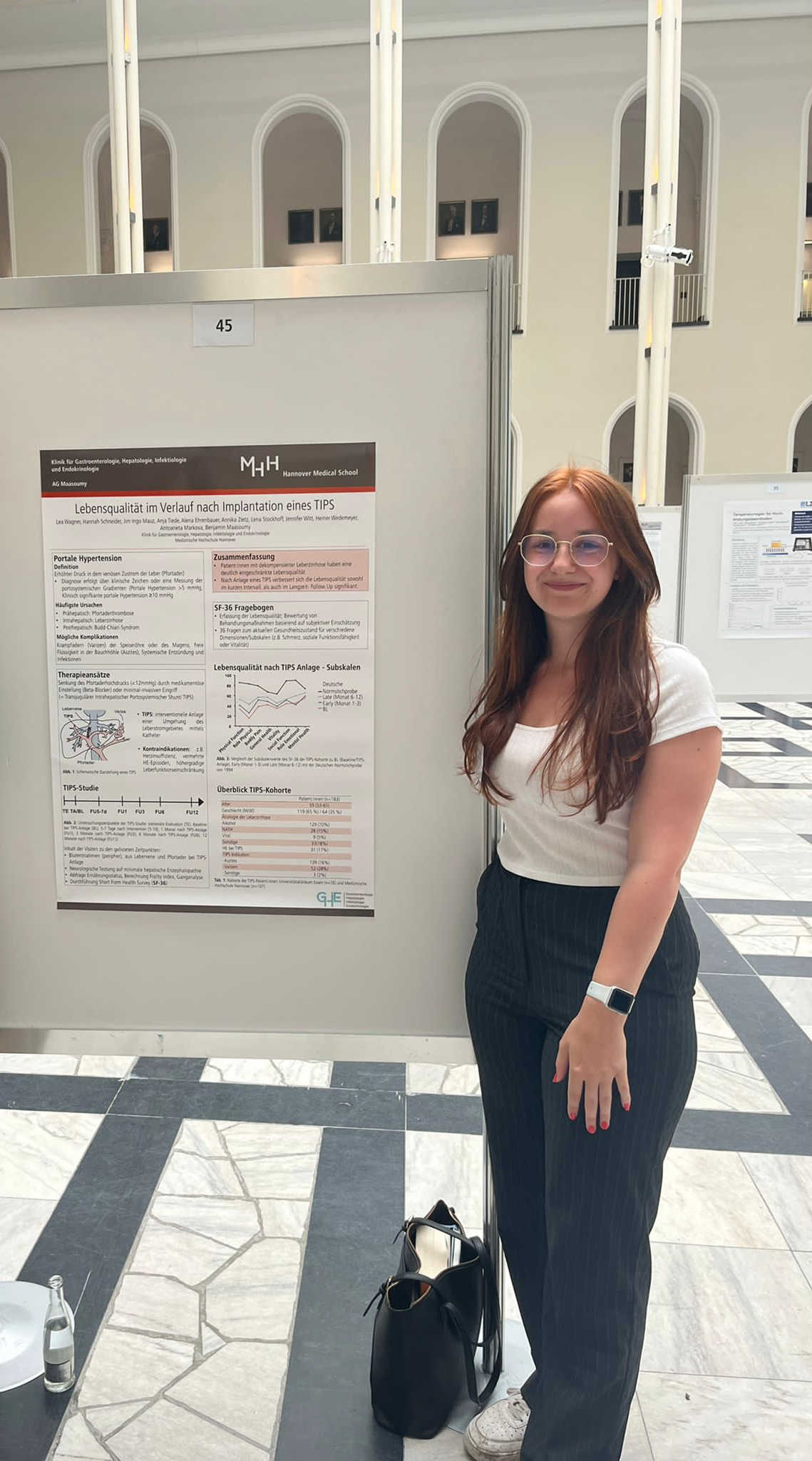
Like so many young high school graduates, Lea Wagner didn't know what exactly she wanted to be. As a schoolgirl, she spent a year abroad in the USA, languages came easily to her and science was one of her favorite subjects. That's why she became aware of the Voluntary Scientific Year (FWJ) at the MHH, she found out about the projects on offer - one immediately appealed to her, she applied and was accepted. In the working group of Prof. Dr. Benjamin Maasoumy from the Clinical Department of Gastroenterology, Hepatology, Infectious Diseases and Endocrinology, she was to research the quality of life of patients who had received a so-called Transjugular Intrahepatic Portosystemic Shunt (TIPS) following liver cirrhosis. This minimally invasive detour relieves excess pressure in the portal vein leading to the liver in order to reduce the life-threatening risks associated with blood congestion.
Lea Wagner interviewed 190 patients, recorded their data, was allowed to carry out clinical examinations and evaluate the results. The 21-year-old not only quickly familiarized herself with her project, but also immediately made friends with the young research team in the laboratory. "I was so well received and had so much support from doctoral students and researchers that I got more and more involved in the topic and became more and more interested in the research work," says the young researcher. She even successfully gave a presentation on her research work at the annual conference of the German Society for Gastroenterology, Digestive and Metabolic Diseases (DGVS).
Lea Wagner has found her profession. She wants to become a researcher and started her medical studies at the MHH in October. Prof. Dr. Benjamin Maasoumy's research group is delighted to have found another talented young scientist in Lea Wagner as an FWJ student. "She immediately integrated excellently into the team and was highly motivated from day one. Her performance here is anything but a matter of course. This is the third year we have had an FWJ student in our working group. It is a great pleasure to see the commitment with which young people here take on a sometimes very challenging task in clinical research straight after graduating from high school," says Prof. Dr. Benjamin Maasoumy, praising the Voluntary Scientific Year. "I am very pleased that Ms. Wagner has decided to study medicine. Now she just has to become a gastroenterologist," he hopes. The FWJ student's initial research results are impressive and will soon be published. One thing is certain: TIPS significantly improves people's quality of life, both in the short term and in the long term. Lea Wagner is both proud and grateful for this research opportunity: "Without Hannah Schneider, a doctoral student in the Maasoumy working group, I would not have been able to start this evaluation, let alone complete it successfully."
After her FWJ, Lea Wagner completed the first part of her nursing internship, which is mandatory for a medical degree, in the Clinical Department of Gastroenterology, Hepatology, Infectious Diseases and Endocrinology. This is where she got to know and appreciate the nursing side. "I enjoy working with patients and am now looking forward to starting my medical studies and delving even deeper into scientific topics," says the student. "I feel exactly right here. The first weeks of the propaedeutic course on the kidneys and back were very extensive and learning-intensive, but it makes you want to do more and I'm very happy to finally be able to do what I've been working towards for a long time.
Text: Bettina Dunker
KEYWORD FWJ
The Voluntary Scientific Year (FWJ) at the MHH is aimed at high school graduates who are interested in studying or training in the natural sciences. Applications to start the FWJ in 2024 are open until the end of January. You can find the information here: https: //www.mhh.de/gb-i/freiwilligendienste/fwj