
More news on the homepage
Progress in the fight against bile duct and gallbladder cancer
International committee of experts led by Professor Arndt Vogel updates ESMO treatment guidelines for biliary carcinoma
Biliary tract cancer (BTC) refers to cancers of the bile ducts and gallbladder. BCTs are rare and account for less than one percent of malignant neoplasms in humans. Overall, BCT has a poor prognosis. Five years after diagnosis, only 10 to 20 percent of those affected are still alive. However, advances in medicine and research offer hope, which have led to the updating of the treatment guidelines of the European Society for Medical Oncology (ESMO). The guidelines have now been published in the journal Annals of Oncology.
Gastroenterologist Prof. Dr. Arndt Vogel from Hannover Medical School (MHH) and member of the ESMO Steering Committee played a key role in the update: "From a systemic perspective, there are three significant changes that affect all levels of treatment. For the first time, we can make clear recommendations for adjuvant therapies. In first-line treatment, immunotherapy is gaining acceptance, and in second-line treatment there are now approved options for targeted therapies with the recommendation to carry out molecular testing at a very early stage."
Recommendations for adjuvant therapy for the first time
"There is currently only a chance of a cure with early-stage surgery, although unfortunately many patients cannot be operated on when they are first diagnosed," explains Professor Vogel, who is a senior consultant in the Clinical Department of Gastroenterology, Hepatology and Endocrinology. Despite radical resection, there is also a high risk of cancer recurrence. In order to combat possible but as yet undetectable tumor metastases after an operation, supplementary treatment measures, so-called adjuvant therapy concepts, have been increasingly discussed. "For a long time, there were no clear recommendations for adjuvant therapies after surgery for biliary tumors. Thanks to the BILCAP study, we now have a recommendation for post-operative chemotherapy with the cell growth inhibitor capecitabine, which improves the overall survival of patients."
Immunotherapy in first-line treatment
"We can also look back on a positive study situation for immunotherapy in bile duct cancer," says Vogel. In immunotherapy, the body's own immune system is specifically activated to detect and attack cancer cells. Various methods are used, such as immune checkpoint inhibitors. "The TOPAZ-1 study shows improvements in overall survival by adding the immune checkpoint inhibitor durvalumab to the two chemotherapeutic agents cisplatin-gemcitabine. Cisplatin-gemcitabine-durvalumab should therefore be considered for first-line treatment of advanced biliary carcinoma. In addition, immunotherapy with pembrolizumab is recommended for patients with proven microsatellite instability (MSI) based on the single-arm KEYNOTE-158 study." Both therapies already have a recommendation from the European Medicines Agency (EMA).
Breakthrough in molecular sequencing
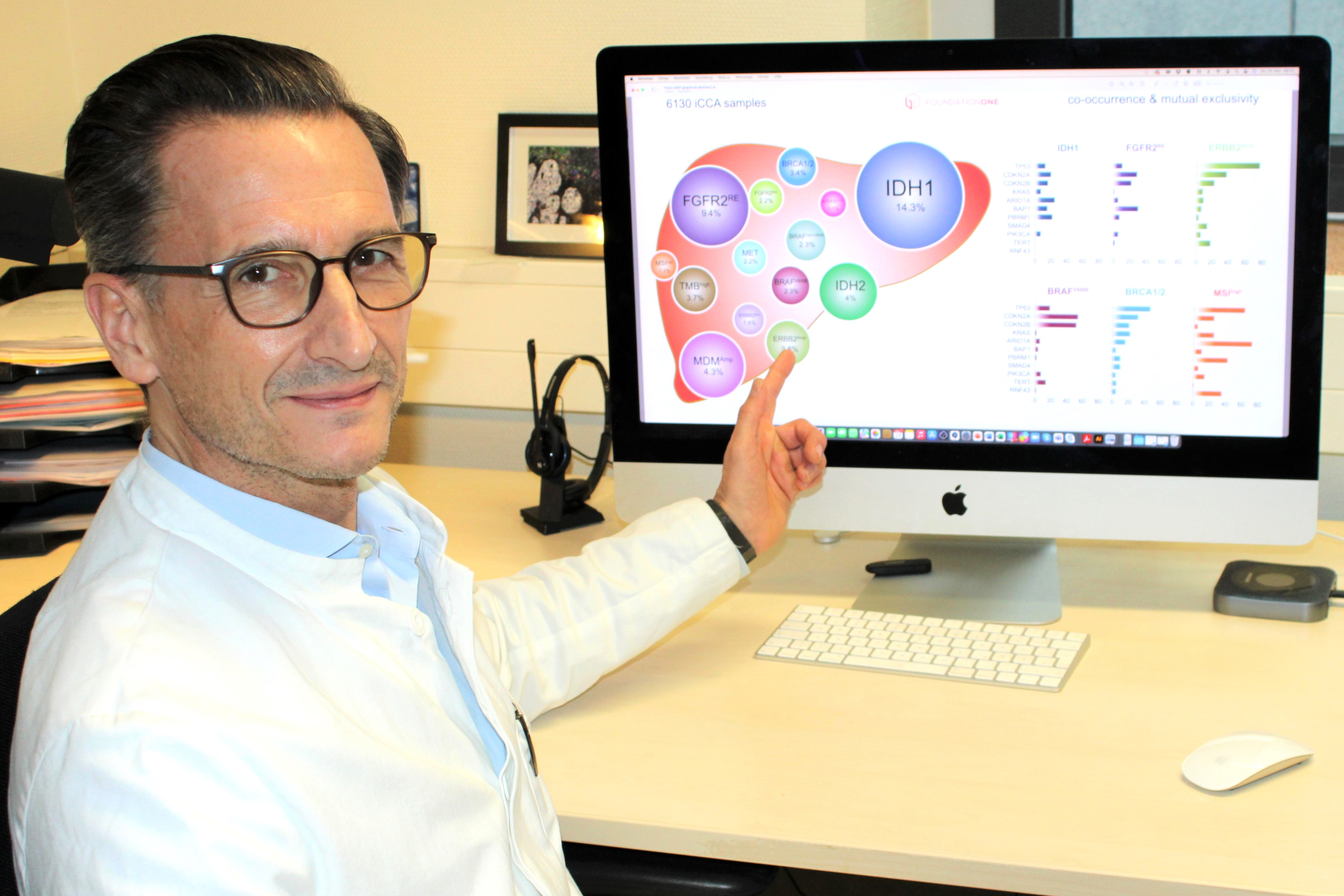
The search for genetic changes using molecular sequencing has led to significant successes in the treatment of cancer in the past. "Over the past five years, we have also made a breakthrough in the treatment of biliary tumors," emphasizes Vogel. "Almost 40 percent of patients with biliary tract tumors have genetic changes that represent potential targets for precision medicine and for which we now have targeted therapies." According to the recommendations of the ESMO expert committee, these patients should receive a comprehensive genetic analysis at an early stage, before or during first-line therapy, and be treated with the drugs already approved by the Food and Drug Administration (FDA) and the EMA. This includes, for example, pemigatinib for patients with so-called FGFR2 fusions. FGFR2 is a fibroblast growth factor receptor-2. In bile duct tumors, FGFR2 is fused with other genes due to a genetic malformation. These fusion rearrangements lead to a permanent activation of signaling pathways that contribute to tumor growth.
"Targeted molecular sequencing is a very essential component," emphasizes Vogel. It is important that patients are discussed in a molecular tumor board. The task of such a cross-organ, interdisciplinary tumor board is to identify treatment options for people with severe cancer after guideline-based treatment has been exhausted. The molecular tumour board is the central instrument of personalized medicine and is offered in specialized centers such as the Comprehensive Cancer Center of the MHH.