More news on the homepage
Septic shock: MHH team researches new treatment strategy
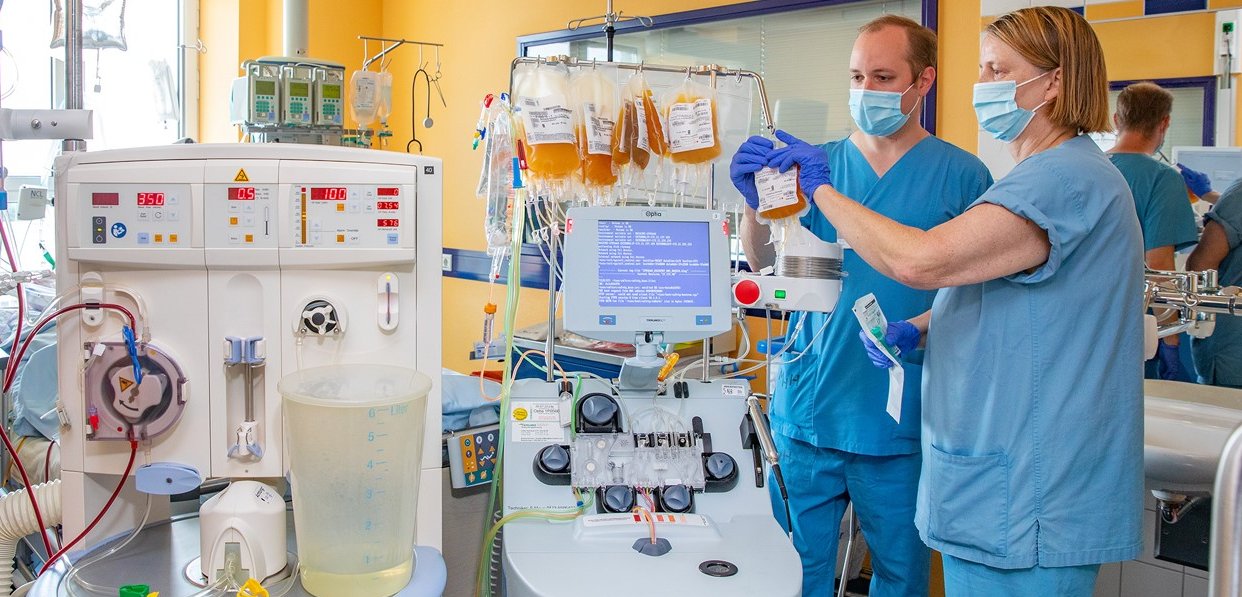
Sepsis is the most common cause of death from infections. In Germany alone, around 75,000 people die from it every year. The most severe form of sepsis leads to circulatory failure, which experts refer to as septic shock. 60 percent of cases are fatal. To date, there is no specific treatment for septic shock - but this could soon change. An interdisciplinary team of researchers at Hannover Medical School (MHH) wants to investigate a new treatment strategy in a multicenter study. The focus is on therapeutic plasma exchange. The scientists want to find out whether the new treatment method increases the survival rate of those affected. The German Research Foundation is funding the study with 1.2 million euros.
Sepsis is a medical emergency
Sepsis is triggered by infections, regardless of how severe they are or where they develop in the body. Even a urinary tract infection or a minor external injury can be enough to trigger sepsis. "Sepsis occurs when the body's own immune response goes into overdrive and attacks its own organs," explains Prof. Dr. Sascha David from the Clinical Department of Nephrology and Hypertension at the MHH and the Institute of Intensive Care Medicine at the University Hospital Zurich. Sepsis is always a medical emergency. Those affected usually have to be treated in an intensive care unit. In severe cases, they receive circulatory support medication, have to be artificially ventilated and their kidney function has to be supported with dialysis. "It is important to diagnose sepsis at an early stage and start treatment immediately," says Professor David. Without medical care, the risk of death increases by seven percent per hour.
Healthy plasma replaces diseased plasma
Therapeutic plasma exchange is not a new procedure. However, it is not yet established in the treatment of septic shock. Professor David's "Translational Intensive Care Medicine" working group, which also includes associate professor (PD) Dr. Klaus Stahl from the Clinical Department of Gastroenterology, Hepatology and Endocrinology and Dr. Benjamin Seeliger from the Clinical Department of Pneumology, has been working on the topic for several years. Plasma is the liquid component of blood. It contains proteins, mineral salts and many other substances. In plasma exchange, the diseased plasma is replaced by the plasma of a healthy person. "We combine two therapeutic measures in a single procedure," explains PD Dr. Stahl. "On the one hand, the harmful substances present in the diseased plasma, such as molecules that promote inflammation and disrupt blood vessels and circulation, are removed. On the other hand, the protective substances used up by the sepsis, which have an anti-inflammatory effect and stabilize the vessels and promote blood circulation, are replaced by healthy plasma."
Rapid stabilization
The working group only ever uses the procedure in addition to the other established treatment measures for sepsis. In smaller studies, it has already achieved good results with additive therapeutic plasma exchange. The condition of those affected often improved quickly, even in cases of severe septic shock. "After just two hours, we were able to observe a significant stabilization of the circulation and after six hours, the circulatory support measures could be reduced by half," reports PD Dr. Stahl.
More than 20 study centers
"The new treatment strategy is safe and has the potential to provide significant benefits for patients. In the new study, we want to find out on a scientifically sound basis whether it actually increases the survival rate. There are many indications that it does," explains Professor David. More than 20 centers in Germany, Switzerland and Austria with around 270 patients are participating in the international study. The study is being led by the team of the "Translational Intensive Care Medicine" working group led by Prof. David and PD Dr. Stahl, as well as PD Dr. Christian Bode from the University Hospital Bonn. The study, which is being funded by the DFG with 1.2 million euros over 36 months, will start at the beginning of 2023.
SERVICE:
Forfurther information, please contact Prof. Dr. Sascha David, david.sascha@mh-hannover.de, and associate professor Dr. Klaus Stahl, stahl.klaus@mh-hannover.de.