
More news on the homepage
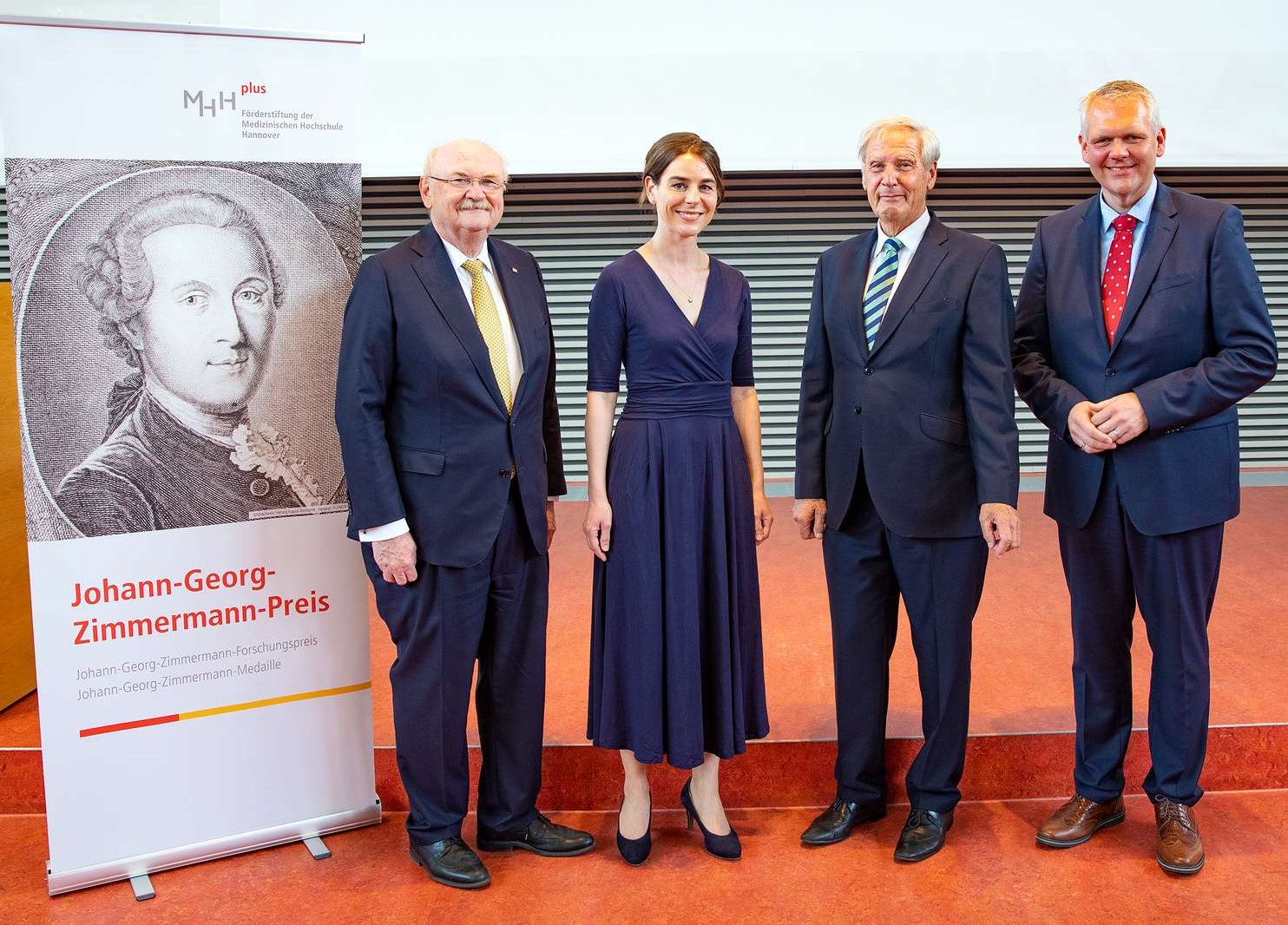
The MHH plus Foundation honors Prof. Dr. Christoph Huber and PD Dr. Anna Saborowski / Award ceremony by Science Minister Björn Thümler and MHH President Prof. Michael Manns
The Johann Georg Zimmermann Research Prize and the Johann Georg Zimmermann Medal are among the highest honors for achievements in cancer research in Germany. The MHH plus Foundation awarded the prizes on Monday , June 13, 2022, at Hannover Medical School (MHH). Lower Saxony's Minister for Science and Culture Björn Thümler presented the prizes together with MHH President Prof. Dr. Dr. Michael Manns.
"The Johann-Georg-Zimmermann-Prize is one of the most important awards in Germany in the field of cancer research. A look at the biography of the man who gave the award its name makes it amazingly clear how topical and relevant his life and work are for today's medical discourse. Today's prizewinners are exemplary for the potential of modern cancer research," said Lower Saxony's Science Minister Björn Thümler. "I congratulate Dr. Anna Saborowski and Prof. Dr. Christoph Huber from the bottom of my heart. Not least because strengthening transfer, translation and science communication remains a matter close to my heart - not only in the fight against widespread diseases."
Prof. Dr. Christoph Huber, former Head of the III Clinical Department at Mainz University Hospital and co-founder of the company BionTech, was awarded the Johann Georg Zimmermann Medal for his services to immunotherapy for oncological diseases. His work on the translational development of mRNA vaccination technology has significantly changed the treatment of solid tumors and infectious diseases such as SARS-CoV-2. In addition, as a company co-founder and scientific networker, he has repeatedly provided new impetus in the fight against cancer.
The Johann-Georg-Zimmermann Research Prize, endowed with 10,000 euros and aimed at young cancer researchers for their current scientific work, was awarded to PD Dr. Anna Saborowski, Clinical Department of Gastroenterology, Hepatology and Endocrinology at the MHH. As a clinical scientist at the interface between patient care and basic research, she plays a key role in the further development of therapeutic approaches for the treatment of bile duct carcinomas.
"With Prof. Dr. Christoph Huber, we are honouring one of the most outstanding and innovative oncologists of our time, who, together with his colleagues and companions, has paved the way for the immunotherapy of tumors in everyday clinical practice," emphasizes MHH President Prof. Dr. Dr. Michael Manns. "And PD Dr. Anna Saborowski's research shows how important personalized tumor therapy is for overcoming therapy resistance."
Outstanding researcher and networker
Prof. Dr. Dr. Christoph Huber is considered one of the pioneers and visionaries of immunological cancer research, whose groundbreaking potential the Vienna-born scientist recognized as early as the 1970s. In 2008, Professor Huber was one of the co-founders of the Mainz-based biotechnology companies Ganymed and BioNTech, with which he was or is associated as a member of the supervisory board. Christoph Huber studied medicine in Innsbruck, where he also completed his specialist training in internal medicine and completed his habilitation there. In 1983, he founded one of the first European stem cell transplantation facilities in Innsbruck. From 1990, Prof. Huber shaped the III. Medical Clinical Department and Polyclinic of the University Medical Center Mainz for almost 20 years - under his aegis it became an internationally leading Facilities or Institutions for the treatment of malignant blood and tumor diseases and a center for stem cell transplantation and palliative medicine. Thanks to his commitment, numerous research results in cancer immunotherapy were transferred from the laboratory to clinical application. The companies Ganymed and BionTech, founded with Prof. Ugur Sahin and Prof. Özlem Türeci, have now brought more than a dozen highly innovative immunotherapeutics to market and the first Covid-19 vaccination has been admitted. Prof. Huber has played an impressive role as a reviewer and official in national and international research funding organizations and as a scientific advisor in major German research institutions such as the German Cancer Research Center in Heidelberg, the GSF Research Center for Environment and Health in Munich and the Max Delbrück Center in Berlin. His flair for innovative ideas, his eye for outstanding scientists and his ability to bring the two together are what particularly distinguish the recipient of the Federal Cross of Merit, the Federal President's Future Prize and honorary citizen of the cities of Mainz and Innsbruck. Prof. Huber is also the author of more than 450 scientific publications in renowned journals, editor of numerous international scientific journals, the German-language standard textbook "Die innere Medizin" and the first guide to cancer immunotherapy.
Treating cancer patients with precision
Cancers of the biliary tract and liver are the specialty of PD Dr. Anna Saborowski, Clinical Department of Gastroenterology, Hepatology and Endocrinology at the MHH. The 40-year-old studies the molecular signaling pathways that contribute to the development of malignant tumors and are suitable targets for targeted therapies.
After completing her medical studies at the MHH and her basic science training as a postdoctoral fellow at Memorial Sloan-Kettering Cancer Center, NY, Anna Saborowski has taken on the challenges of a "dual career" in science and research: on the one hand, she is involved in the care of patients with gastrointestinal tumors as a physician, and on the other hand, she heads a basic science research group. The mother of two children is also actively involved in the promotion of young scientists, for example as equal opportunities officer for a special research area or within the young scientists' committee of the European Association for the Study of the Liver (EASL). What drives her? "In recent years, an improved understanding of the pathophysiology of malignant diseases has made it possible to integrate completely new concepts into oncological therapies. I believe that these new concepts can be further developed and that we will be able to treat more tumour patients on an individualized basis in the near future. Currently working at the interface between the Clinical Department and research is extremely exciting and motivating," she says. Dr. Saborowski uses a mouse model, for example, to investigate the influence of certain genetic changes on a tumor. Is the genetic modification suitable as a target structure for drug therapy approaches? Can premature treatment failure be averted, for example by combining different drugs? Anna Saborowski is looking for answers to these and similar questions.