
Main characteristics of the MD/PhD program
The MD/PhD program "Molecular Medicine" at Hannover Medical School recruits M.Sc. or equivalent holders in medicine, veterinary medicine, or natural sciences. Students pursue independent, project-based training over 3–4 years, aiming to bridge basic sciences and clinical research while developing research and teaching skills. Each year, ~20 students are admitted. Detailed program information is available in the following sections.
The MD/PhD program is integrated into the Hannover Biomedical Research School (graduate school) since October 2003.
The program was fully accreditated according to European standards as the first PhD program in Germany in December 2003.
Target Group
We are looking for highly qualified medical and veterinary physicians and graduates of natural science (such as Biology, Biochemistry, Biotechnology). An above average level of performance is expected from all applicants, and the curriculum vitae should reveal a prominent ability and motivation for scientific work. At least some independent research experience (6-months of bench work) is required, as demonstrated in the description of a former research project.
(Application, from December 1st to March 1st)
Aims of the PhD Program "Molecular Medicine"
The PhD program enables students to deepen their methodological knowledge beyond their specialty and gain experience in interdisciplinary collaboration. They develop communication skills, learn to formulate challenging scientific questions, and master complex data organization. Under expert supervision, they build a strong foundation for future success, such as leading a junior research group. The program includes rigorous quality control through tripartite feedback from the HBRS, students, and supervisors. It integrates basic research with clinical questions, broadening medical students’ translational perspective and equipping natural science students with clinical insights.
Degree
A PhD degree (alternatively Dr.rer.nat for life scientists) will be awarded after successful completion of the program. (see PhD rules)
Financing
All students are financially secured primarily by support of the respective supervisor (around 1.700 - 1.900 Euro/month for 3-4 years).
You will either receive a stipend or are employed with MHH. Please see here for detailed info.
In addition, a limited number of grants will be awarded from Hannover Biomedical Research School or internal funds. Child benefit is also available.
Of course, the MD/PhD program is always seeking for sponsors for financial support of our students or events. Please contact us!
Projects
A great variety of projects are available, as most of the departments/labs at MHH and regional institutes in the molecular field are part of our MD/PhD program Molecular Medicine.
Students have a free choice of projects once they are selected for the program.
To get an idea of projects, please browse the "students" section.
Course
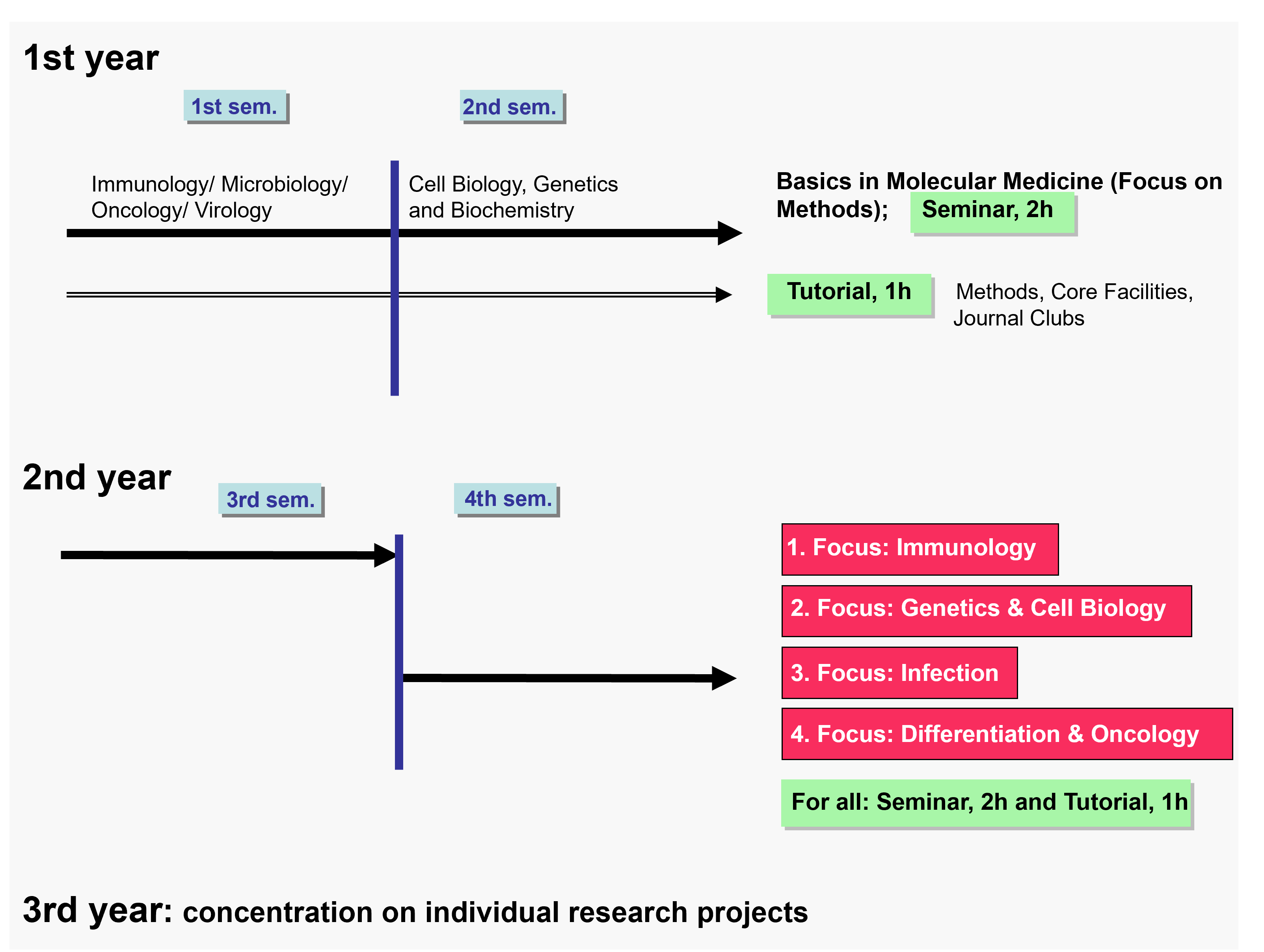
In the first phase, students receive foundational training in Immunology, Virology, Microbiology, Genetics, Cell Biology, and Biochemistry—delivered jointly with other HBRS PhD programs and partner institutes. Medical students gain introductory scientific methods (e.g., molecular and cell biology techniques), while science-background students focus on medical research topics, ensuring comparable knowledge levels despite differing entry qualifications. This phase, typically completed after 18 months, ends with an intermediate examination.
The second phase emphasizes clinical/applied research and project-based work, culminating in thesis completion and publication in international journals. Research periods may be conducted at partner institutes in Germany or abroad.
Over the 3-year program, students complete ~80 hours of project-oriented and ~60 hours of interdisciplinary seminars. Strong focus is placed on soft skills—presentation techniques, scientific writing, research ethics, gene technology safety, animal experimentation—and career development. Regular industry excursions are also organized.
See below and The ABC of the MD/PhD program.
Scientific Exposure
Students present their research projects at an annual retreat and are encouraged to participate in international scientific meetings and conferences.
Two publications as first author in international peer-reviewd journals are desired for the admittance to the PhD final examination. The PhD examination generally takes place at the end of the third year.
Supervision
PhD students are individually supervised by experts selected by the MD/PhD Program Committee. Each students has one main supervisor and two co-supervisors from different departments/institutes , forming a thesis advisory group. This group of supervisors continuously monitors the PhD student throughout the program through reports and intermittent feedback. An advisory meeting usually takes place at least once a year, usually before the annual retreat.
Research projects feature a clearly defined topic using suitable methods, with a realistic prospect of success and publication in international peer-reviewed journals. The PhD Commission ensures that students are not laden with menial tasks not related to the PhD. The supervisors will also advise the PhD students on career planning.
The main supervisor provides all facilities necessary for performing the PhD thesis (including lab bench, computers) and are responsible for the financing of the research project and for sponsorship of the PhD student assigned to them during the 3-4 year PhD study period.
Cooperations
The MD/PhD program leverages on longstanding cooperation with the Leibniz University of Hannover. In addition, there are various cooperation partners, such as the Helmholtz Institute for Infection Research, HZI, Braunschweig; IPF PharmaCeuticals GmbH (IPF), Hannover; Fraunhofer-Institute of Toxicology and Experimental Medicine, Hannover (ITEM); and the TwinCore Hannover.
International cooperation partners include several scientists in India, in Europe (Karolinska Institute Stockholm, Imperial College of London) and numerous international partners in the individual research projects.
Facilities
Hannover Medical School has excellent facilities for students from the PhD programs.
Platforms (core units) have been established at MHH and partner institutes to provide up-to-date technologies and support (e. g. gene expression profiling, experimental animal work, confocal microscopy for in vivo imaging, and proteomics).
A huge library with relevant textbooks and journals is available (and about 20 computer working places).
The Hannover Biomedical Research School (HBRS) has its own seminar rooms.
There are three cafeterias and a mensa on campus.
International students in the MD/PhD program can be accomodated in a students' hostel nearby.
Orientation weeks
At the beginning of October, students are given assistance with all relevant administration (housing, bank, insurance, enrolment). Other highlights include guided tours, excursions, culture shock seminars, a German crash course, and an international party.
Language
English is the main language of the program. German courses are offered to our international students (beginners A1 and advanced A2). And we offer a course on "English Scientific Conversation".
Academic Year
Winter Semester 2026/2027
Start: 05.10.2026 End: 26.02.2027
PhD intermediate examination: by February 26th (TwinCore retreat March 4th/5th, 2027)
Summer Semester 2027
Start: 05.04.2027 End: 16.07.2027

Curriculum
In the first 18 months of the course, up to the intermediate examination, participants of the PhD program should acquire a general consolidation of the natural scientific and fundamental principles of biomedical research, so that by the time of the intermediate examination, all participants in the program achieve approximately the same level of theoretical and practical knowledge, despite different qualifications on entry.
In the second part of the PhD Program, more emphasis is then placed on the project-specific qualification. Time spend abroad during the PhD Program will be recognized if the curriculum content at the guest university is equivalent to the PhD curriculum and has been certified as such.
Since 2004, we have a joint Curriculum in the Hannover Biomedical Research School (HBRS)!!