Range of courses
Admission:
The fully passed preliminary dental examination is a prerequisite for participation in all courses of the clinical study section, including the General and Special Pathology modules.
Learning objectives:
The teaching of pathology comprises the teaching of the most important characteristics of macroscopically and microscopically detectable pathological changes in cells, tissues and organs together with the underlying pathophysiological principles.
Topics of general pathology:
- Introduction to pathology
- Cell damage and adaptation reaction
- Circulatory disorders
- Acute inflammation
- Chronic inflammation
- Pathological immune reactions and inflammation in the head and neck area
- Tumor pathology I (general tumor pathology)
- Tumor pathology II (classification, metastasis)
- Tumor pathology III (molecular basics)
- Tumor pathology IV (tumors in the head and neck area)
Macroscopic specimens are demonstrated at the institute.
Topics of special pathology:
- Arteriosclerosis
- Acute myocardial infarction
- Cardiac callus after infarction
- Chronic pulmonary edema
- Pulmonary emphysema
- Lobar pneumonia - red hepatization
- Lobar pneumonia - grey hepatization
- Organizing pneumonia
- Interstitial pulmonary fibrosis
- Tuberculosis
- Liver fibrosis in chronic hepatitis
- Liver cirrhosis
- Glomerulonephritis
- Diabetic glomerulopathy
- Gastric ulcer
- Acute appendicitis
- Hodgkin's lymphoma
- Sarcoidosis
- Graves' disease
- Seborrheic keratosis
- Nevus cell nevus
- Basal cell carcinoma
- Malignant melanoma
- Mucoepidermoid carcinoma
- Adenoid cystic carcinoma
- Warthin tumor
- Fibroepithelial hyperplasia
- Squamous cell papilloma
- Apical granuloma
- Radicular cyst
- Follicular cyst
- Keratocyst
- Fibrous dysplasia
- Osteomyelitis of the jaw
- Giant cell pulis
- Odontoameloblastoma
- Ameloblastic fibroma
- Ameloblastoma
- Non-Hodgkin's lymphoma
- Kaposi's sarcoma
- Leukoplakia
- Squamous cell carcinoma, well differentiated
- Squamous cell carcinoma, poorly differentiated
Microscopic preparations are demonstrated during the microscopy course and microscoped independently by the students.
Course achievements:
Compulsory participation in the microscopy course, lectures and the institute observation.
Examination form:
Structured oral exam (SOE). Knowledge from the lecture, textbooks and pathology course is tested on two histological preparations using selected examples from the microscopy course and the lectures.
Courses offered in accordance with the new Dental Licensing Regulations
Admission:
The fully passed preliminary dental examination is a prerequisite for participation in all courses of the clinical study section, including the pathology module.
Learning objectives:
The teaching of pathology covers the most important characteristics of macroscopically and microscopically detectable pathological changes in cells, tissues and organs together with the underlying pathophysiological principles.
Topics of general pathology:
- Introduction to pathology
- Cell damage and adaptation reaction
- Circulatory disorders
- Acute inflammation
- Chronic inflammation
- Pathological immune reactions
- General tumor pathology I
- General tumor pathology II
- Benign diseases of the head and neck
- Malignant diseases of the head and neck
The topics are based on the IMPP subject catalog dentistry (GK ZM) from 2023 for the new dental licensing regulations.
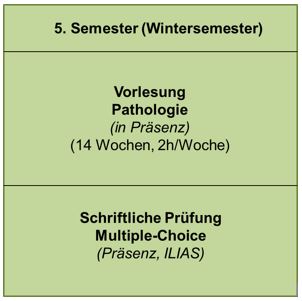
Theoretical content of the above-mentioned subject areas is taught in the lecture. On three lecture dates, the events take place in the microscopy room, which also gives students practical experience in microscopy of relevant clinical pictures.
Coursework:
Compulsory participation in the lecture
Examination form:
Written examination. Single-choice (from 5 possible answers), 30 questions, some with histological images. Online via the ILIAS platform. Knowledge from the lecture and textbooks will be tested.